In the Darkest of Places
זכרו תורת משה | February 28, 2026
Print This Article
View Original PDF

In the Darkest of Places

זכרו תורת משה | February 28, 2026

Rabbi Yisrael Meir Altmen once told over an incredible letter he received.

“I work hard to support my family,” the man wrote. “But despite my demanding schedule, I carve out four hours each day to learn with a dedicated chavrusa. That commitment anchors me.”

But then something shifted.

“I can’t share the details,” he continued. “All I’ll tell you is that I fell...and then I fell deeper. One day, I caught myself and realized that if I didn’t somehow stop from falling further, there would be no end to my descent.”

He tried to pull himself back, and it helped. But only for a while. The struggle felt impossible to overcome.

“I knew my efforts meant something to Hashem,” he wrote, “yet I saw no fruit.”

Then came the moment that changed everything.

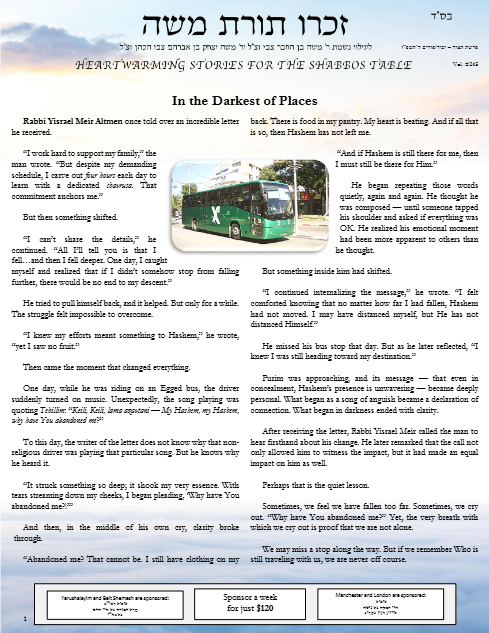
One day, while he was riding on an Egged bus, the driver suddenly turned on music. Unexpectedly, the song playing was quoting Tehillim: “Keili, Keili, lama azavtani — My Hashem, my Hashem, why have You abandoned me?”

To this day, the writer of the letter does not know why that non-religious driver was playing that particular song. But he knows why he heard it.

“It struck something so deep; it shook my very essence. With tears streaming down my cheeks, I began pleading, ‘Why have You abandoned me?!’”

And then, in the middle of his own cry, clarity broke through.

“Abandoned me? That cannot be. I still have clothing on my back. There is food in my pantry. My heart is beating. And if all that is so, then Hashem has not left me.

“And if Hashem is still there for me, then I must still be there for Him.”

He began repeating those words quietly, again and again. He thought he was composed — until someone tapped his shoulder and asked if everything was OK. He realized his emotional moment had been more apparent to others than he thought.

But something inside him had shifted.

“I continued internalizing the message,” he wrote. “I felt comforted knowing that no matter how far I had fallen, Hashem had not moved. I may have distanced myself, but He has not distanced Himself.”

He missed his bus stop that day. But as he later reflected, “I knew I was still heading toward my destination.”

Purim was approaching, and its message — that even in concealment, Hashem’s presence is unwavering — became deeply personal. What began as a song of anguish became a declaration of connection. What began in darkness ended with clarity.

After receiving the letter, Rabbi Yisrael Meir called the man to hear firsthand about his change. He later remarked that the call not only allowed him to witness the impact, but it had made an equal impact on him as well.

Perhaps that is the quiet lesson.

Sometimes, we feel we have fallen too far. Sometimes, we cry out. “Why have You abandoned me?” Yet, the very breath with which we cry out is proof that we are not alone.

We may miss a stop along the way. But if we remember Who is still traveling with us, we are never off course.
Rabbi Yisrael Meir Altmen once told over an incredible letter he received.

“I work hard to support my family,” the man wrote. “But despite my demanding schedule, I carve out four hours each day to learn with a dedicated chavrusa. That commitment anchors me.”

But then something shifted.

“I can’t share the details,” he continued. “All I’ll tell you is that I fell...and then I fell deeper. One day, I caught myself and realized that if I didn’t somehow stop from falling further, there would be no end to my descent.”

He tried to pull himself back, and it helped. But only for a while. The struggle felt impossible to overcome.

“I knew my efforts meant something to Hashem,” he wrote, “yet I saw no fruit.”

Then came the moment that changed everything.

One day, while he was riding on an Egged bus, the driver suddenly turned on music. Unexpectedly, the song playing was quoting Tehillim: “Keili, Keili, lama azavtani — My Hashem, my Hashem, why have You abandoned me?”

To this day, the writer of the letter does not know why that non-religious driver was playing that particular song. But he knows why he heard it.

“It struck something so deep; it shook my very essence. With tears streaming down my cheeks, I began pleading, ‘Why have You abandoned me?!’”

And then, in the middle of his own cry, clarity broke through.

“Abandoned me? That cannot be. I still have clothing on my back. There is food in my pantry. My heart is beating. And if all that is so, then Hashem has not left me.

“And if Hashem is still there for me, then I must still be there for Him.”

He began repeating those words quietly, again and again. He thought he was composed — until someone tapped his shoulder and asked if everything was OK. He realized his emotional moment had been more apparent to others than he thought.

But something inside him had shifted.

“I continued internalizing the message,” he wrote. “I felt comforted knowing that no matter how far I had fallen, Hashem had not moved. I may have distanced myself, but He has not distanced Himself.”

He missed his bus stop that day. But as he later reflected, “I knew I was still heading toward my destination.”

Purim was approaching, and its message — that even in concealment, Hashem’s presence is unwavering — became deeply personal. What began as a song of anguish became a declaration of connection. What began in darkness ended with clarity.

After receiving the letter, Rabbi Yisrael Meir called the man to hear firsthand about his change. He later remarked that the call not only allowed him to witness the impact, but it had made an equal impact on him as well.

Perhaps that is the quiet lesson.

Sometimes, we feel we have fallen too far. Sometimes, we cry out. “Why have You abandoned me?” Yet, the very breath with which we cry out is proof that we are not alone.

We may miss a stop along the way. But if we remember Who is still traveling with us, we are never off course.

PDF Preview