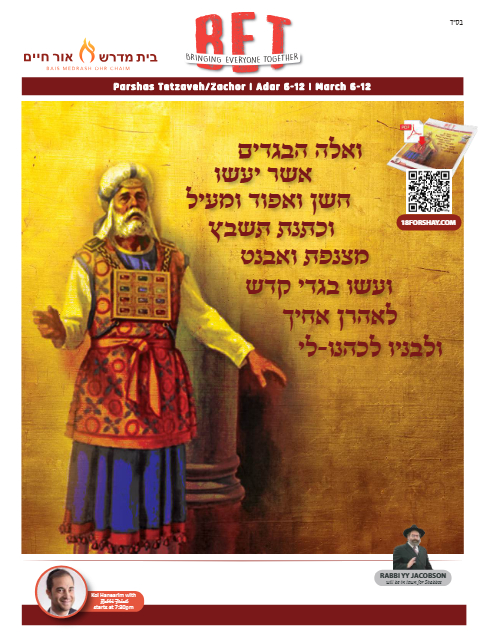
The Breastplate and the Apron
There is an intriguing mitzvah (commandment) recorded in this week’s Torah portion:
“And they shall bind the choshen (breastplate) by its rings to the rings of the ephod (apron) ... so that the choshen shall not budge from the ephod.”
The meaning of these words is this: The choshen (breastplate) and the ephod (apron) were two of the eight special garments worn by the High Priest (Kohein Gadol) while performing the services in the Tabernacle. The choshen was a breastplate set with twelve precious stones, each inscribed with the name of one of the twelve tribes of Israel. It was worn on the breast, over the heart. The ephod was an apron-like garment, covering the lower back of the body, from the waist to the ankles, with a belt that tied in the front.
Two gold rings sewn on the ephod’s belt lined up with two gold rings sewn to the bottom corners of the choshen; these were bound together with ribbons of blue wool. It is of vital importance, the Torah stresses, that the two should remain securely fastened at all times that the priestly garments are worn. “The choshen shall not budge from the ephod.”
But why? Why the insistence that the breastplate and apron must be tightly linked at all times? What’s wrong if they are disconnected or only loosely connected?
A Tale of Two Garments
One answer presented by the commentators is moving. The two garments – the breastplate seated atop the heart and the apron hanging on the lower back – represent the “upper” and “lower” dimensions of life or the “forward” and “backward” aspects of human existence. The breast-plate represented those individuals whose hearts were aflame with spiritual passion and ecstasy, while the apron symbolized the people who struggled with backward temptations, the crass and lowly impulses and dispositions.
This is not merely a distinction between two types of people; it is, rather, a distinction between two aspects existing in each of our lives.
Few are the people who can be defined as “breastplates” or “aprons” exclusively. Most of us vacillate between backward and frontward tendencies, between lower and higher aspirations. We celebrate moments of light, but we must also quarrel with darkness, trauma, addiction, and emotional prisons. At times, life is a cruise through a tranquil seabed, yet at other times, it consists of navigation through turbulent waves, battlefields, and war zones. There are moments when we sense our calling, yet, at other times, we yearn to discover our true selves, we struggle to find our place in the world. Crudeness, superficiality, and lowliness may, at any moment, consume our multi-dimensional personalities.
Hence, the Torah instructs us to tightly link the breastplate to the apron, “so that the choshen shall not budge from the ephod.” We must learn to integrate the two parts of the self without escaping into either element. Do not retreat, the Torah is saying, into your “higher” self and forget about your “lower” self, for when the lower self resurfaces, you might fall hard. On the other hand, do not allow yourself to be swept away by your lower self and ignore your transcendental aspirations, for such a life is likely to leave you deeply empty, thirsty, and anxious.
You must learn the art of integration. You must come to terms with the truth that the “breastplate” and the “apron” together constitute the very objective of existence, to confront darkness and transform it into light, to create harmony out of the building blocks of diversity.
Trust in Hashem Provides Additional Channels and Vessels for Blessings
“... you write about your general frame of mind and your anxieties. I also understand that your husband has been in a similar mood lately. Needless to say, I am quite surprised at both you and your husband, in view of your background. For the matter of bitachon is not an abstract thing, but a real feeling that should fill the mind and heart with the awareness of G-d’s proximity and closeness at all times and under all circumstances, in every aspect of one’s life. Surely you know the emphasis that Chassidus places on the idea of Divine Providence, which extends to everyone and everything individually, and that it is a benevolent Providence, as G-d is the Essence of Goodness, and that, as a result, every Jew should and is able to serve G-d [b’simcha u’v’tuv levav] with joy and gladness of heart. I trust that you will reflect on the points mentioned above, which our Sages of blessed memory summarized in their well-known statement, “All that the Merciful One does is for the good,” and you will strengthen your faith and trust in G-d and rid yourself of the troubling thoughts and anxieties. This very faith and trust will provide the additional channels and vessels [tzinoros and keilim] to receive G-d’s blessings in all your needs...”
==== Rebbe Responsa #41
Rabbi YY Jacobson