The Connection between the Law of Malveh and Eliminating the Klipah of Amalek
Shvilei Pinchas | February 28, 2026
Print This Article
View Original PDF

The Connection between the Law of Malveh and Eliminating the Klipah of Amalek

Shvilei Pinchas | February 28, 2026

The Connection between the Law of “Malveh” and Eliminating the Klipah of Amalek

Next, we will explain the connection to the law of "מלוה" based on the statement in the Gemara cited above regarding tzedakah: Rabbi Yochanan said: What is the meaning of that which is written: “One who is gracious to the poor is lending (‘malveh’) to Hashem”? If it was not explicitly written, it would be impossible to say it. So to speak, Hashem is beholden to one who gives tzedakah based on the passuk: “A borrower is a servant to the lender.” By financially supporting a poor person, it is as if one is lending money to HKB”H, so to speak. HKB”H will then return that money to him, as the passuk goes on to say (Mishlei 19, 17): "וגמולו ישלם לו"—and He will pay him his due. We find a similar explanation in the Maharsha:

He states that the term "מלוה" always applies to the one who lends his money to someone else . . . The same holds true in this passuk. It implies that HKB”H becomes a borrower, so to speak, rather than a guarantor. As such, He is obligated to repay the loan . . . This is the message conveyed by the end of the passuk: "וגמולו ישלם לו". Since the pauper lacks the means to repay the money, HKB”H—Who is now a sort of borrower—will recompense him (the one who gave the tzedakah).

With immense pleasure, we will now add an exposition by Chazal in the Midrash Tanchuma (Mishpatim 15) related to the passuk (Shemos 22, 24): "אם כסף תלוה את עמי את העני עמך"—if you lend money to any of My people, to the poor person who is with you:

“If you lend money to any of My people.” Rabbi Tanchuma began the discussion with the passuk: “One who is gracious to the poor is lending to Hashem, and He will pay him his due.” So to speak, he is lending to Hashem, and He will repay him. Rabbi Pinchas hakohen, the son of Chama, said that Rabbi Reuven asked: What is the meaning of “and He will pay him his due”? Is it plausible that if he gave a perutah to a poor man, HKB”H will repay him? Rather, HKB”H said, “When the soul of a poor man is struggling to leave its body because of hunger, and you provide him with sustenance and keep him alive, be assured that I will repay you soul for soul. In the future, if your son or daughter becomes sick or deathly ill, I will recall for them the mitzvah you performed for the poor man, and I will save them from death. This is the meaning of “and He will pay him his due”—that is, I will repay you soul for soul. HKB”H said, “It is sufficient that you are called a lender to Me.” HKB”H said: “If you lend money to 'עמי',” you will merit being in My proximity. (The word "עמי" can be read to mean “My people” or “with Me.”)

Additionally, let us introduce what the brilliant Rabbi Tzaddok hakohen explains in Pri Tzaddik (Shushan Purim 1) along with others regarding the mitzvah on Purim of "מתנות לאביונים": Giving tzedakah to a poor person portends abolishing the klipah of Amalek. This concurs with what they expounded in the Gemara (Sanhedrin 106a) regarding the battle with Amalek (ibid. 17, 8): "ויבוא עמלק וילחם עם ישראל ברפידים מאי לשון רפידים... רבי יהושע אומר שריפו עצמן מדברי תורה, שנאמר לא הפנו אבות אל בנים מרפיון ידים". “Amalek came and they battled Yisrael in Rephidim.” What is the meaning of “Rephidim”? Rabbi Yehoshua says: It indicates that they were remiss regarding the study of Torah, as it says (Yirmiyah 47, 3): “Fathers will not attend to children because of laxness (weakening) of hands.” Rashi provides the following clarification: The fathers did not tend to their children’s welfare by inculcating in them the value of Torah and mitzvos, because of “lax hands.” Here, too, “Rephidim” implies a lax attitude. In other words, because of their lax attitude toward the Torah, Amalek attacked them. [Translator’s note: The name “Rephidim” is interpreted by some as a contraction of the two words “rifyon yadayim,” meaning a weakening of the hands, i.e., being lax.] Other sacred sources explain that “their hands were lax” (remiss) from giving tzedakah, of which the Torah says (Devarim 15, 10): "כי פתוח תפתח את ידך לו"—rather, you shall open your hand to him.

Also, in connection with the battle with Amalek, the Gaon of Berzhan, ztz”l, in Techeiles Mordechai (Beshalach), interprets the passuk (Shemos 17, 11): "והיה כאשר ירים משה ידו וגבר ישראל וכאשר יניח ידו וגבר עמלק"—it so happened that when Moshe would raise his hand, Yisrael prevailed, and when he lowered his hand, Amalek prevailed. In other words, when Moshe encouraged Yisrael to open their hands to give tzedakah, “Yisrael prevailed” over the klipah of Amalek. As we have learned, when a Jew gives tzedakah to a pauper, he becomes a lender to HKB”H, so to speak, and HKB”H is beholden to him, in the sense of "עבד לוה לאיש מלוה". As such, He rescues them from the klipah of Amalek, who attacked them in Rephidim, causing their hands to be lax and remiss in giving tzedakah. This explains the significance of the letter “mem” of the mnemonic עמל"ק related to the law of a “malveh,” and how it portends abolishing the klipah of Amalek.
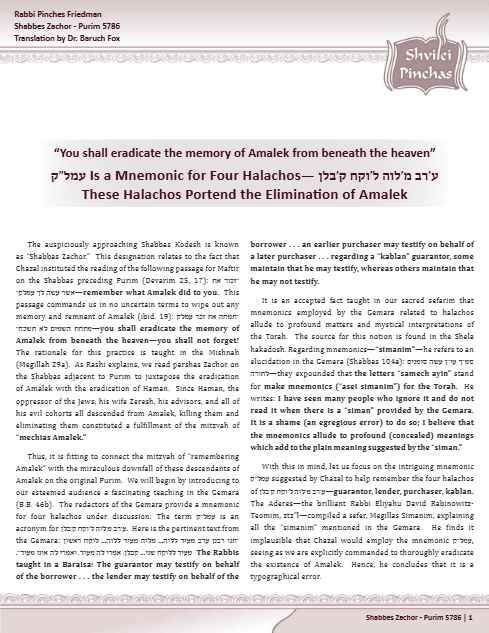
The Connection between the Law of “Malveh” and Eliminating the Klipah of Amalek

Next, we will explain the connection to the law of "מלוה" based on the statement in the Gemara cited above regarding tzedakah: Rabbi Yochanan said: What is the meaning of that which is written: “One who is gracious to the poor is lending (‘malveh’) to Hashem”? If it was not explicitly written, it would be impossible to say it. So to speak, Hashem is beholden to one who gives tzedakah based on the passuk: “A borrower is a servant to the lender.” By financially supporting a poor person, it is as if one is lending money to HKB”H, so to speak. HKB”H will then return that money to him, as the passuk goes on to say (Mishlei 19, 17): "וגמולו ישלם לו"—and He will pay him his due. We find a similar explanation in the Maharsha:

He states that the term "מלוה" always applies to the one who lends his money to someone else . . . The same holds true in this passuk. It implies that HKB”H becomes a borrower, so to speak, rather than a guarantor. As such, He is obligated to repay the loan . . . This is the message conveyed by the end of the passuk: "וגמולו ישלם לו". Since the pauper lacks the means to repay the money, HKB”H—Who is now a sort of borrower—will recompense him (the one who gave the tzedakah).

With immense pleasure, we will now add an exposition by Chazal in the Midrash Tanchuma (Mishpatim 15) related to the passuk (Shemos 22, 24): "אם כסף תלוה את עמי את העני עמך"—if you lend money to any of My people, to the poor person who is with you:

“If you lend money to any of My people.” Rabbi Tanchuma began the discussion with the passuk: “One who is gracious to the poor is lending to Hashem, and He will pay him his due.” So to speak, he is lending to Hashem, and He will repay him. Rabbi Pinchas hakohen, the son of Chama, said that Rabbi Reuven asked: What is the meaning of “and He will pay him his due”? Is it plausible that if he gave a perutah to a poor man, HKB”H will repay him? Rather, HKB”H said, “When the soul of a poor man is struggling to leave its body because of hunger, and you provide him with sustenance and keep him alive, be assured that I will repay you soul for soul. In the future, if your son or daughter becomes sick or deathly ill, I will recall for them the mitzvah you performed for the poor man, and I will save them from death. This is the meaning of “and He will pay him his due”—that is, I will repay you soul for soul. HKB”H said, “It is sufficient that you are called a lender to Me.” HKB”H said: “If you lend money to 'עמי',” you will merit being in My proximity. (The word "עמי" can be read to mean “My people” or “with Me.”)

Additionally, let us introduce what the brilliant Rabbi Tzaddok hakohen explains in Pri Tzaddik (Shushan Purim 1) along with others regarding the mitzvah on Purim of "מתנות לאביונים": Giving tzedakah to a poor person portends abolishing the klipah of Amalek. This concurs with what they expounded in the Gemara (Sanhedrin 106a) regarding the battle with Amalek (ibid. 17, 8): "ויבוא עמלק וילחם עם ישראל ברפידים מאי לשון רפידים... רבי יהושע אומר שריפו עצמן מדברי תורה, שנאמר לא הפנו אבות אל בנים מרפיון ידים". “Amalek came and they battled Yisrael in Rephidim.” What is the meaning of “Rephidim”? Rabbi Yehoshua says: It indicates that they were remiss regarding the study of Torah, as it says (Yirmiyah 47, 3): “Fathers will not attend to children because of laxness (weakening) of hands.” Rashi provides the following clarification: The fathers did not tend to their children’s welfare by inculcating in them the value of Torah and mitzvos, because of “lax hands.” Here, too, “Rephidim” implies a lax attitude. In other words, because of their lax attitude toward the Torah, Amalek attacked them. [Translator’s note: The name “Rephidim” is interpreted by some as a contraction of the two words “rifyon yadayim,” meaning a weakening of the hands, i.e., being lax.] Other sacred sources explain that “their hands were lax” (remiss) from giving tzedakah, of which the Torah says (Devarim 15, 10): "כי פתוח תפתח את ידך לו"—rather, you shall open your hand to him.

Also, in connection with the battle with Amalek, the Gaon of Berzhan, ztz”l, in Techeiles Mordechai (Beshalach), interprets the passuk (Shemos 17, 11): "והיה כאשר ירים משה ידו וגבר ישראל וכאשר יניח ידו וגבר עמלק"—it so happened that when Moshe would raise his hand, Yisrael prevailed, and when he lowered his hand, Amalek prevailed. In other words, when Moshe encouraged Yisrael to open their hands to give tzedakah, “Yisrael prevailed” over the klipah of Amalek. As we have learned, when a Jew gives tzedakah to a pauper, he becomes a lender to HKB”H, so to speak, and HKB”H is beholden to him, in the sense of "עבד לוה לאיש מלוה". As such, He rescues them from the klipah of Amalek, who attacked them in Rephidim, causing their hands to be lax and remiss in giving tzedakah. This explains the significance of the letter “mem” of the mnemonic עמל"ק related to the law of a “malveh,” and how it portends abolishing the klipah of Amalek.

PDF Preview