Contests and Trials
Challenge, true. After all, to spend one’s whole fortune on others, even if you are generous by nature, is not easy. But for Avrohom, the epitome of kindness and generosity, it would have been more an exercise than a test. So Avrohom’s test, and his greatest, was that he had to go against everything that he embodied, his kindness, his goodness, and instead do the most cruel thing one can imagine. To kill a defenceless human being is a great cruelty. If that defenceless human being is one’s own son, this calls for abnormal cruelty beyond the abilities of most normal people. For Avrohom, “the pillar of kindness,” to do this deed at the command of HaShem shows how he puts aside completely his own feelings and is willing to go utterly against his own nature so as to comply with the command of HaShem.
We won’t even mention here his own personal sadness (and the sadness of Sarah) at the death of his beloved son — at his own hands. And neither will we speak now of how ridiculous and hypocritical he will look in the eyes of the whole world, to whom he had preached how wrong was human sacrifice as practiced by the idolaters of the time. To Avrohom Ovinu there is no question. Avrohom Ovinu says, “If HaShem commands it, it must be done!” And Avrohom passed the test. That’s loyalty! That’s serving HaShem!
Yitzchok too, in his life, had to contend with his own tests. Yitzchok Ovinu’s life’s work was to serve HaShem with strictness and even severity: in a certain sense, Yitzchok Ovinu’s mission was to temper the kindness of his father Avrohom with a stern sense of duty. For Yitzchok, therefore, one of his most difficult tests was that he, the uncompromising, determined servant of HaShem, whose whole life epitomised firmness and strength, found himself forced to be soft, to constantly make excuses for his firstborn son Aysov, to accommodate his son’s obvious transgressions and horrid lifestyle. Yitzchok’s eyesight was dimmed, true, but he was not, G-d forbid, a fool! Yitzchok was most definitely not blind to what Aysov was. But he accepted in silence and resignation the Will of HaShem. He never complained. He never said to HaShem, “Why do I have to suffer in my own house this flagrant rejection of everything that our family hold sacred?” He accepted HaShem’s decree without gripe or grumble. That too is loyalty! To resign oneself to HaShem’s Will without question, that too is serving HaShem!
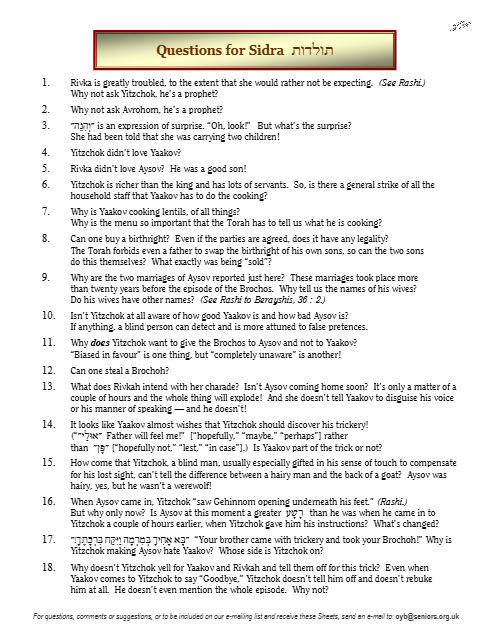
In this week’s Sidra we have another such example, this time with Yaakov Ovinu. Without entering into the question of how can one “steal a Brochoh” or why Rivkah did what she did or what Yitzchok Ovinu’s intentions were (all subjects in themselves!) we know that every fibre in Yaakov’s being rebelled against doing what his mother Rivkah, guided by Ru’ach HaKodesh, instructed him to do. After all, even any half-decent person would baulk at deceiving a blind man. And when that blind man is his own father, how much more so is it horrible and mean. Yet as much as Avrohom is the epitome of Chessed and kindness (as the Possuk says, “Ascribe kindness to Avrohom”) Yaakov’s principle characteristic, as that same Possuk says, is sincerity and truth! “Ascribe truth to Yaakov” — meaning, if you’re talking of honesty and integrity, Yaakov is your prime example! And yet of all things, Yaakov is ordered to deceive his own blind father! Why? How come?
The answer in all these cases is as has just been said, that a test from HaShem, that is, to prove that a person is a true and loyal servant of HaShem and deserving His blessing, it is not a matter of performing a tough exercise in doing what we anyway like to do. No, what tests a person’s obedience to HaShem’s wishes is to do something that runs against one’s own character and feelings — and to do what has to be done only because HaShem commands it. That is a true servant of HaShem.
Related Articles




