First Reading Rebeccah Esau and the Fourth Revolution
Gal Einai | November 17, 2023
Print This Article
View Original PDF

First Reading Rebeccah Esau and the Fourth Revolution

Gal Einai | December 31, 2025

“The boys wrestled in her [Rebeccah’s] womb and she said, ‘If so why do I exist?’ She went to inquire of God. God answered her, ‘Two nations are in your womb, two separate peoples shall issue from your body; one people shall be mightier than the other, and the older shall succumb to the younger.’”

What Was Rebeccah Doing?

In his commentary on this verse, Rashi, the classic medieval commentator on the Torah quotes the sages: “When she [Rebeccah] would pass by the entrances to Shem and Ever’s places of Torah study, Jacob hastened to be born, but when she passed by a doorway of idol worship, Esau struggled to get out.”

Rabbi Shmuel of Shinova (Sieniawa, Poland), author of Ramatayim Tzofim, asks a seemingly simple question on this statement from the sages: “What would bring Rebeccah to pass by places of idol worship in the first place? She was undoubtedly careful to guard the purity of her unborn children and made efforts, while still pregnant, to regularly be present (for their sake) at her husband Yitzchak’s Beit Midrash (house of Torah study.) Further, why was the situation described as a struggle or fight between the boys in trying to determine whether they would ultimately enter a Beit Midrash or a place of idol worship? Clearly, they could not be in two places at the same time, so what was the struggle about?

He then proceeds to offer the following answer: It is known that our patriarchs and matriarchs would approach strangers in order to convert them [to belief in the One God, the Creator]. This necessitated using logic and philosophy in order to speak to the idol worshippers and prove to them that there was no substance to their beliefs. This is what “the doorway to idol worship” refers to. Esau would be struggling to get out at that time, because he was from the impure side and wanted to connect with the idolaters. He could not hear the positive and sacred words that were uttered in such a meeting with an idolater.

Jacob, on the other hand, would have nothing to do with these discussions. It was only after the idolater would convert and learn Torah in a Beit Midrash for the purpose of serving the Creator, would Jacob feel the need to connect with them.

In summary, Rabbi Shmuel adds that the word the sages use to describe Jacob’s haste to leave the womb (מְ פַ רְ כּ ֵ ס)—a word that usually describes the convulsions of the soul as it departs the body—hints at Jacob’s self-sacrifice in his struggle to not become defiled by the acerbic nature of Esau’s evil and impurity. This self-sacrifice has been carried down through the generations by young Jewish men and women who have faced similar struggles. To counter the influence of the impurity around them, many of them found a safe harbor by clinging to tzaddikim.

Rabbi Shmuel of Shinova’s novel insight is that to bring the world closer to Torah, one must actively leave the Beit Midrash and go out among the nations. This mission even applied to Rebeccah, a modest woman careful to raise her children in holiness and purity. This inspired Torah teaching was no doubt heard from Rabbi Shmuel’s teacher Rebbe Simchah Bunim of Peshischa, who is known to have been highly successful in bringing those distant from God closer through philosophical discussions that had real world applications.

(Wisdom, Issue 46)
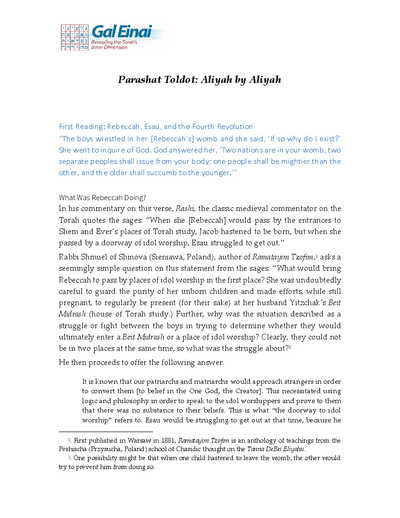
“The boys wrestled in her [Rebeccah’s] womb and she said, ‘If so why do I exist?’ She went to inquire of God. God answered her, ‘Two nations are in your womb, two separate peoples shall issue from your body; one people shall be mightier than the other, and the older shall succumb to the younger.’”

What Was Rebeccah Doing?

In his commentary on this verse, Rashi, the classic medieval commentator on the Torah quotes the sages: “When she [Rebeccah] would pass by the entrances to Shem and Ever’s places of Torah study, Jacob hastened to be born, but when she passed by a doorway of idol worship, Esau struggled to get out.”

Rabbi Shmuel of Shinova (Sieniawa, Poland), author of Ramatayim Tzofim, asks a seemingly simple question on this statement from the sages: “What would bring Rebeccah to pass by places of idol worship in the first place? She was undoubtedly careful to guard the purity of her unborn children and made efforts, while still pregnant, to regularly be present (for their sake) at her husband Yitzchak’s Beit Midrash (house of Torah study.) Further, why was the situation described as a struggle or fight between the boys in trying to determine whether they would ultimately enter a Beit Midrash or a place of idol worship? Clearly, they could not be in two places at the same time, so what was the struggle about?

He then proceeds to offer the following answer: It is known that our patriarchs and matriarchs would approach strangers in order to convert them [to belief in the One God, the Creator]. This necessitated using logic and philosophy in order to speak to the idol worshippers and prove to them that there was no substance to their beliefs. This is what “the doorway to idol worship” refers to. Esau would be struggling to get out at that time, because he was from the impure side and wanted to connect with the idolaters. He could not hear the positive and sacred words that were uttered in such a meeting with an idolater.

Jacob, on the other hand, would have nothing to do with these discussions. It was only after the idolater would convert and learn Torah in a Beit Midrash for the purpose of serving the Creator, would Jacob feel the need to connect with them.

In summary, Rabbi Shmuel adds that the word the sages use to describe Jacob’s haste to leave the womb (מְ פַ רְ כּ ֵ ס)—a word that usually describes the convulsions of the soul as it departs the body—hints at Jacob’s self-sacrifice in his struggle to not become defiled by the acerbic nature of Esau’s evil and impurity. This self-sacrifice has been carried down through the generations by young Jewish men and women who have faced similar struggles. To counter the influence of the impurity around them, many of them found a safe harbor by clinging to tzaddikim.

Rabbi Shmuel of Shinova’s novel insight is that to bring the world closer to Torah, one must actively leave the Beit Midrash and go out among the nations. This mission even applied to Rebeccah, a modest woman careful to raise her children in holiness and purity. This inspired Torah teaching was no doubt heard from Rabbi Shmuel’s teacher Rebbe Simchah Bunim of Peshischa, who is known to have been highly successful in bringing those distant from God closer through philosophical discussions that had real world applications.

(Wisdom, Issue 46)

PDF Preview


