How Yitzchaks Blindness Was the Cause of Him Wanting to Bless Eisav
Zera Shimshon | November 28, 2024
Print This Article
View Original PDF

How Yitzchaks Blindness Was the Cause of Him Wanting to Bless Eisav

Zera Shimshon | June 27, 2025

And it was when Yitzchak had become old, and his eyes dimmed from seeing, that he summoned Eisav, his older son... And he said “See, now, I have aged; I know not the day of my death. Now sharpen, if you please, your gear... Then make delicacies for me... so that my soul may bless you before I die”.

The simple understanding of this Passuk is that when Yitzchak saw himself aging, he called over his son, Eisav, and told him that now that he is growing old, he understands that his day of death is coming closer, and thus he wants to bless him before he dies. There is a difficulty with this simple explanation; why does the Passuk feel it necessary to mention that Yitzchak’s eyes have dimmed, as it doesn’t seem to have anything to do with the discussion at hand, of Yitzchak wanting to bless Eisav, for it seems that it was Yitzchak’s old age alone which compelled him to do so.

The Midrash tells us a reason why Hashem caused Yitzchak to lose his eyesight.

‘And his eyes dimmed from seeing’. R’ Elazar ben Azarya said in explanation of this Passuk; Yitzchak’s eyes dimmed to prevent him from seeing evil, that is, from seeing the evil of the wicked one, Eisav. Hashem said, “Yitzchak will go out to the marketplace and people will say about him, “This is the father of that wicked person”. Rather, to avoid this, I will dim his eyes and, inevitably, he will need to remain inside his home”.

We find another Midrash that tells us an additional reason why Hashem caused Yitzchok to become blind.

Yitzchak requested physical afflictions. He said, “Hashem, at present a man dies without having experienced any afflictions, and consequently, following his death the Divine Attribute of Justice is extended against him. However, as a result of Your bringing afflictions upon him during his lifetime, following his death the Divine Attribute of Justice will not be extended against him”. [i.e. The suffering that one endures in this world has the effect of cleansing him of his sins, and can therefore spare him from punishment in the next world]. Hashem said to him, “You have requested a good thing. I will therefore grant your request, and I will begin this practice with you...”, as the Passuk states, ‘And it was when Yitzchak had become old, and his eyes dimmed from seeing...’

When Yitzchak became blind, he initially understood that the reason for his blindness was as the first Midrash explains; in order to protect him from seeing Eisav’s wickedness. Thus, he realized that when the time would come for him to bless his children, although Eisav was the older brother, and it would only make sense that he should receive the blessings, nevertheless, because he was wicked, so much so as to cause Yitzchak to need to become blind, he definitely was not worthy of receiving the blessings.

But when Yitzchak realized the timing of losing his eyesight, that it was only after his becoming old, he understood that because he had aged, it was within reason to assume that his day of death was getting closer, and thus his blindness had nothing to do with Eisav at all. Rather, his blindness was a fulfillment of his request to Hashem, that before passing away one should be afflicted with physical ailments, so that the Divine Attribute of Justice will not be stretched against him following his death. Thus, his blindness which came with old age, brought Yitzchak much clarity. It made him realize that his day of death was coming closer; it also made him realize that there was no reason to believe that his blindness had anything to do with Eisav, and thus he was indeed worthy of being blessed.

Accordingly, we can understand why the Torah says, ‘When Yitzchak became old and thereafter his eyes dimmed from seeing’, for indeed it was only the fact that Yitzchak became old, and subsequently became blind as well, which caused him to recognize that his day of death was near, and thus made him feel that the time had come to bless one of his sons. It also brought Yitzchak to understand that there was no reason to doubt Eisav’s worthiness, as his blindness had no connection to Eisav, and therefore, ‘he summoned his older son, Eisav, and said to him, “Now that I have aged and do not know the day of my death, please sharpen your gear and make delicacies for me so that my soul may bless you before I die”.
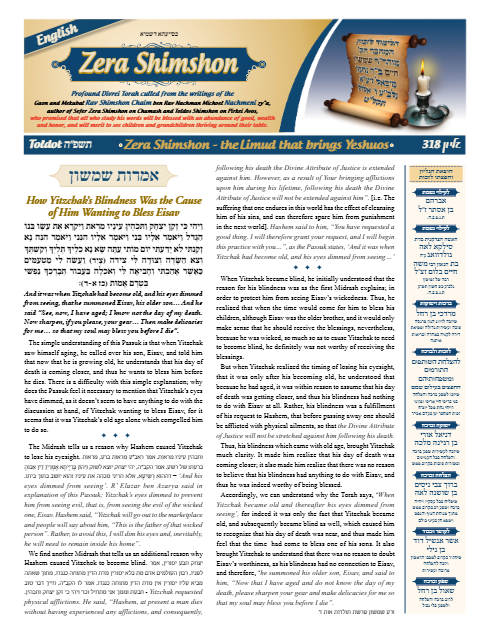

And it was when Yitzchak had become old, and his eyes dimmed from seeing, that he summoned Eisav, his older son... And he said “See, now, I have aged; I know not the day of my death. Now sharpen, if you please, your gear... Then make delicacies for me... so that my soul may bless you before I die”.

The simple understanding of this Passuk is that when Yitzchak saw himself aging, he called over his son, Eisav, and told him that now that he is growing old, he understands that his day of death is coming closer, and thus he wants to bless him before he dies. There is a difficulty with this simple explanation; why does the Passuk feel it necessary to mention that Yitzchak’s eyes have dimmed, as it doesn’t seem to have anything to do with the discussion at hand, of Yitzchak wanting to bless Eisav, for it seems that it was Yitzchak’s old age alone which compelled him to do so.

The Midrash tells us a reason why Hashem caused Yitzchak to lose his eyesight.

‘And his eyes dimmed from seeing’. R’ Elazar ben Azarya said in explanation of this Passuk; Yitzchak’s eyes dimmed to prevent him from seeing evil, that is, from seeing the evil of the wicked one, Eisav. Hashem said, “Yitzchak will go out to the marketplace and people will say about him, “This is the father of that wicked person”. Rather, to avoid this, I will dim his eyes and, inevitably, he will need to remain inside his home”.

We find another Midrash that tells us an additional reason why Hashem caused Yitzchok to become blind.

Yitzchak requested physical afflictions. He said, “Hashem, at present a man dies without having experienced any afflictions, and consequently, following his death the Divine Attribute of Justice is extended against him. However, as a result of Your bringing afflictions upon him during his lifetime, following his death the Divine Attribute of Justice will not be extended against him”. [i.e. The suffering that one endures in this world has the effect of cleansing him of his sins, and can therefore spare him from punishment in the next world]. Hashem said to him, “You have requested a good thing. I will therefore grant your request, and I will begin this practice with you...”, as the Passuk states, ‘And it was when Yitzchak had become old, and his eyes dimmed from seeing...’

When Yitzchak became blind, he initially understood that the reason for his blindness was as the first Midrash explains; in order to protect him from seeing Eisav’s wickedness. Thus, he realized that when the time would come for him to bless his children, although Eisav was the older brother, and it would only make sense that he should receive the blessings, nevertheless, because he was wicked, so much so as to cause Yitzchak to need to become blind, he definitely was not worthy of receiving the blessings.

But when Yitzchak realized the timing of losing his eyesight, that it was only after his becoming old, he understood that because he had aged, it was within reason to assume that his day of death was getting closer, and thus his blindness had nothing to do with Eisav at all. Rather, his blindness was a fulfillment of his request to Hashem, that before passing away one should be afflicted with physical ailments, so that the Divine Attribute of Justice will not be stretched against him following his death. Thus, his blindness which came with old age, brought Yitzchak much clarity. It made him realize that his day of death was coming closer; it also made him realize that there was no reason to believe that his blindness had anything to do with Eisav, and thus he was indeed worthy of being blessed.

Accordingly, we can understand why the Torah says, ‘When Yitzchak became old and thereafter his eyes dimmed from seeing’, for indeed it was only the fact that Yitzchak became old, and subsequently became blind as well, which caused him to recognize that his day of death was near, and thus made him feel that the time had come to bless one of his sons. It also brought Yitzchak to understand that there was no reason to doubt Eisav’s worthiness, as his blindness had no connection to Eisav, and therefore, ‘he summoned his older son, Eisav, and said to him, “Now that I have aged and do not know the day of my death, please sharpen your gear and make delicacies for me so that my soul may bless you before I die”.

PDF Preview

