Past and Present Love
זכרון יעקב | November 28, 2024
Print This Article
View Original PDF

Past and Present Love

זכרון יעקב | June 27, 2025

RABBI YISSOCHER FRAND (Aish.com)

"And Yitzchak loved Eisav, for the game he put in his mouth, but Rivkah loves Yaakov" (25:28).

Even people not normally attuned to grammar are struck by the Torah's strange use of tenses to describe the relationship of Yitzchak and Rivkah with their children. Yitzchak "loved" Eisav, in the past tense, while Rivkah "loves" Yaakov, in the present tense. What is this meant to teach us?

The Dubno Maggid suggests a solution based on a keen observation of the world. In non-Jewish society, people define themselves and are defined by others according to what they do. In Jewish society, people are defined by what they are.

Eisav represented non-Jewish values. He defined himself and expected other to define him by what he did. He wanted to be seen as the athlete, the warrior, the storied hunter. The basis for the admiration and love of other people was what he had accomplished in the past. Should he cease to be a hunter, the admiration would cease as well. Therefore, Yitzchak "loved" Eisav, in the past tense, "for the game he put in his mouth," the things he had done in the past. But Yaakov represented Jewish values. He was defined by what he was rather than by what he did. Therefore, Rivkah "loves" Yaakov, in the present tense, a love that continues uninterrupted and is not dependent on his latest feat and achievement.

This is particularly true in our own times. Ask a non-Jewish child what he wants to be when he grows up and he will inevitably tell you he wants to be a doctor or a lawyer or a Silicon Valley entrepreneur or perhaps a rock star. Ask a Jewish child, and hopefully he will tell you he wants to be a tzaddik (righteous person), a talmid chacham (Torah scholar), a baal chessed (kind), and oveid Hashem (servant of G-d). Hopefully.

The Jewish child answers the question directly. He tells you what he wants to "be." The non-Jewish child, however, is not giving a direct answer to the question. He is telling what he will "do" rather than what he will "be." He has been conditioned to believe that a person's entire value is dependent on his profession or vocation. If he is a doctor he is important. If he is a mailman he is not important.

A columnist here in Baltimore recently wrote a piece decrying this tendency in society. Whenever he meets someone new at a function or party, it takes no more than fifteen seconds before he is asked, "So what do you do?" Sometimes, he is so annoyed he identifies himself as an auditor for the Internal Revenue Service, which is a guaranteed conversation stopper. Obviously, he concludes, in America "you are what you do," and what you really are - your character, your interests, your thoughts, your feelings, your opinions - do not really matter that much.

In America, you are measured by your performance, by what you do. Therefore, you may be idolized and adored one day and despised the next. If the level of your performance falls off, if you go through a stretch when you strike out instead of hitting, your fickle admirers will turn on you. After all, it was not what you are that they never admired but what you do, and when you no longer do it, there is no longer any basis for the admiration.

This is not the perspective of Judaism. In fact, it is the exact opposite. Judaism values all people for what they are, for their tzelem Elokim, for their character, their integrity, their goodness, their ethical standards, their menschlichkeit, their spiritual accomplishments. What they do for a living or for professional fulfillment is only secondary.
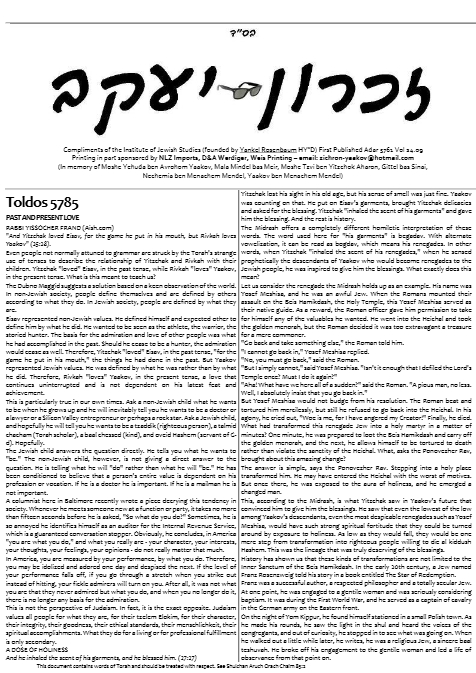

RABBI YISSOCHER FRAND (Aish.com)

"And Yitzchak loved Eisav, for the game he put in his mouth, but Rivkah loves Yaakov" (25:28).

Even people not normally attuned to grammar are struck by the Torah's strange use of tenses to describe the relationship of Yitzchak and Rivkah with their children. Yitzchak "loved" Eisav, in the past tense, while Rivkah "loves" Yaakov, in the present tense. What is this meant to teach us?

The Dubno Maggid suggests a solution based on a keen observation of the world. In non-Jewish society, people define themselves and are defined by others according to what they do. In Jewish society, people are defined by what they are.

Eisav represented non-Jewish values. He defined himself and expected other to define him by what he did. He wanted to be seen as the athlete, the warrior, the storied hunter. The basis for the admiration and love of other people was what he had accomplished in the past. Should he cease to be a hunter, the admiration would cease as well. Therefore, Yitzchak "loved" Eisav, in the past tense, "for the game he put in his mouth," the things he had done in the past. But Yaakov represented Jewish values. He was defined by what he was rather than by what he did. Therefore, Rivkah "loves" Yaakov, in the present tense, a love that continues uninterrupted and is not dependent on his latest feat and achievement.

This is particularly true in our own times. Ask a non-Jewish child what he wants to be when he grows up and he will inevitably tell you he wants to be a doctor or a lawyer or a Silicon Valley entrepreneur or perhaps a rock star. Ask a Jewish child, and hopefully he will tell you he wants to be a tzaddik (righteous person), a talmid chacham (Torah scholar), a baal chessed (kind), and oveid Hashem (servant of G-d). Hopefully.

The Jewish child answers the question directly. He tells you what he wants to "be." The non-Jewish child, however, is not giving a direct answer to the question. He is telling what he will "do" rather than what he will "be." He has been conditioned to believe that a person's entire value is dependent on his profession or vocation. If he is a doctor he is important. If he is a mailman he is not important.

A columnist here in Baltimore recently wrote a piece decrying this tendency in society. Whenever he meets someone new at a function or party, it takes no more than fifteen seconds before he is asked, "So what do you do?" Sometimes, he is so annoyed he identifies himself as an auditor for the Internal Revenue Service, which is a guaranteed conversation stopper. Obviously, he concludes, in America "you are what you do," and what you really are - your character, your interests, your thoughts, your feelings, your opinions - do not really matter that much.

In America, you are measured by your performance, by what you do. Therefore, you may be idolized and adored one day and despised the next. If the level of your performance falls off, if you go through a stretch when you strike out instead of hitting, your fickle admirers will turn on you. After all, it was not what you are that they never admired but what you do, and when you no longer do it, there is no longer any basis for the admiration.

This is not the perspective of Judaism. In fact, it is the exact opposite. Judaism values all people for what they are, for their tzelem Elokim, for their character, their integrity, their goodness, their ethical standards, their menschlichkeit, their spiritual accomplishments. What they do for a living or for professional fulfillment is only secondary.

PDF Preview

