The Blessed Life
BET Journal | November 21, 2025
Print This Article
View Original PDF

The Blessed Life

BET Journal | December 07, 2025

Yitzchok’s uncertainty is finally resolved, and we expect the blessing to gush forward from father to son. Yet we are hardly past the first phrase of the blessing, and the ba’al koreh stops, and the person called for shishi comes forward. Only after that pause do we resume the familiar “V’yitein“ in which Yitzchak asks Hashem to bestow bountiful physical blessings on Yaakov. Why the pause in mid-sentence?

Truth be told, many are quick to point out that we are not sure of the pedigree of these pauses and who determined their location. Nevertheless, in this case, as in most cases, they are widely held practices, and as such, deserve some attention.

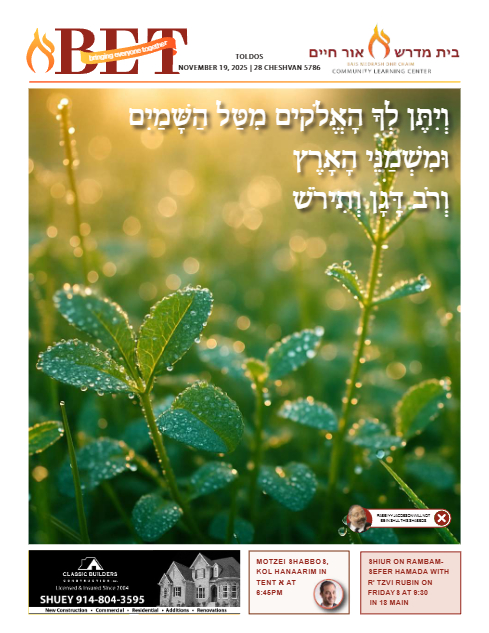
Nonetheless, even if the pause would not pique our curiosity, the pasuk that begins this blessing deserves comment. “And he approached him, and he kissed him, and he smelled the scent of his clothes, and he blessed him and said: Look, the scent of my son is as the smell of the field that Hashem blessed“ (27:27). Apparently, the Torah sees that calling attention to the scent of his clothes is part of the blessing. Not only is it introduced as such, but it is followed by the conjunctive “vov,“ tying it to the material blessing that follows. Moreover, Rashi explains that Yitzchak perceived the aroma of Gan Eden unexpectedly, overwhelming him, and it is that fragrance that he insists on impressing on Yaakov prior to bestowing a blessing.

Perhaps Yitzchak first instructs his son how to effectively receive a brachah and how to best prepare oneself for the blessings and prayers of others. Moments of brachah in our experience usually come at the beginning of new stages and most often at celebrations of those beginnings. We, too, would do well to take lesson from these pesukim.

It would seem that the first part of every blessing and prayer is to appreciate what one has already. “Re’eh bini,“ see and realize and be grateful for the scent of Gan Eden that is already yours. A blessing, a prayer, or a blessed life begins with dwelling on one’s strengths and gifts. How sad it is to see people totally unaware of their G-d-given talents, often casting about for years, if not decades, till they contribute in a self-fulfilling manner. On the other hand, isn’t it almost inspiring to see people who live with self-awareness and profound gratitude and seek out opportunities to simply be grateful? Perhaps that is why Klal Yisrael, the wisdom of whose customs we have long come to expect, has us pause when Yaakov is being forced by his father to become aware and absorb his own blessings.

Perhaps Yitzchok wants to make sure that his son realizes these strengths and aspires to the great heights that they can bring. If one indeed catches the whiff of Eden in one’s coat, is there any limit to where bestowed blessings will take him?

OHR SAMEACH OHR.EDU
RABBI YAAKOV NEUBURGER
Yitzchok’s uncertainty is finally resolved, and we expect the blessing to gush forward from father to son. Yet we are hardly past the first phrase of the blessing, and the ba’al koreh stops, and the person called for shishi comes forward. Only after that pause do we resume the familiar “V’yitein“ in which Yitzchak asks Hashem to bestow bountiful physical blessings on Yaakov. Why the pause in mid-sentence?

Truth be told, many are quick to point out that we are not sure of the pedigree of these pauses and who determined their location. Nevertheless, in this case, as in most cases, they are widely held practices, and as such, deserve some attention.

Nonetheless, even if the pause would not pique our curiosity, the pasuk that begins this blessing deserves comment. “And he approached him, and he kissed him, and he smelled the scent of his clothes, and he blessed him and said: Look, the scent of my son is as the smell of the field that Hashem blessed“ (27:27). Apparently, the Torah sees that calling attention to the scent of his clothes is part of the blessing. Not only is it introduced as such, but it is followed by the conjunctive “vov,“ tying it to the material blessing that follows. Moreover, Rashi explains that Yitzchak perceived the aroma of Gan Eden unexpectedly, overwhelming him, and it is that fragrance that he insists on impressing on Yaakov prior to bestowing a blessing.

Perhaps Yitzchak first instructs his son how to effectively receive a brachah and how to best prepare oneself for the blessings and prayers of others. Moments of brachah in our experience usually come at the beginning of new stages and most often at celebrations of those beginnings. We, too, would do well to take lesson from these pesukim.

It would seem that the first part of every blessing and prayer is to appreciate what one has already. “Re’eh bini,“ see and realize and be grateful for the scent of Gan Eden that is already yours. A blessing, a prayer, or a blessed life begins with dwelling on one’s strengths and gifts. How sad it is to see people totally unaware of their G-d-given talents, often casting about for years, if not decades, till they contribute in a self-fulfilling manner. On the other hand, isn’t it almost inspiring to see people who live with self-awareness and profound gratitude and seek out opportunities to simply be grateful? Perhaps that is why Klal Yisrael, the wisdom of whose customs we have long come to expect, has us pause when Yaakov is being forced by his father to become aware and absorb his own blessings.

Perhaps Yitzchok wants to make sure that his son realizes these strengths and aspires to the great heights that they can bring. If one indeed catches the whiff of Eden in one’s coat, is there any limit to where bestowed blessings will take him?

OHR SAMEACH OHR.EDU
RABBI YAAKOV NEUBURGER

PDF Preview