Yitzchak Wished to Bless Eisav since He Witnessed Animals Flocking to Him of Their Own Accord
Shvilei Pinchas | November 28, 2024
Print This Article
View Original PDF

Yitzchak Wished to Bless Eisav since He Witnessed Animals Flocking to Him of Their Own Accord

Shvilei Pinchas | June 27, 2025

HKB”H fashioned for Adam and Chava from the skin of the nachash. They drew every animal, beast, and bird to them automatically. For, as explained, the nachash was created to be the king of all the animals. As such, all the animals came to it to join in its mission of assisting man to serve Hashem.

Unfortunately, the nachash rebelled against Hashem. Not only did it not help Adam to fulfill the mitzvos of Hashem, but it even caused him to sin. This prompted HKB”H to strip off its amazing skin and make garments from it for Adam and Chava. This was designed to teach them a valuable lesson. Although they were banished from Gan Eden for violating Hashem’s command, and they forfeited their automatic sustenance, as per the decree (ibid. 19): "בזיעת אפיך תאכל לחם"—by the sweat of your brow shall you eat bread; nevertheless, if they accept upon themselves the burden and responsibility of Torah, they will still possess the inherent, auspicious power of the “garments of skin.” In other words, all plant-life and animal-life will run towards them, so that they may be elevated as a pleasant aroma to Hashem.

Through the graces of Hashem, we now approach the conclusion of our journey regarding the “garments of skin.” The Torah describes how Yaakov Avinu entered his father’s tent wearing Eisav’s coveted garments. We have learned that they were fashioned by HKB”H from the skin of the “nachash hakadmoni” in Gan Eden for Adam and Chava. Yitzchak intended to bestow the Berachos upon Eisav, because (ibid. 25, 28): "ויאהב יצחק את עשו כי ציד בפיו"—Yitzchak loved Eisav for trapping was in his mouth. Rashi comments: “In his mouth” is to be understood as rendered by the Targum—in the mouth of Yitzchak.

Let us suggest an explanation in keeping with this essay. Upon seeing that Eisav was able to trap prey with the “garments of skin” worn by Adam HaRishon, and they all came to him of their own accord, this proved to him beyond a shadow of a doubt that Eisav wanted to assist Yaakov—to enable him to study Torah without distractions. Because of this altruism, he was privileged to acquire this unique garment, formerly belonging to Adam HaRishon, which attracted all forms of animal life to it. That being the case, Yitzchak concluded that Eisav truly deserved the Berachos. This coincides magnificently with the sacred insights of the Chasam Sofer and the Sefas Emes that Yitzchak Avinu planned to pass on the Berachos to Eisav, because he believed that the relationship between Eisav and Yaakov would mirror the ideal paradigm of Zevulun and Yissachar—where Eisav, representing Zevulun, would provide for Yaakov, representing the people of Yisrael as Yissachar.

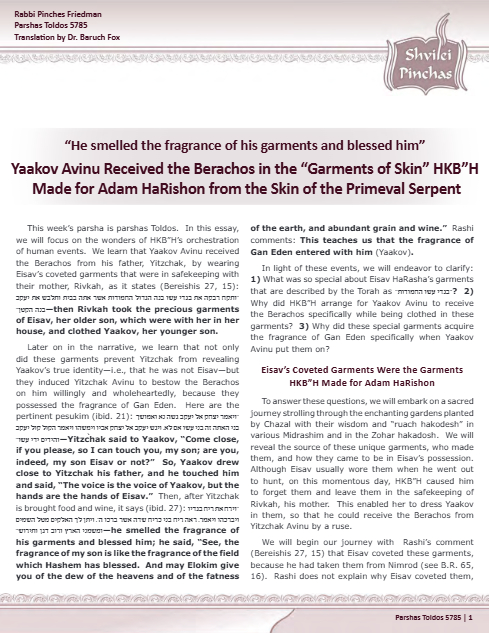
But then Yaakov entered clothed in Eisav’s precious garments. Suddenly, Yitzchak Avinu sensed the fragrance of Gan Eden, which he was familiar with, because he spent three years after the Akeidah in Gan Eden (see last week’s essay). He realized that when Eisav wore the garments, they did not emit the scent of Gan Eden, and that Eisav did not really deserve to have them; they really belonged to someone else, namely Yaakov. Hence, Yaakov was truly worthy to receive the Berachos. This is the message conveyed by the pesukim: “He (Yitzchak) smelled the fragrance of his garments and blessed him; he said, ‘See, the fragrance of my son is like the fragrance of the field which Hashem has blessed. And may Elokim give you of the dew of the heavens and of the fatness of the earth, and abundant grain and wine.’”

HKB”H fashioned for Adam and Chava from the skin of the nachash. They drew every animal, beast, and bird to them automatically. For, as explained, the nachash was created to be the king of all the animals. As such, all the animals came to it to join in its mission of assisting man to serve Hashem.

Unfortunately, the nachash rebelled against Hashem. Not only did it not help Adam to fulfill the mitzvos of Hashem, but it even caused him to sin. This prompted HKB”H to strip off its amazing skin and make garments from it for Adam and Chava. This was designed to teach them a valuable lesson. Although they were banished from Gan Eden for violating Hashem’s command, and they forfeited their automatic sustenance, as per the decree (ibid. 19): "בזיעת אפיך תאכל לחם"—by the sweat of your brow shall you eat bread; nevertheless, if they accept upon themselves the burden and responsibility of Torah, they will still possess the inherent, auspicious power of the “garments of skin.” In other words, all plant-life and animal-life will run towards them, so that they may be elevated as a pleasant aroma to Hashem.

Through the graces of Hashem, we now approach the conclusion of our journey regarding the “garments of skin.” The Torah describes how Yaakov Avinu entered his father’s tent wearing Eisav’s coveted garments. We have learned that they were fashioned by HKB”H from the skin of the “nachash hakadmoni” in Gan Eden for Adam and Chava. Yitzchak intended to bestow the Berachos upon Eisav, because (ibid. 25, 28): "ויאהב יצחק את עשו כי ציד בפיו"—Yitzchak loved Eisav for trapping was in his mouth. Rashi comments: “In his mouth” is to be understood as rendered by the Targum—in the mouth of Yitzchak.

Let us suggest an explanation in keeping with this essay. Upon seeing that Eisav was able to trap prey with the “garments of skin” worn by Adam HaRishon, and they all came to him of their own accord, this proved to him beyond a shadow of a doubt that Eisav wanted to assist Yaakov—to enable him to study Torah without distractions. Because of this altruism, he was privileged to acquire this unique garment, formerly belonging to Adam HaRishon, which attracted all forms of animal life to it. That being the case, Yitzchak concluded that Eisav truly deserved the Berachos. This coincides magnificently with the sacred insights of the Chasam Sofer and the Sefas Emes that Yitzchak Avinu planned to pass on the Berachos to Eisav, because he believed that the relationship between Eisav and Yaakov would mirror the ideal paradigm of Zevulun and Yissachar—where Eisav, representing Zevulun, would provide for Yaakov, representing the people of Yisrael as Yissachar.

But then Yaakov entered clothed in Eisav’s precious garments. Suddenly, Yitzchak Avinu sensed the fragrance of Gan Eden, which he was familiar with, because he spent three years after the Akeidah in Gan Eden (see last week’s essay). He realized that when Eisav wore the garments, they did not emit the scent of Gan Eden, and that Eisav did not really deserve to have them; they really belonged to someone else, namely Yaakov. Hence, Yaakov was truly worthy to receive the Berachos. This is the message conveyed by the pesukim: “He (Yitzchak) smelled the fragrance of his garments and blessed him; he said, ‘See, the fragrance of my son is like the fragrance of the field which Hashem has blessed. And may Elokim give you of the dew of the heavens and of the fatness of the earth, and abundant grain and wine.’”

PDF Preview

