ABSTRACT לקוטי שיחות (Part 2)
Ben Chamesh L'Mikra | April 08, 2025
Print This Article
View Original PDF

ABSTRACT לקוטי שיחות (Part 2)

Ben Chamesh L'Mikra | June 27, 2025

A person’s service must increase in quantity (physical) as well as in quality (spiritual)

This Parsha provides supplemental quality to the previous one in certain laws (עולה מנחה וחטאת) and in other laws provides totally new quantity concepts (אשם ותודה)

זאת תורת החטאת

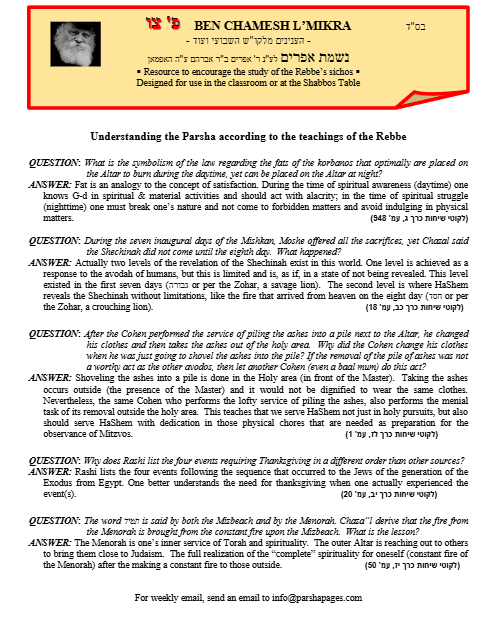
Two types of service: Inner (for one’s self) Outer (reaching out to others)

תמיד by the menorah means consistently and 24/7. This verse implies the menorah (inner) is lit from the outer altar (where the fire always burns)

אש תמיד

Appearance of a lion on the altar – 2 types. A savage lion – incremental influence of below; subject to limitations – גבורה. A crouching lion – Divine influence, not incremental – חסד. Similar difference to that of the 7 days of מלואים and of the eighth day

זהר כבא

Every day is the day of anointing, a person’s service refreshes each day. The High Priest’s offering combines elements both of Tzibur and of individuals. Three-finger fistful (communal). The remainder is burnt (personal, like the other individual priests)

כליל תקטר

Nosar occurs at the point that the sacrifice becomes unfit for consumption even if the time period for eating hasn’t lapsed; example, the ceramic vessel that absorbs and that portion of the food is no longer eligible to be eaten

וכלי חרש

Nosar limitation to midnight is different from other enactments of the Sages, since this decree can be seen from the verse as well. They are called חכמים since they have wisdom to discern people’s nature

עד בקר

Every Jew, through the Moshe aspect in each of us, should serve G-d through immersion in Torah. The Priesthood of Moshe was a portion of his mission to receive and transmit Torah, and not a separate function of priesthood

ויקטר המזבחה

One must be dedicated to serve HaShem in simple, physical chores, as well as the holy tasks. After shoveling the ashes into a pile next to the Altar, the Cohen (preferably) changes his clothes to take the ashes out; the shoveling (a preparatory, unclean task) which is in the Master’s presence, still requires formal attire

ופשט את בגדיו
A person’s service must increase in quantity (physical) as well as in quality (spiritual)

This Parsha provides supplemental quality to the previous one in certain laws (עולה מנחה וחטאת) and in other laws provides totally new quantity concepts (אשם ותודה)

זאת תורת החטאת

Two types of service: Inner (for one’s self) Outer (reaching out to others)

תמיד by the menorah means consistently and 24/7. This verse implies the menorah (inner) is lit from the outer altar (where the fire always burns)

אש תמיד

Appearance of a lion on the altar – 2 types. A savage lion – incremental influence of below; subject to limitations – גבורה. A crouching lion – Divine influence, not incremental – חסד. Similar difference to that of the 7 days of מלואים and of the eighth day

זהר כבא

Every day is the day of anointing, a person’s service refreshes each day. The High Priest’s offering combines elements both of Tzibur and of individuals. Three-finger fistful (communal). The remainder is burnt (personal, like the other individual priests)

כליל תקטר

Nosar occurs at the point that the sacrifice becomes unfit for consumption even if the time period for eating hasn’t lapsed; example, the ceramic vessel that absorbs and that portion of the food is no longer eligible to be eaten

וכלי חרש

Nosar limitation to midnight is different from other enactments of the Sages, since this decree can be seen from the verse as well. They are called חכמים since they have wisdom to discern people’s nature

עד בקר

Every Jew, through the Moshe aspect in each of us, should serve G-d through immersion in Torah. The Priesthood of Moshe was a portion of his mission to receive and transmit Torah, and not a separate function of priesthood

ויקטר המזבחה

One must be dedicated to serve HaShem in simple, physical chores, as well as the holy tasks. After shoveling the ashes into a pile next to the Altar, the Cohen (preferably) changes his clothes to take the ashes out; the shoveling (a preparatory, unclean task) which is in the Master’s presence, still requires formal attire

ופשט את בגדיו

PDF Preview