All Fat Belongs to the Lord
And the priest shall cause it to [go up in] smoke on the altar, consumed as a fire offering, [with] a pleasing fragrance. All fat belongs to the Lord.
Vayikra 3:16
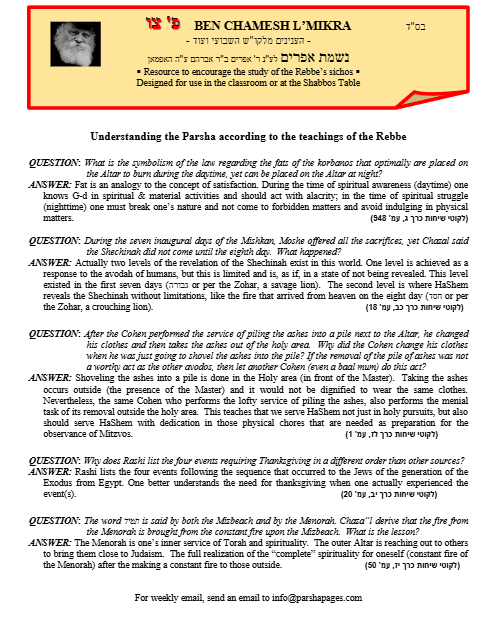
When the verse states that all fat is for G-d, it does not only mean that the fat of the sacrifice should be brought on top of the altar, but it also is an instruction that one must sacrifice their own fats and pleasure for the Almighty.
Which pleasure?
Nonetheless, a person may think that while true that he must sacrifice his personal, selfish pleasures to G-d, he mustn’t sacrifice the pleasure which he derives from the experience of doing a mitzvah.
A person can rationalize, that that only regarding his personal matters must he completely sanctify them to G-d and not partake of these pleasures for himself; however, concerning things that are holy, he may think that not only is there nothing reprehensible about doing them with pleasure, but on the contrary, it is a constructive to personally enjoy these mitzvos.
This is then the message that is derived from burning the fats of the sacrifice:
We see that although eating from the sacrifice is a mitzvah, one is prohibited from partaking of the meat before the fats were placed on the altar to be burnt. Thus, even when one is doing a mitzvah, one must see to it that the pleasure of the mitzvah, i.e., the fat, is sanctified to G-d.
This is the litmus test for a person to be sure that they are doing the mitzvah properly, without ulterior motives.
If the individual has yet to sacrifice the fats—the pleasure—it is possible that he is not doing the mitzvah solely because that is what G-d said to do, but because of the personal gratification that he derives from the mitzvah. However, after the person has sanctified his pleasure, and burned it for the Almighty, he can be sure that he is fulfilling the mitzvah with proper intent.
For, while true that the person must do the mitzvah with energy and excitement, and that he should not do the mitzvah dryly, it should not contain a personal sense of pleasure, but rather a satisfaction that he is able to fulfill the Almighty’s will.
Related Articles




