All Fat Belongs to the Lord
And the priest shall cause it to [go up in] smoke on the altar, consumed as a fire offering, [with] a pleasing fragrance. All fat belongs to the Lord.
Vayikra 3:16
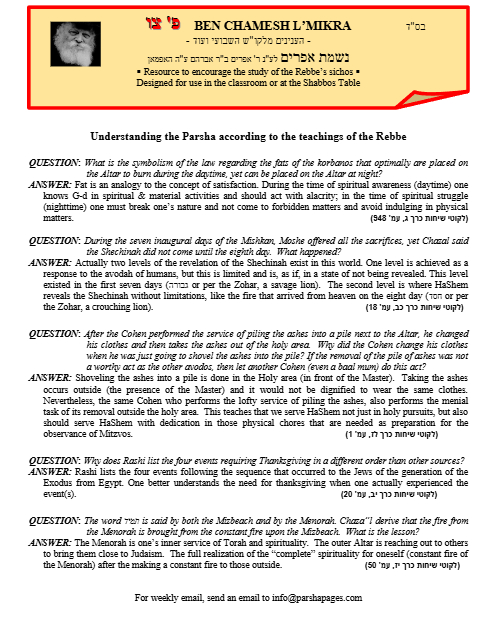
When the verse states that all fat is for G-d, it does not only mean that the fat of the sacrifice should be brought on top of the altar, but it also is an instruction that one must sacrifice their own fats and pleasure for the Almighty.
Which pleasure?
Nonetheless, a person may think that while true that he must sacrifice his personal, selfish pleasures to G-d, he mustn’t sacrifice the pleasure which he derives from the experience of doing a mitzvah.
A person can rationalize, that that only regarding his personal matters must he completely sanctify them to G-d and not partake of these pleasures for himself; however, concerning things that are holy, he may think that not only is there nothing reprehensible about doing them with pleasure, but on the contrary, it is a constructive to personally enjoy these mitzvos.
This is then the message that is derived from burning the fats of the sacrifice:
We see that although eating from the sacrifice is a mitzvah, one is prohibited from partaking of the meat before the fats were placed on the altar to be burnt. Thus, even when one is doing a mitzvah, one must see to it that the pleasure of the mitzvah, i.e., the fat, is sanctified to G-d.
This is the litmus test for a person to be sure that they are doing the mitzvah properly, without ulterior motives.
If the individual has yet to sacrifice the fats—the pleasure—it is possible that he is not doing the mitzvah solely because that is what G-d said to do, but because of the personal gratification that he derives from the mitzvah. However, after the person has sanctified his pleasure, and burned it for the Almighty, he can be sure that he is fulfilling the mitzvah with proper intent.
For, while true that the person must do the mitzvah with energy and excitement, and that he should not do the mitzvah dryly, it should not contain a personal sense of pleasure, but rather a satisfaction that he is able to fulfill the Almighty’s will.
During the day
According to the above—that the burning of the fats is expressive of sacrificing one’s pleasure to G-d—the reason that the burning of the fats should be done during the daytime, and that only if one has not done so, may he burn them at night, can be understood as it relates to man’s service of G-d.
Day is the time of light, and in a spiritual sense, is expressive of revelation. Daytime is associated with the study of Torah and doing Mitzvos, as King Shlomo writes:
For a mitzvah is a candle, and the Torah is light, and disciplining rebukes are the way of life.
Mishlei 6:23
Daytime represents the period that an individual is involved in learning Torah and doing mitzvos, while nighttime is expressive of when the person is involved in their own pursuits.
The burning of fats—the pleasure—should be fulfilled preferably during the daytime:
This teaches, that concerning one’s own pursuits (represented by the nighttime), it is obvious that he should not be involved in them for his own pleasure and that they should rather be done for the sake of Heaven.
However, concerning Torah and mitzvos, a person is likely to convince himself that since he is involved with holy things, his actions are inherently good, no matter how he goes about performing them, as long as he is involved with learning Torah and doing mitzvos.
His rationale will be predicated on the following statement of the Sages:
A man should always occupy himself with Torah and good deeds, though it is not for their own sake, for through [doing good] with an ulterior motive, there comes [doing good] for its own sake.
Talmud, Pesachim 50b
A person is likely to think, that because the Torah tells him to continue doing Torah and mitzvos though he has ulterior motives, he can be satisfied with remaining at such a level.
However, this mentality is not correct, and such is the lesson of burn the fats during the daytime.
It is specifically in one’s Torah learning and fulfillment of mitzvos that one must make sure he is doing them in the proper way, and sanctifying his pleasure to G-d.
This guarantees that he will indeed learn Torah properly. For, if he is learning Torah for his own pleasure, he will not be bothered if his ideas are not in line with the ultimate truth of Torah; he is satisfied that he is enjoying the intellectual study of its wisdom.
This though, is not the case with a person who sanctifies their personal pleasure of learning to the Almighty. If such a person would develop a novel insight in Torah, which is not in line with the commentators (and therefore, not expressive of the truth of Torah), he will “burn” his pleasure. His intent is to understand the truth of Torah and not merely to enjoy the intellectual stimulation.
Day vs. Night
As was enumerated above, there are two aspects of burning the fats: 1) as an active service of G-d, and 2) to prevent the prohibition that anything be left over.
This can be appreciated through an additional explanation as to the meaning of day and night.
Day and night are not only expressive of a person’s actions (G-dly activities vs. personal ones), but represent as well, the different situations that a person can find himself in.
Daytime: This is indicative of when the person feels inspired in his service of G-d. He consciously senses that the Torah is from G-d and that the physicality as well, has a G-dly purpose. He is not involved in the physical for himself, but instead feels G-dliness in all that he does.
Night: This is expressive of when the person does not feel G-dliness. When a person is in a situation of spiritual darkness, he experiences a constant internal struggle toward serving G-d. This conflict is not only relegated to the physical domain, in his efforts to ensure that all these activities are done for the sake of Heaven, and not for his own pleasure, but his challenge is (understandably) also in regards to his fulfillment of Torah and mitzvos.
When a person is experiencing spiritual darkness and less spiritual inspiration, he must exert tremendous energy to ensure that he is learning Torah and doing mitzvos, not for his own pleasure, but because it is G-d’s will.
While this effort of burning his personal pleasure applies both during the “day” and the “night,” the manner in which they are each accomplished is entirely different.
During the “day,” the times of his spiritual high, his entire pleasure transforms into the G-dly. When a person feels G-dliness in a revealed way, he is able to affect within himself that everything he does is infused with G-dliness.
However, during the “night,” although he cannot affect within himself to feel G-dliness in all that he does, he must at least sanctify himself to the extent that he does not do Torah, mitzvos and his own pursuits for his own gratification, but that he does them for the sake of Heaven.
This is the difference between burning the fats as an active service of G-d (the first aspect of the mitzvah), which is performed during the daytime, and the preventative aspect of burning the fats (the second aspect), which is done during the nighttime.
These two aspects parallel one’s two spiritual states as follows: when he is spiritually inspired, he is actively able to transform his pleasure into a G-dly one. When he is not, he must at least ensure that there is no negativity in his service of G-d, and that he does not perform them for his personal pleasure.
An advantage
Although the manner of serving G-d at night is indeed lower, there is however an advantage, in that ultimately, it is through breaking one’s negativity that one brings the era of Moshiach.
This is expressed in the following verse:
You shall not sacrifice the blood of My sacrifice with leaven, and the fat of My festive sacrifice shall not stay overnight until morning.
Shemos 23:18
Not leaving over the negativity and fats brings to the time of morning. When we ensure that there is no ulterior motives we herald in the time that “you shall no longer have the sun for light by day, and for brightness, the moon shall not give you light, but the Lord shall be to you for an everlasting light, and your God for your glory.”
When we transform darkness we come to everlasting day with the coming of Moshiach. May it be speedily in our time!
(Based on Likutei Sichos 3, Tzav, reworked by Rabbi Dovid Markel. To see other projects and to partner in our work, see: www.Neirot.com.)
Related Articles