Parshas Tzav Sacrificing Pleasure
Ben Chamesh L'Mikra | April 08, 2025
Print This Article
View Original PDF

Parshas Tzav Sacrificing Pleasure

Ben Chamesh L'Mikra | June 27, 2025

נדפס לעילוי נשמת הרה"ת יהושע בן שמחה בונים בראנשטיין

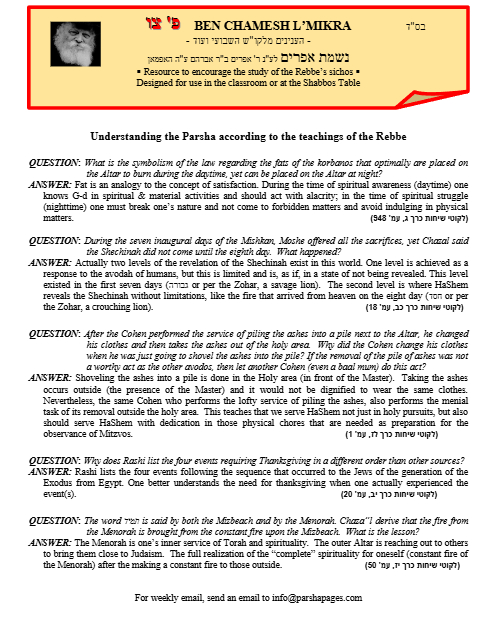
This week’s Torah portion discusses the laws of the burnt offering and the obligation that the sacrificial parts be totally consumed on top of the altar within a certain time frame. In discussing the specific parameters of this law, we gain insight into the “burning” of our own pleasures, physical and spiritual.

This week’s parsha continues the discussion of the laws of sacrifices. The opening verses deal with the laws that concern the burnt offering:

Text 1

And the Lord spoke to Moshe, saying, command Aharon and his sons, saying, this is the law of the burnt offering: That is the burnt offering which burns on the altar all night until morning, and the fire of the altar shall burn with it. Vayikra 6:1-2

Rashi makes the following comment on the verse and explains that the above wording indicates that the offering may be burnt throughout the night.

Text 2

This passage comes to teach us that the burning of [sacrificial] fats and parts [of an animal] is valid throughout the entire night [following the day it is offered up]. Rashi, ibid

Menachos 72a. While the Talmud states that the kohanim would indeed attempt to burn the fats and the limbs during the daytime—being that this was the actual time for the burning—in truth, they had all night for it to be consumed. This is the law as it is biblically—that one may burn offering until the following day. In practice though, there are two opinions regarding the time limit of this offering. The argument is based on the following Mishna:

Text 3

From what time may one recite the Shema in the evening? From the time that the priests enter [their house] in order to eat their terumah until the end of the first watch. These are the words of R. Eliezer. The Sages say until midnight. R. Gamliel says until the dawn. Wherever the Sages say until midnight, the precept may be performed until dawn comes up. The precept of burning the fat and the [sacrificial] pieces too, may be performed untill dawn comes up. Similarly, all [the offerings] that are to be eaten within one day may be lawfully consumed until the coming up of dawn. Why then, did the Sages say “until midnight?” In order to keep a man far from transgression. Mishna, Berachos 2a
נדפס לעילוי נשמת הרה"ת יהושע בן שמחה בונים בראנשטיין

This week’s Torah portion discusses the laws of the burnt offering and the obligation that the sacrificial parts be totally consumed on top of the altar within a certain time frame. In discussing the specific parameters of this law, we gain insight into the “burning” of our own pleasures, physical and spiritual.

This week’s parsha continues the discussion of the laws of sacrifices. The opening verses deal with the laws that concern the burnt offering:

Text 1

And the Lord spoke to Moshe, saying, command Aharon and his sons, saying, this is the law of the burnt offering: That is the burnt offering which burns on the altar all night until morning, and the fire of the altar shall burn with it. Vayikra 6:1-2

Rashi makes the following comment on the verse and explains that the above wording indicates that the offering may be burnt throughout the night.

Text 2

This passage comes to teach us that the burning of [sacrificial] fats and parts [of an animal] is valid throughout the entire night [following the day it is offered up]. Rashi, ibid

Menachos 72a. While the Talmud states that the kohanim would indeed attempt to burn the fats and the limbs during the daytime—being that this was the actual time for the burning—in truth, they had all night for it to be consumed. This is the law as it is biblically—that one may burn offering until the following day. In practice though, there are two opinions regarding the time limit of this offering. The argument is based on the following Mishna:

Text 3

From what time may one recite the Shema in the evening? From the time that the priests enter [their house] in order to eat their terumah until the end of the first watch. These are the words of R. Eliezer. The Sages say until midnight. R. Gamliel says until the dawn. Wherever the Sages say until midnight, the precept may be performed until dawn comes up. The precept of burning the fat and the [sacrificial] pieces too, may be performed untill dawn comes up. Similarly, all [the offerings] that are to be eaten within one day may be lawfully consumed until the coming up of dawn. Why then, did the Sages say “until midnight?” In order to keep a man far from transgression. Mishna, Berachos 2a

PDF Preview