Parshas Vaera A True Redemption
Ben Chamesh L'Mikra | January 08, 2024
Print This Article
View Original PDF

Parshas Vaera A True Redemption

Ben Chamesh L'Mikra | December 10, 2025

Parshas Vaera
A True Redemption

The Almighty let Moshe know that He would reveal Himself to him with the holy name of YKVK. Additionally, G-d specifically contrasted this revelation with that of which was revealed to the Patriarchs. This Sicha uncovers the meaning and significance behind these two names of G-d, and the inherent connection with the exodus of the Jewish people from Egypt.

In the opening of the Torah portion G-d answers the question which Moshe posed at the end of last week’s portion, Parshas Shemos. Moshe had gone to Pharaoh to demand the release of his people from bondage. Yet, instead of Pharaoh acquiescing to Moshe’s demand, he placed a greater burden on the backs of his Israelite slaves. Pharoah demanded that although the Israelites were previously given the straw with which to make bricks, they must now gather the straw themselves, while at the same time, not decrease their daily quota of production. Moshe, upset that his words had only exacerbated the affliction of his people, returned to the Almighty and declared: “My Lord, why have You done evil to this people? Why have You sent me?” Moshe tells the Almighty that since his coming to Pharaoh, the predicament of the Israelites had worsened, yet G-d had not saved them. The present Torah portion opens with G-d’s rejoinder to Moshe’s accusation that He has done nothing for his people:

Text 1
G-d spoke to Moshe, and He said to him, "I am HaShem. I appeared to Avraham, to Yitzchak, and to Yaakov as Keil Shakai, but with My name HaShem (YKVK), I did not make Myself known to them. Moreover, I established My covenant with them to give them the land of Canaan, the land of their sojourning, in which they sojourned. Moreover, I heard the groan of the Children of Israel, whom Egypt enslaves, and I remembered My covenant. Therefore, say to the Children of Israel, 'I am HaShem (YKVK), and I will take you out from under the burdens of the Egyptians, and I will save you from their labor, and I will redeem you with an outstretched arm and with great judgments. And I will take you to Me as a people, and I will be a G-d to you, and you will know that I am HaShem (YKVK) your G-d, Who has brought you out from under the burdens of the Egyptians.’
Shemos 6:2-6

The basic intent of the verse connotes G-d’s message to Moshe not to be concerned whether or not G-d will redeem His people from bondage. G-d tells Moshe that whereas previously the time for the redemption had not yet arrived, now has come the time which He had promised to the Patriarchs, and now He will redeem His people. There is, though, a curious statement in this verse which demands additional clarification. When G-d relays to Moshe that the time of the Jewish people’s redemption has arrived, G-d prefaces His words by telling Moshe that although He is revealing Himself to him—as per His statement, “I am HaShem”—He did not reveal Himself to the Patriarchs—Avraham, Yitzchak or Yaakov. The Almiighty declares: “I am HaShem. I appeared to Avraham, to Yitzchak, and to Yaakov as Keil Shakai, but with My name HaShem (YKVK), I did not make Myself known to them.” He makes it abundantly clear that the way in which He is expressing Himself to Moshe is not something that the Patriarchs merited to experience. Why is it pertinent for the Almighty to tell Moshe that He didn’t reveal Himself as HaShem (YKVK) to the Forefathers, and that He rather used the identity of Keil Shakai, in His revelation of Himself? What difference does it make regarding which name the Almighty used in His expression to Moshe or to the Patriarchs? Rashi explains, that with G-d telling Moshe, “I am HaShem (YKVK),” He was explaining the focal difference between Moshe and his predecessors. G-d was expressing to Moshe that though He had not fulfilled His assurance to his forbearers, and that they never saw the execution of His promises, He will now honor His word and His faithfulness will be clear.

Text 2
It is not written here, “but My Name HaShem I did not make known to them,” rather, “I did not become known.” [I.e.,] I was not recognized by them with My true attribute, by dint of which My name is called HaShem (YKVK), [which means that I am] faithful to verify My words, for I made promises to them, but I did not fulfill [them while they were alive].
Rashi, Shemos 6:3

The Almighty was essentially telling Moshe, that only now was He making known His attribute of faithfulness, which had previously not been known to the Partriarchs, and therefore it is now that He will redeem His people. Rashi’s explanation however, does not answer multiple issues observed when examining the verse.

  1. Why is it pertinent for G-d to tell Moshe now what He didn’t reveal to the Patriarchs? Doesn’t it make more sense to explain what He will do, rather than say what He didn’t do?
  2. Everything that is written in the Torah is an eternal lesson for all generations. This being the case, what is the pertinent lesson that we are to learn from the fact that G-d did not reveal Himself with the name of HaShem to the Patriarchs?
  3. There seem to be superfluous words in the verse. G-d said, “I appeared to Avraham, to Yitzchak, and to Yaakov.” These words, “to,” seem to be unnecessary, as it should have said simply, “I appeared to your forbearers,” or “I appeared to Avraham, Yitzchak and Yaakov.”

What can be learned in the verse’s specifying and separating of each of the patriarchs from one another?

I am G-d

In Chassidic thought it is explained, that in the words “G-d spoke to Moshe, and He said to him, ‘I am HaShem (YKVK)’” is embedded the answer to Moshe’s original query—“why have You done evil to this people? Why have You sent me?”

With these word of “I am HaShem (YKVK),” G-d was not only comforting Moshe for the terrible persecution that the Jewish people were enduring, and informing him that now He would redeem His people. He was also explaining to Moshe the reason that the suffering was necessary. The verse stresses numerous times, the name of HaShem (YKVK). G-d’s statement begins with “I am HaShem (YKVK),” and continues, “Therefore, say to the Children of Israel, 'I am HaShem (YKVK).’” Still, G-d concludes His oration with the words, “and you will know that I am HaShem (YKVK) your G-d.” G-d’s expression of Himself in the form of HaShem (YKVK) is repeated four times throughout these few verses. It is because the Almighty was revealing Himself with the name HaShem (YKVK) that necessitated the arduous slavery in Egypt. When G-d reveals Himself with a certain name, it is not only that He is using this particular name to introduce Himself, but more importantly, He is expressing Himself in the specific manner that is embedded in that specific name. The difference between Moshe and the Patriarchs was in the G-dly revelation that they each respectively experienced. The revelation of G-dliness in the manner of HaShem (YKVK) was so tremendous, that G-d did not reveal Himself in this manner, even to the Patriarchs. As the verse says, “but with My name HaShem (YKVK), I did not make Myself known to them.” The Patriarchs beheld the revelation of G-d through the name Keil Shakai, but the name HaShem (YKVK) was too deep for them to relate to.

The two names

The difference between the two names of G-d is as follows: Whereas the name HaShem (YKVK) is the true expression of G-d, the name Keil Shakai is an expression of G-dliness in a contracted form, through which it can relate to the world. When G-d reveals Himself to Avraham in order to make a covenant with him, and to his name (thereby changing his destiny), He tells him: “I am Keil Shakai ; walk before Me and be perfect.” G-d uses the name Shakai (ש-ד-י) in His expression of Himself to Avraham. The Talmud explains the specific intent of this particular name of G-d:

Text 3
And that, too, is what Resh Lakish said: “What is the meaning of the verse, ‘I am Keil Shakai (ש-ד-י)?’ [It means], I am He that said to the world, ‘Enough (די)!’” Resh Lakish said: “When the Holy One, blessed be He, created the sea, it went on expanding until the Holy One, blessed be He, rebuked it and caused it to dry up, for it is said: ‘He rebukes the sea and makes it dry, and dries up all the rivers.’”
Talmud, Chagiga 12b

The name Shakai indicates that an expression of G-d is in the way that the Almighty lowers Himself to interact with the creation that is defined with finite limitations. This is not an infinite expression of G-d, but it is rather the way that G-d interacts with the finite.

Nachum 1:4.

The name HaShem (YKVK) though, is an expression of the way that G-dliness transcends the limitations of the world and is, so to speak, an expression of the Almighty Himself.

Text 4
The name HaShem (YKVK) indicates that G-d transcends time, for "He was, He is, and He will be at the same instant."
Tanya, Sha-ar HaYichud VehaEmuna, Ch. 7

In order for the Jewish people to merit such a deep revelation, which even the Patriarchs did not merit, there first needed to be a period in which G-dliness was concealed, during the time of the Egyptian slavery. Only afterwards was it possible for the revelation of HaShem to be manifest. This is so, since when a person is trying to reach a higher level there is an interim period where all revelation is concealed. G-d was not only consoling Moshe and informing him that the Jewish people would now be redeemed. G-d was explaining as well, the need for the exile to begin with.

The Patriarchs

When G-d told Moshe, “I am HaShem. I appeared to Avraham, to Yitzchak, and to Yaakov as Keil Shakai (ש-ד-י), but with My name HaShem (YKVK), I did not make Myself known to them,” He was explaining to Moshe the essence of the redemption from Egypt. The quintessence of redemption is the revelation and the knowledge of G-d, in the way He reveals Himself using the name HaShem (YKVK).

The redemption was not merely to free the Jewish people from a material servitude and provide them physical emancipation, but it was primarily a spiritual redemption.

Text 5
And He said, "For I will be with you, and this is the sign for you that it was I Who sent you. When you take the people out of Egypt, you will worship G-d on this mountain."
Shemos 3:12

Furthermore, the purpose of the redemption was not only to bring them from physical enslavement to a spiritual freedom in the service of G-d. Rather, the objective and goal of the spiritual emancipation was to reveal the name of HaShem (YKVK). This is the innermost intent regarding the verse’s lengthy description of the verse concerning the Forefathers. The verse says, “I am HaShem. I appeared to Avraham, to Yitzchak, and to Yaakov as Keil Shakai, but with My name HaShem (YKVK), I did not make Myself known to them.” The reason for this portrayal is because therein lies the reason for exile and the crux of the redemption.
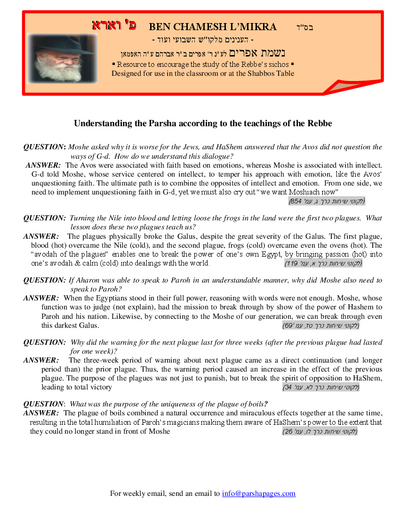

Parshas Vaera
A True Redemption

The Almighty let Moshe know that He would reveal Himself to him with the holy name of YKVK. Additionally, G-d specifically contrasted this revelation with that of which was revealed to the Patriarchs. This Sicha uncovers the meaning and significance behind these two names of G-d, and the inherent connection with the exodus of the Jewish people from Egypt.

In the opening of the Torah portion G-d answers the question which Moshe posed at the end of last week’s portion, Parshas Shemos. Moshe had gone to Pharaoh to demand the release of his people from bondage. Yet, instead of Pharaoh acquiescing to Moshe’s demand, he placed a greater burden on the backs of his Israelite slaves. Pharoah demanded that although the Israelites were previously given the straw with which to make bricks, they must now gather the straw themselves, while at the same time, not decrease their daily quota of production. Moshe, upset that his words had only exacerbated the affliction of his people, returned to the Almighty and declared: “My Lord, why have You done evil to this people? Why have You sent me?” Moshe tells the Almighty that since his coming to Pharaoh, the predicament of the Israelites had worsened, yet G-d had not saved them. The present Torah portion opens with G-d’s rejoinder to Moshe’s accusation that He has done nothing for his people:

Text 1
G-d spoke to Moshe, and He said to him, "I am HaShem. I appeared to Avraham, to Yitzchak, and to Yaakov as Keil Shakai, but with My name HaShem (YKVK), I did not make Myself known to them. Moreover, I established My covenant with them to give them the land of Canaan, the land of their sojourning, in which they sojourned. Moreover, I heard the groan of the Children of Israel, whom Egypt enslaves, and I remembered My covenant. Therefore, say to the Children of Israel, 'I am HaShem (YKVK), and I will take you out from under the burdens of the Egyptians, and I will save you from their labor, and I will redeem you with an outstretched arm and with great judgments. And I will take you to Me as a people, and I will be a G-d to you, and you will know that I am HaShem (YKVK) your G-d, Who has brought you out from under the burdens of the Egyptians.’
Shemos 6:2-6

The basic intent of the verse connotes G-d’s message to Moshe not to be concerned whether or not G-d will redeem His people from bondage. G-d tells Moshe that whereas previously the time for the redemption had not yet arrived, now has come the time which He had promised to the Patriarchs, and now He will redeem His people. There is, though, a curious statement in this verse which demands additional clarification. When G-d relays to Moshe that the time of the Jewish people’s redemption has arrived, G-d prefaces His words by telling Moshe that although He is revealing Himself to him—as per His statement, “I am HaShem”—He did not reveal Himself to the Patriarchs—Avraham, Yitzchak or Yaakov. The Almiighty declares: “I am HaShem. I appeared to Avraham, to Yitzchak, and to Yaakov as Keil Shakai, but with My name HaShem (YKVK), I did not make Myself known to them.” He makes it abundantly clear that the way in which He is expressing Himself to Moshe is not something that the Patriarchs merited to experience. Why is it pertinent for the Almighty to tell Moshe that He didn’t reveal Himself as HaShem (YKVK) to the Forefathers, and that He rather used the identity of Keil Shakai, in His revelation of Himself? What difference does it make regarding which name the Almighty used in His expression to Moshe or to the Patriarchs? Rashi explains, that with G-d telling Moshe, “I am HaShem (YKVK),” He was explaining the focal difference between Moshe and his predecessors. G-d was expressing to Moshe that though He had not fulfilled His assurance to his forbearers, and that they never saw the execution of His promises, He will now honor His word and His faithfulness will be clear.

Text 2
It is not written here, “but My Name HaShem I did not make known to them,” rather, “I did not become known.” [I.e.,] I was not recognized by them with My true attribute, by dint of which My name is called HaShem (YKVK), [which means that I am] faithful to verify My words, for I made promises to them, but I did not fulfill [them while they were alive].
Rashi, Shemos 6:3

The Almighty was essentially telling Moshe, that only now was He making known His attribute of faithfulness, which had previously not been known to the Partriarchs, and therefore it is now that He will redeem His people. Rashi’s explanation however, does not answer multiple issues observed when examining the verse.

  1. Why is it pertinent for G-d to tell Moshe now what He didn’t reveal to the Patriarchs? Doesn’t it make more sense to explain what He will do, rather than say what He didn’t do?
  2. Everything that is written in the Torah is an eternal lesson for all generations. This being the case, what is the pertinent lesson that we are to learn from the fact that G-d did not reveal Himself with the name of HaShem to the Patriarchs?
  3. There seem to be superfluous words in the verse. G-d said, “I appeared to Avraham, to Yitzchak, and to Yaakov.” These words, “to,” seem to be unnecessary, as it should have said simply, “I appeared to your forbearers,” or “I appeared to Avraham, Yitzchak and Yaakov.”

What can be learned in the verse’s specifying and separating of each of the patriarchs from one another?

I am G-d

In Chassidic thought it is explained, that in the words “G-d spoke to Moshe, and He said to him, ‘I am HaShem (YKVK)’” is embedded the answer to Moshe’s original query—“why have You done evil to this people? Why have You sent me?”

With these word of “I am HaShem (YKVK),” G-d was not only comforting Moshe for the terrible persecution that the Jewish people were enduring, and informing him that now He would redeem His people. He was also explaining to Moshe the reason that the suffering was necessary. The verse stresses numerous times, the name of HaShem (YKVK). G-d’s statement begins with “I am HaShem (YKVK),” and continues, “Therefore, say to the Children of Israel, 'I am HaShem (YKVK).’” Still, G-d concludes His oration with the words, “and you will know that I am HaShem (YKVK) your G-d.” G-d’s expression of Himself in the form of HaShem (YKVK) is repeated four times throughout these few verses. It is because the Almighty was revealing Himself with the name HaShem (YKVK) that necessitated the arduous slavery in Egypt. When G-d reveals Himself with a certain name, it is not only that He is using this particular name to introduce Himself, but more importantly, He is expressing Himself in the specific manner that is embedded in that specific name. The difference between Moshe and the Patriarchs was in the G-dly revelation that they each respectively experienced. The revelation of G-dliness in the manner of HaShem (YKVK) was so tremendous, that G-d did not reveal Himself in this manner, even to the Patriarchs. As the verse says, “but with My name HaShem (YKVK), I did not make Myself known to them.” The Patriarchs beheld the revelation of G-d through the name Keil Shakai, but the name HaShem (YKVK) was too deep for them to relate to.

The two names

The difference between the two names of G-d is as follows: Whereas the name HaShem (YKVK) is the true expression of G-d, the name Keil Shakai is an expression of G-dliness in a contracted form, through which it can relate to the world. When G-d reveals Himself to Avraham in order to make a covenant with him, and to his name (thereby changing his destiny), He tells him: “I am Keil Shakai ; walk before Me and be perfect.” G-d uses the name Shakai (ש-ד-י) in His expression of Himself to Avraham. The Talmud explains the specific intent of this particular name of G-d:

Text 3
And that, too, is what Resh Lakish said: “What is the meaning of the verse, ‘I am Keil Shakai (ש-ד-י)?’ [It means], I am He that said to the world, ‘Enough (די)!’” Resh Lakish said: “When the Holy One, blessed be He, created the sea, it went on expanding until the Holy One, blessed be He, rebuked it and caused it to dry up, for it is said: ‘He rebukes the sea and makes it dry, and dries up all the rivers.’”
Talmud, Chagiga 12b

The name Shakai indicates that an expression of G-d is in the way that the Almighty lowers Himself to interact with the creation that is defined with finite limitations. This is not an infinite expression of G-d, but it is rather the way that G-d interacts with the finite.

Nachum 1:4.

The name HaShem (YKVK) though, is an expression of the way that G-dliness transcends the limitations of the world and is, so to speak, an expression of the Almighty Himself.

Text 4
The name HaShem (YKVK) indicates that G-d transcends time, for "He was, He is, and He will be at the same instant."
Tanya, Sha-ar HaYichud VehaEmuna, Ch. 7

In order for the Jewish people to merit such a deep revelation, which even the Patriarchs did not merit, there first needed to be a period in which G-dliness was concealed, during the time of the Egyptian slavery. Only afterwards was it possible for the revelation of HaShem to be manifest. This is so, since when a person is trying to reach a higher level there is an interim period where all revelation is concealed. G-d was not only consoling Moshe and informing him that the Jewish people would now be redeemed. G-d was explaining as well, the need for the exile to begin with.

The Patriarchs

When G-d told Moshe, “I am HaShem. I appeared to Avraham, to Yitzchak, and to Yaakov as Keil Shakai (ש-ד-י), but with My name HaShem (YKVK), I did not make Myself known to them,” He was explaining to Moshe the essence of the redemption from Egypt. The quintessence of redemption is the revelation and the knowledge of G-d, in the way He reveals Himself using the name HaShem (YKVK).

The redemption was not merely to free the Jewish people from a material servitude and provide them physical emancipation, but it was primarily a spiritual redemption.

Text 5
And He said, "For I will be with you, and this is the sign for you that it was I Who sent you. When you take the people out of Egypt, you will worship G-d on this mountain."
Shemos 3:12

Furthermore, the purpose of the redemption was not only to bring them from physical enslavement to a spiritual freedom in the service of G-d. Rather, the objective and goal of the spiritual emancipation was to reveal the name of HaShem (YKVK). This is the innermost intent regarding the verse’s lengthy description of the verse concerning the Forefathers. The verse says, “I am HaShem. I appeared to Avraham, to Yitzchak, and to Yaakov as Keil Shakai, but with My name HaShem (YKVK), I did not make Myself known to them.” The reason for this portrayal is because therein lies the reason for exile and the crux of the redemption.

PDF Preview