Thanking Hashem for Affliction and Salvation
Inspired by a Story | January 15, 2026
Print This Article
View Original PDF

Thanking Hashem for Affliction and Salvation

Inspired by a Story | January 20, 2026

In Hallel we say the Passuk, “Odecha ki anisaoi vatehi li lishuah” - I thank you Hashem that you answered me and you were for me a salvation.

The translation of ‘Anisoni’ is ‘you answered me’. However, Anisoni has another translation based on the root of the word ‘Inah’ – to afflict. The Passuk has a completely different translation now. I thank you Hashem for afflicting me and you were for me a salvation.

We can understand David Hamelech thanking Hashem for answering him, but why was David Hamelech thanking Hashem for afflicting him?

The Be’er Mayim Chaim explains, that the end of the sentence explains the beginning.

David Hamelech came to the ultimate realization that everything Hashem does is for the best. If Hashem did something that on the surface looks bad, there must be a reason that in the future it will bring a benefit, either directly or indirectly.

Let us take one small example. We know that Yosef interpreted the dreams for the chief butler and chief baker. Yosef asked the chief butler to try and help him get freed. Chazal tell us that for someone so great like Yosef this was a flaw and was therefore punished with an additional two years in prison. To us this seems a punishment. The Lev Simcha (Gur) writes that although it was a punishment, a great benefit came out of it. After the two years Yosef became deputy king in Mitzrayim, something that otherwise wouldn’t have happened earlier.

David Hamelech thanked Hashem even for the troubles he went through because he was sure that it will bring him a salvation.

We find a similar approach in this week’s Parsha from the Meor Einayim. The last Pessukim of last week’s Parsha, Moshe complained to Hashem that after he went and spoke to Pharaoh, things got worse for Klal Yisrael and Hashem didn’t save Klal Yisrael.

By Rabbi Dovid Caro
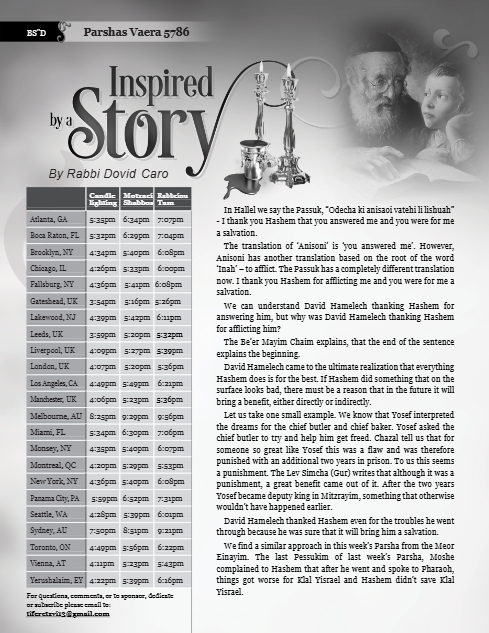
In Hallel we say the Passuk, “Odecha ki anisaoi vatehi li lishuah” - I thank you Hashem that you answered me and you were for me a salvation.

The translation of ‘Anisoni’ is ‘you answered me’. However, Anisoni has another translation based on the root of the word ‘Inah’ – to afflict. The Passuk has a completely different translation now. I thank you Hashem for afflicting me and you were for me a salvation.

We can understand David Hamelech thanking Hashem for answering him, but why was David Hamelech thanking Hashem for afflicting him?

The Be’er Mayim Chaim explains, that the end of the sentence explains the beginning.

David Hamelech came to the ultimate realization that everything Hashem does is for the best. If Hashem did something that on the surface looks bad, there must be a reason that in the future it will bring a benefit, either directly or indirectly.

Let us take one small example. We know that Yosef interpreted the dreams for the chief butler and chief baker. Yosef asked the chief butler to try and help him get freed. Chazal tell us that for someone so great like Yosef this was a flaw and was therefore punished with an additional two years in prison. To us this seems a punishment. The Lev Simcha (Gur) writes that although it was a punishment, a great benefit came out of it. After the two years Yosef became deputy king in Mitzrayim, something that otherwise wouldn’t have happened earlier.

David Hamelech thanked Hashem even for the troubles he went through because he was sure that it will bring him a salvation.

We find a similar approach in this week’s Parsha from the Meor Einayim. The last Pessukim of last week’s Parsha, Moshe complained to Hashem that after he went and spoke to Pharaoh, things got worse for Klal Yisrael and Hashem didn’t save Klal Yisrael.

By Rabbi Dovid Caro

PDF Preview