Trusting Hashem Positive Thinking
The Weekly Farbrengen | August 15, 2024
Print This Article
View Original PDF

Trusting Hashem Positive Thinking

The Weekly Farbrengen | June 25, 2025

What is the definition of bitachon? Rabbeinu Bechaye writes in Chovas HaLevavos that bitachon is complete peace of mind, a state in which a person is fully calm, knowing that he can rely on HaShem and trust in Him. When a person contemplates how HaShem loves him, cares for him, is able to fill his needs, and knows what is best for him; when he considers how HaShem alone monitors his life, and always does good even to those who are undeserving; – he will then feel full bitachon in Him. Such trust can be found only in HaShem, for any other option, such as mortal benefactors or financial security, can fail or discontinue.

(חובת הלבבות שער הבטחון פרק א)

When the revered mashpia, Reb Michoel Beliner (better known as Reb Michoel der Alter), was still a young man, his son fell deathly ill, and the doctors said that there was nothing they could do. Reb Michoel went to the local beis midrash and shared his bitter news with the chassidim who were there at the time. Doing their best to encourage him, they assured him that HaShem would surely have rachmonus, and advised him to travel immediately to the Rebbe, the Tzemach Tzedek. Reb Michoel began to weep, saying that he would strongly like to go, but the doctors said that it was only a matter of hours, so why should he set out on the road? One of the older chassidim berated him. He quoted from the Gemara that one should never despair of being granted HaShem's mercy, and added that surely the good malochim would succeed in having the Heavenly verdict postponed until he reached the Rebbe. One of those chassidishe yungeleit, a tailor, offered to join Reb Michoel on his trip, and together they set out on foot, here and there hitching a cheap wagonride.

Arriving at last in Lubavitch, Reb Michoel was fortunately able to be received for yechidus immediately.

He later related: "When I entered the Rebbe's room and handed him my pidyon nefesh for my son, I thought to myself, 'Who knows what has meanwhile happened with him? The doctors said it's only a few hours...,' and I began to weep. The Rebbe read the note and said, 'Don't cry. You must have bitachon in HaShem with simple emunah that He will save your son. Tracht gut vet zien gut. (Think good and things will be good.) You will yet celebrate the bar-mitzvas of your grandsons!' "

Soon after, the boy recovered completely. From then on, whenever Reb Michoel experienced difficulty he would bring to mind the luminous face of the Rebbe as he spoke those words, and the situation would change for the better.

(לקו"ד ח"א ע' קנט, אג"ק ריי"צ ח"ז ע' קצז)

The Rebbe explains that when a person places his full trust in HaShem, feeling fully at ease with complete bitachon, that is enough for him to merit HaShem's salvation. This is true even for someone who is seemingly undeserving, for this avodah of bitachon alone gives him the merit to be helped. That is the deeper message of the words of the Tzemach Tzedek, "Tracht gut" – "Think good and things will be good."

(לקו"ש חל"ו ע' 4)
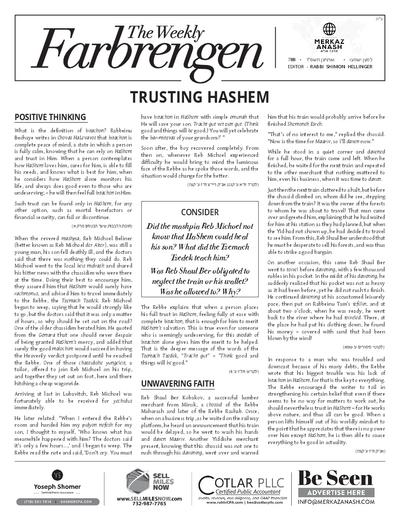
What is the definition of bitachon? Rabbeinu Bechaye writes in Chovas HaLevavos that bitachon is complete peace of mind, a state in which a person is fully calm, knowing that he can rely on HaShem and trust in Him. When a person contemplates how HaShem loves him, cares for him, is able to fill his needs, and knows what is best for him; when he considers how HaShem alone monitors his life, and always does good even to those who are undeserving; – he will then feel full bitachon in Him. Such trust can be found only in HaShem, for any other option, such as mortal benefactors or financial security, can fail or discontinue.

(חובת הלבבות שער הבטחון פרק א)

When the revered mashpia, Reb Michoel Beliner (better known as Reb Michoel der Alter), was still a young man, his son fell deathly ill, and the doctors said that there was nothing they could do. Reb Michoel went to the local beis midrash and shared his bitter news with the chassidim who were there at the time. Doing their best to encourage him, they assured him that HaShem would surely have rachmonus, and advised him to travel immediately to the Rebbe, the Tzemach Tzedek. Reb Michoel began to weep, saying that he would strongly like to go, but the doctors said that it was only a matter of hours, so why should he set out on the road? One of the older chassidim berated him. He quoted from the Gemara that one should never despair of being granted HaShem's mercy, and added that surely the good malochim would succeed in having the Heavenly verdict postponed until he reached the Rebbe. One of those chassidishe yungeleit, a tailor, offered to join Reb Michoel on his trip, and together they set out on foot, here and there hitching a cheap wagonride.

Arriving at last in Lubavitch, Reb Michoel was fortunately able to be received for yechidus immediately.

He later related: "When I entered the Rebbe's room and handed him my pidyon nefesh for my son, I thought to myself, 'Who knows what has meanwhile happened with him? The doctors said it's only a few hours...,' and I began to weep. The Rebbe read the note and said, 'Don't cry. You must have bitachon in HaShem with simple emunah that He will save your son. Tracht gut vet zien gut. (Think good and things will be good.) You will yet celebrate the bar-mitzvas of your grandsons!' "

Soon after, the boy recovered completely. From then on, whenever Reb Michoel experienced difficulty he would bring to mind the luminous face of the Rebbe as he spoke those words, and the situation would change for the better.

(לקו"ד ח"א ע' קנט, אג"ק ריי"צ ח"ז ע' קצז)

The Rebbe explains that when a person places his full trust in HaShem, feeling fully at ease with complete bitachon, that is enough for him to merit HaShem's salvation. This is true even for someone who is seemingly undeserving, for this avodah of bitachon alone gives him the merit to be helped. That is the deeper message of the words of the Tzemach Tzedek, "Tracht gut" – "Think good and things will be good."

(לקו"ש חל"ו ע' 4)

PDF Preview