Baking Matzos
Chukai Chaim | March 21, 2025
Print This Article
View Original PDF

Baking Matzos

Chukai Chaim | June 27, 2025

The Dough

Becoming Chometz

1. After making the dough, optimally one should be working with the dough without a moment's pause until baking it to prevent it from becoming chometz. As long as one is working with it, even all day, it does not become chometz (שו"ע תנט ס"ב ).

Lapse in Activity Before Forming the Matzah

2. If, before the dough was flattened, it sat untouched for 18 minutes, it is chometz (שו"ע ומ"ב שם ), even if it does not display signs of chometz (מ"ב סקי"ד ). There are a few poskim who hold that time spent working with the dough is included in the 18 minutes (ריא"ז הובא בב"ח שם, ערוה"ש שם ס"ח ).

3. If one is unsure if 18 minutes have elapsed, as long as the dough does not display signs of chometz [i.e., the dough's surface has not paled], one does not need to be concerned, perhaps the time has elapsed. (חזו"א או"ח קכב סק"ט ).

Lapse After Starting to Form the Matzah

4. If one flattened the dough and warmed it with his hands and then put it down, it immediately becomes chometz (שו"ע שם ). This means that the dough becomes chometz as soon as it leaves his hands (מ"ב סקי"ח ). Most people are not so careful about this. Perhaps "immediately" is not literal; rather it means after a short time (מ"ב שם ) or after a few moments (ביאה"ל תסא ס"ג ד"ה ויש ).

5. It is unclear what constitutes "a short time" or "a few moments." It cannot mean that it becomes chometz after only a few seconds. If the dough was motionless for less than 30 seconds [the amount of time it takes to make a new dough, which the Mishna Berura (סקמ"ג ) permits bedieved], it is definitely not forbidden, especially in light of the fact that some hold the Rama is of the opinion that although it is preferable to avoid letting the dough sit, if it did, it is not forbidden (חזו"א או"ח קכא סקט"ז ). If it sat for 30 seconds, its status starts getting questionable.

Multiple Shorter Lapses

6. Some say that if the dough sat still for a sum total of 18 minutes, even if it never sat for one full 18-minute period, it is forbidden because multiple shorter lapses add up (מהרי"ל ). Therefore, one should hurry when making matzos (רמ"א שם ס"ב ).

7. Some hold that substantial activity with the dough [e.g., mixing, kneading, pounding, or flattening] nullifies a prior lapse in activity, and it does not combine with subsequent lapses. However, minor activity [e.g. cutting, or perforating], although not itself considered a lapse which can cause the dough to become chometz, does not nullify prior lapses (תרומת הדשן קכג הובא במ"ב סקט"ז ).

Types of Activity

8. Only working with the whole dough – not part of it – prevents it from becoming chometz. Also, slow motion movement or stroking the dough is not considered activity. In fact, the dough is more likely to become chometz when warmed by the hands (מ"ב סקכ"ב ).

9. Therefore, the one in charge of cutting the dough must take great care to constantly work with all the dough until he passes along the pieces to get flattened. Still, it is better for the dough to sit still than for him to gently roll or stroke it. Similarly, if matzos waiting to get perforated are accumulating, it is better that they sit still than get stroked or tapped lightly. The best would be to avoid accumulation of matzos by appointing a second person perforating.

Blood

10. Anyone involved in making matzos should be sure not to have a wound producing blood on his hands which may get into the dough and cause it to become chometz faster, as fruit juice does (שו"ע תסב ס"ב ). If one has a wound, he should bandage it, replacing the bandage every 18 minutes, similar to the halacha regarding the tablecloth (מ"ב תנא סקק"ח ). One should not put any cream on his hands while working with matzos.

Quantity of Dough

11. One should not knead a quantity of dough for matzos greater than that which requires hafroshas challah – the volume of 43.2 average-sized eggs (שו"ע או"ח תנו ), because Chazal estimated that the normal work one person does when making dough will not prevent it from becoming chometz in such a quantity (מ"ב סק"א ). Bedieved, however, it is permissible (שו"ע ס"ב ).

12. In modern-day terms, one should not knead more than 1.25 kg. [Rav Chaim Naeh] or 1.2 kg. [Chazon Ish], which are the amounts requiring hafroshas challah without a bracha [Issue 14, Halacha 8]. Some hold that one should not knead more than 1 kg. of flour at a time (קובץ אגרות לחזו"א ח"א אגרת קפ"ה אות ח ).

13. Some poskim hold, that only applied back then, but nowadays that matzos are made in large groups of people working very quickly, using rolling pins, and in very large ovens, one can bake more than the above amount at one time, as is common practice (מ"ב סק"ז ). However, a yerei shamayim should be machmir even today (מ"ב ).

14. Machine matzos. Some permit making more than the above amount in a machine, because machines are powerful and work the dough more vigorously than a person can (שו"ת מנח"י ח"ג קמ אות יז ). One may make up to three kav (שעה"צ סק" י ) [Rav Chaim Naeh – approx. 4 kg.; Chazon Ish – approx. 7 kg.], as long as it can be made within 18 minutes. Some allow even more than that in a machine. (הליכות שלמה פסח פ"ז דבר הלכה אות טז ).

Adding Flour

15. After making the dough, one may not add flour (שו"ע תנט ס" ו ) because it may not get mixed into the dough and fully baked, and may then fall into soup on Pesach and become chometz (מ"ב סקמ"ב ).

16. If the dough is too soft, someone else (מ"ב סקמ"ג ) should make a piece of thicker dough and mix that with the soft dough (שו"ע שם ).

17. This halacha only applies to those who eat gebrochts. Those who are careful not to eat gebrochts need not be careful with this, because even if some flour is not fully baked, it cannot become chometz without soaking in liquid (כמבואר במ"ב סקמ"ד ).

18. Machine matzos. It used to be common in machine matzah factories – even ones with a good hechsher – for flour to fall into the vat of dough after the start of the kneading. In such a case, it would be forbidden to put that matzah into hot liquid.

19. Therefore, even those who generally eat gebrochts on Pesach may not eat these matzos as gebrochts (כ"ק מרן גאב"ד ירושלים זי''ע בדרשת שבת הגדול לפני כמה שנים ). However, if the matzah fell into a dish, or one put it into a dish not knowing this halacha, it is not forbidden bedieved (מ"ב סקמ"ד ). Today this problem has been rectified.
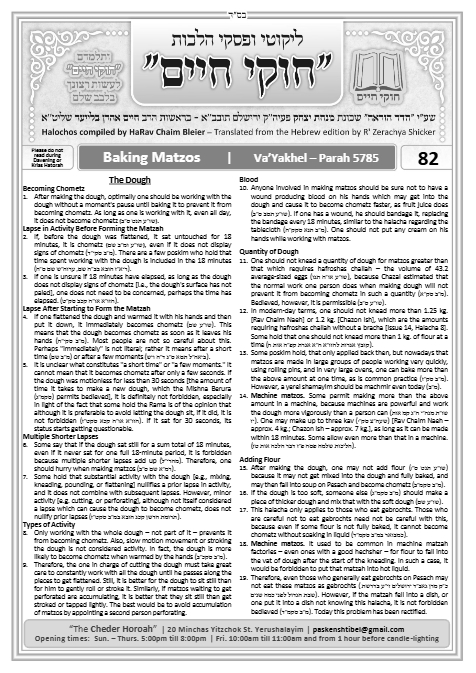
The Dough

Becoming Chometz

1. After making the dough, optimally one should be working with the dough without a moment's pause until baking it to prevent it from becoming chometz. As long as one is working with it, even all day, it does not become chometz (שו"ע תנט ס"ב ).

Lapse in Activity Before Forming the Matzah

2. If, before the dough was flattened, it sat untouched for 18 minutes, it is chometz (שו"ע ומ"ב שם ), even if it does not display signs of chometz (מ"ב סקי"ד ). There are a few poskim who hold that time spent working with the dough is included in the 18 minutes (ריא"ז הובא בב"ח שם, ערוה"ש שם ס"ח ).

3. If one is unsure if 18 minutes have elapsed, as long as the dough does not display signs of chometz [i.e., the dough's surface has not paled], one does not need to be concerned, perhaps the time has elapsed. (חזו"א או"ח קכב סק"ט ).

Lapse After Starting to Form the Matzah

4. If one flattened the dough and warmed it with his hands and then put it down, it immediately becomes chometz (שו"ע שם ). This means that the dough becomes chometz as soon as it leaves his hands (מ"ב סקי"ח ). Most people are not so careful about this. Perhaps "immediately" is not literal; rather it means after a short time (מ"ב שם ) or after a few moments (ביאה"ל תסא ס"ג ד"ה ויש ).

5. It is unclear what constitutes "a short time" or "a few moments." It cannot mean that it becomes chometz after only a few seconds. If the dough was motionless for less than 30 seconds [the amount of time it takes to make a new dough, which the Mishna Berura (סקמ"ג ) permits bedieved], it is definitely not forbidden, especially in light of the fact that some hold the Rama is of the opinion that although it is preferable to avoid letting the dough sit, if it did, it is not forbidden (חזו"א או"ח קכא סקט"ז ). If it sat for 30 seconds, its status starts getting questionable.

Multiple Shorter Lapses

6. Some say that if the dough sat still for a sum total of 18 minutes, even if it never sat for one full 18-minute period, it is forbidden because multiple shorter lapses add up (מהרי"ל ). Therefore, one should hurry when making matzos (רמ"א שם ס"ב ).

7. Some hold that substantial activity with the dough [e.g., mixing, kneading, pounding, or flattening] nullifies a prior lapse in activity, and it does not combine with subsequent lapses. However, minor activity [e.g. cutting, or perforating], although not itself considered a lapse which can cause the dough to become chometz, does not nullify prior lapses (תרומת הדשן קכג הובא במ"ב סקט"ז ).

Types of Activity

8. Only working with the whole dough – not part of it – prevents it from becoming chometz. Also, slow motion movement or stroking the dough is not considered activity. In fact, the dough is more likely to become chometz when warmed by the hands (מ"ב סקכ"ב ).

9. Therefore, the one in charge of cutting the dough must take great care to constantly work with all the dough until he passes along the pieces to get flattened. Still, it is better for the dough to sit still than for him to gently roll or stroke it. Similarly, if matzos waiting to get perforated are accumulating, it is better that they sit still than get stroked or tapped lightly. The best would be to avoid accumulation of matzos by appointing a second person perforating.

Blood

10. Anyone involved in making matzos should be sure not to have a wound producing blood on his hands which may get into the dough and cause it to become chometz faster, as fruit juice does (שו"ע תסב ס"ב ). If one has a wound, he should bandage it, replacing the bandage every 18 minutes, similar to the halacha regarding the tablecloth (מ"ב תנא סקק"ח ). One should not put any cream on his hands while working with matzos.

Quantity of Dough

11. One should not knead a quantity of dough for matzos greater than that which requires hafroshas challah – the volume of 43.2 average-sized eggs (שו"ע או"ח תנו ), because Chazal estimated that the normal work one person does when making dough will not prevent it from becoming chometz in such a quantity (מ"ב סק"א ). Bedieved, however, it is permissible (שו"ע ס"ב ).

12. In modern-day terms, one should not knead more than 1.25 kg. [Rav Chaim Naeh] or 1.2 kg. [Chazon Ish], which are the amounts requiring hafroshas challah without a bracha [Issue 14, Halacha 8]. Some hold that one should not knead more than 1 kg. of flour at a time (קובץ אגרות לחזו"א ח"א אגרת קפ"ה אות ח ).

13. Some poskim hold, that only applied back then, but nowadays that matzos are made in large groups of people working very quickly, using rolling pins, and in very large ovens, one can bake more than the above amount at one time, as is common practice (מ"ב סק"ז ). However, a yerei shamayim should be machmir even today (מ"ב ).

14. Machine matzos. Some permit making more than the above amount in a machine, because machines are powerful and work the dough more vigorously than a person can (שו"ת מנח"י ח"ג קמ אות יז ). One may make up to three kav (שעה"צ סק" י ) [Rav Chaim Naeh – approx. 4 kg.; Chazon Ish – approx. 7 kg.], as long as it can be made within 18 minutes. Some allow even more than that in a machine. (הליכות שלמה פסח פ"ז דבר הלכה אות טז ).

Adding Flour

15. After making the dough, one may not add flour (שו"ע תנט ס" ו ) because it may not get mixed into the dough and fully baked, and may then fall into soup on Pesach and become chometz (מ"ב סקמ"ב ).

16. If the dough is too soft, someone else (מ"ב סקמ"ג ) should make a piece of thicker dough and mix that with the soft dough (שו"ע שם ).

17. This halacha only applies to those who eat gebrochts. Those who are careful not to eat gebrochts need not be careful with this, because even if some flour is not fully baked, it cannot become chometz without soaking in liquid (כמבואר במ"ב סקמ"ד ).

18. Machine matzos. It used to be common in machine matzah factories – even ones with a good hechsher – for flour to fall into the vat of dough after the start of the kneading. In such a case, it would be forbidden to put that matzah into hot liquid.

19. Therefore, even those who generally eat gebrochts on Pesach may not eat these matzos as gebrochts (כ"ק מרן גאב"ד ירושלים זי''ע בדרשת שבת הגדול לפני כמה שנים ). However, if the matzah fell into a dish, or one put it into a dish not knowing this halacha, it is not forbidden bedieved (מ"ב סקמ"ד ). Today this problem has been rectified.

PDF Preview