No More Donations
Parsha Halacha | March 08, 2024
Print This Article
View Original PDF

No More Donations

Parsha Halacha | June 27, 2025

In the Torah portion of Vaykahel, we read about how Moshe Rabeinu instructed the Jewish people to donate materials for the Mishkan. The people gave so enthusiastically that within a few days Moshe announced that they should stop donating. As the verse says,

“Moshe had this proclamation made throughout the camp: ‘Let no man or woman make further effort [אַל יַעֲשׂוּ עוֹד מְלָאכָה ] toward gifts for the Sanctuary!’ So, the people stopped bringing.”

The commentaries wonder why Moshe didn’t accept the extra donations and instruct that they be used for the upkeep of the Mishkan. (This is called bedek HaBayit – repairing the house.)

Several explanations have been given:

  • The Seforno says that Moshe only meant that they should stop doing the work involved in making the Mishkan such as spinning the goat’s hair. (He translates the words אַל יַעֲשׂוּ עוֹד מְלָאכָה to be referring to the work on the Mishkan and not to donating.) But they were still welcome to bring donations.
  • The Chidushei HaRim (the first Gerrer Rebbe of 19th Century Poland) explains that if people would give donations and those donations would not be used in the building of the Mishkan, they would be upset that their offering had been “rejected.” As such, all of the donations had to go towards the building of the Mishkan. Although the verse states that there were extra donations, G-d miraculously caused these to “fit” into the Mishkan so that no donation should be left out.
  • Rabbinu Bachaye writes that Moshe didn’t want to keep any of the gold or silver for himself nor to give any appearance that he might be doing so. This is why he stopped the donations once there was enough.
  • According to the Talmud, Moshe told the people to stop bringing donations because it was (almost) Shabbat and they were carrying the donations from their private domains to the public domain (where Moshe was accepting them) which is forbidden on Shabbat. This explanation is derived from the fact that the word וַיַעֲבִירוּ [And they made an announcement] is similar to the word used regarding Yom Kippur (וְהַַֽעֲבַרְתָ שׁוֹפַר תְרוּעָה – “You should make a Shofar blast heard”), which is also a day on which work is forbidden.

Why Was It Shabbat?

The Ba’al HaTurim explains that since the Torah was given on Shabbat, the following 6th of Tishrei (Yom Kippur), which is when Moshe came down the mountain with the second tablets, was a Tuesday.

The next day, Wednesday, is when Moshe assembled the people and told the people to donate to the Mishkan which they immediately began to do and continued to do for the next two mornings, Thursday and Friday, as the verse says, “They continued to bring donations to him morning after morning.” The following day was Shabbat, which is why Moshe announced that all of the donations should cease. The Talmud says that this verse is the source for the prohibition of carrying on Shabbat.

As the verse (36:7) says: וְהוֹתַֽר – "And there was extra.” The extra donations (brought before the announcement) were used for the Bedek haBayit (Ramban).

Although all of the forbidden labors on Shabbat are derived from the labors done when building the Mishkan and, in order to set up the Mishkan, it was necessary for the Levites to carry all of the building materials (see Shabbat 49b), we still need a special verse to teach us that carrying is forbidden. This is because carrying is considered an inferior type of labor insofar as it doesn’t change the object involved (Tosfot D.H. Hotza’ah on Shabbat ibid).
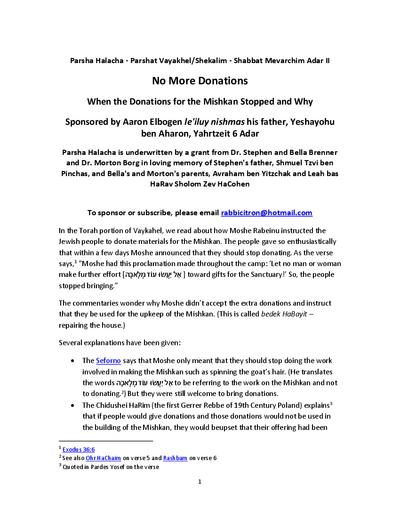

In the Torah portion of Vaykahel, we read about how Moshe Rabeinu instructed the Jewish people to donate materials for the Mishkan. The people gave so enthusiastically that within a few days Moshe announced that they should stop donating. As the verse says,

“Moshe had this proclamation made throughout the camp: ‘Let no man or woman make further effort [אַל יַעֲשׂוּ עוֹד מְלָאכָה ] toward gifts for the Sanctuary!’ So, the people stopped bringing.”

The commentaries wonder why Moshe didn’t accept the extra donations and instruct that they be used for the upkeep of the Mishkan. (This is called bedek HaBayit – repairing the house.)

Several explanations have been given:

  • The Seforno says that Moshe only meant that they should stop doing the work involved in making the Mishkan such as spinning the goat’s hair. (He translates the words אַל יַעֲשׂוּ עוֹד מְלָאכָה to be referring to the work on the Mishkan and not to donating.) But they were still welcome to bring donations.
  • The Chidushei HaRim (the first Gerrer Rebbe of 19th Century Poland) explains that if people would give donations and those donations would not be used in the building of the Mishkan, they would be upset that their offering had been “rejected.” As such, all of the donations had to go towards the building of the Mishkan. Although the verse states that there were extra donations, G-d miraculously caused these to “fit” into the Mishkan so that no donation should be left out.
  • Rabbinu Bachaye writes that Moshe didn’t want to keep any of the gold or silver for himself nor to give any appearance that he might be doing so. This is why he stopped the donations once there was enough.
  • According to the Talmud, Moshe told the people to stop bringing donations because it was (almost) Shabbat and they were carrying the donations from their private domains to the public domain (where Moshe was accepting them) which is forbidden on Shabbat. This explanation is derived from the fact that the word וַיַעֲבִירוּ [And they made an announcement] is similar to the word used regarding Yom Kippur (וְהַַֽעֲבַרְתָ שׁוֹפַר תְרוּעָה – “You should make a Shofar blast heard”), which is also a day on which work is forbidden.

Why Was It Shabbat?

The Ba’al HaTurim explains that since the Torah was given on Shabbat, the following 6th of Tishrei (Yom Kippur), which is when Moshe came down the mountain with the second tablets, was a Tuesday.

The next day, Wednesday, is when Moshe assembled the people and told the people to donate to the Mishkan which they immediately began to do and continued to do for the next two mornings, Thursday and Friday, as the verse says, “They continued to bring donations to him morning after morning.” The following day was Shabbat, which is why Moshe announced that all of the donations should cease. The Talmud says that this verse is the source for the prohibition of carrying on Shabbat.

As the verse (36:7) says: וְהוֹתַֽר – "And there was extra.” The extra donations (brought before the announcement) were used for the Bedek haBayit (Ramban).

Although all of the forbidden labors on Shabbat are derived from the labors done when building the Mishkan and, in order to set up the Mishkan, it was necessary for the Levites to carry all of the building materials (see Shabbat 49b), we still need a special verse to teach us that carrying is forbidden. This is because carrying is considered an inferior type of labor insofar as it doesn’t change the object involved (Tosfot D.H. Hotza’ah on Shabbat ibid).

PDF Preview
