ABSTRACT Lekutei Sichos (Second Abstract)
Ben Chamesh L'Mikra | January 09, 2025
- Superiority of Yehuda’s Teshuvah over Reuven, teaches that a Jew must not only be involved in self-improvement, but also involved with doing good to others. Reuven, in response to his anger affecting others, the Priesthood & Kingship (superiority to others) were taken; regarding his thoughts towards Yaacov’s honor which affected himself, the first-born status (inward honor) was taken.
- The goal of Galus Mitzrayim was to prepare the Jewish people for Matan Torah. The Bavli holds that we decide for the present in a conflict with the future; The Yerushalmi decides for the future and conforms present actions to reflect the desired future outcome (present is a preparation for the future).
- Different explanations of Rashi, emphasize the importance of the burial site, that Yaacov did not just inherit but bought it.
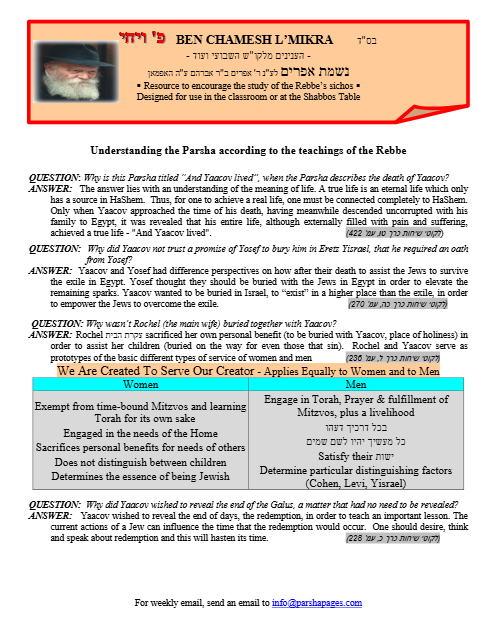
- One should desire, think and speak about redemption and this will hasten its time. Yaacov wished to reveal the end of days, the redemption; the Jew’s actions can influence the time of redemption.
- Levi was not enslaved in Egypt to provide assistance to the rest of the Jews to rise above exile; to turn darkness into light. Menasheh and Efraim carried the aron of Yaacov as the shulchim of Levi & Yosef; with the inception of the exile, these latter two brothers were exempt.
- If a person is blessed with great-grandchildren, then one should teach them Torah or at least contribute to their education. Yosef not only saw his great grandchildren but also helped raise them and taught them Torah.
- In spite of the current physical benefits of Galus, one must insist on Geulah from the depth of one’s soul and this would lead to transform Galus. Yaacov wanted to be buried in Israel, to be higher than the exile to empower the Jews to overcome; Yosef thought they should remain with the Jews in Egypt in order to elevate the remaining sparks.
- Level of Tzadik Tachton – our generation’s avodah is turning bad into good, snatching the sparks wherever possible. Grabbing like a wolf indicates taking from an opponent by force; spiritually “grabbing” means snatching what could be bad to become good.
- The tribes shared in all of the blessings of Yaacov due to their common source in Yaacov, their “father”. תנחומא – they shared in general the result (like Yissachar and Zevulun). בראשית רבה - each tribe influences the others from their own blessing (example, Yissachar establishes time of learning Torah with the others). רש"י - each tribe shares completely their own blessing with the other tribes (each tribe primarily receives their own blessing and just receives the blessings of the others tribes as secondary).
View The Full Article (PDF)
Related Articles

BESURAS HAGEULO The Announcement of the Redemption
Besuras Hageulo • Vayigash

The Announcement of the Redemption
Reflections of Redemption • Vayigash

Yehuda’s Words Created Angels and Respecting Others
The Way of Emunah • Vayigash

Yosef Meets Yaakov and the Power of Shema
Gan Hatorah • Vayigash
ABSTRACT Likkutei Sichos Vayechi Part 2
Ben Chamesh L'Mikra • Vayechi