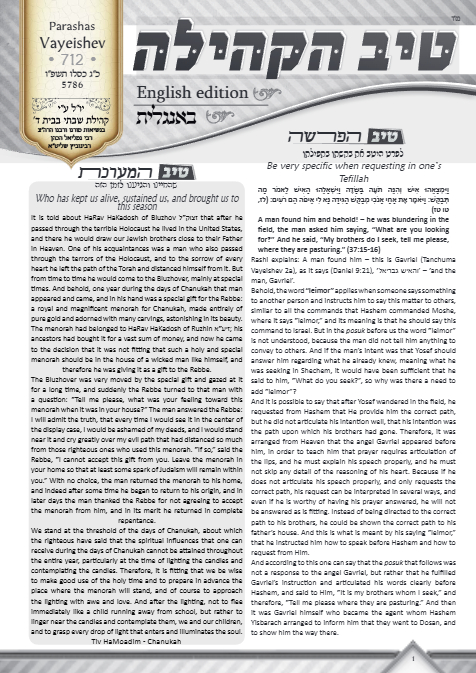
Be Very Specific When Requesting in One's Tefillah
Be very specific when requesting in one’s Tefillah
וַיִּמְצָאֵהוּ אִישׁ וְהִנֵּה תֹעֶה בַּשָּׂדֶה וַיִּשְׁאָלֵהוּ הָאִישׁ לֵאמֹר מַה תְּבַקֵּשׁ: וַיֹּאמֶר אֶת אַחַי אָנֹכִי מְבַקֵּשׁ הַגִּידָה נָּא לִי אֵיפֹה הֵם רֹעִים: (לז, טו טז)
A man found him and behold! – he was blundering in the field, the man asked him saying, “What are you looking for?” And he said, “My brothers do I seek, tell me please, where they are pasturing.” (37:15-16)
Rashi explains: A man found him – this is Gavriel (Tanchuma Vayeishev 2a), as it says (Daniel 9:21), ‘והאיש גבריאל’ – ’and the man, Gavriel‘.
Behold, the word “leimor” applies when someone says something to another person and instructs him to say this matter to others, similar to all the commands that Hashem commanded Moshe, where it says “leimor,” and its meaning is that he should say this command to Israel. But in the posuk before us the word “leimor” is not understood, because the man did not tell him anything to convey to others. And if the man‘s intent was that Yosef should answer him regarding what he already knew, meaning what he was seeking in Shechem, it would have been sufficient that he said to him, “What do you seek?”, so why was there a need to add “leimor”?
And it is possible to say that after Yosef wandered in the field, he requested from Hashem that He provide him the correct path, but he did not articulate his intention well, that his intention was the path upon which his brothers had gone. Therefore, it was arranged from Heaven that the angel Gavriel appeared before him, in order to teach him that prayer requires articulation of the lips, and he must explain his speech properly, and he must not skip any detail of the reasoning of his heart. Because if he does not articulate his speech properly, and only requests the correct path, his request can be interpreted in several ways, and even if he is worthy of having his prayer answered, he will not be answered as is fitting. Instead of being directed to the correct path to his brothers, he could be shown the correct path to his father‘s house. And this is what is meant by his saying “leimor,” that he instructed him how to speak before Hashem and how to request from Him.
And according to this one can say that the posuk that follows was not a response to the angel Gavriel, but rather that he fulfilled Gavriel‘s instruction and articulated his words clearly before Hashem, and said to Him, “It is my brothers whom I seek,” and therefore, “Tell me please where they are pasturing.” And then it was Gavriel himself who became the agent whom Hashem Yisbarach arranged to inform him that they went to Dosan, and to show him the way there.
This matter is indeed a great principle in the service of prayer
that a person must specify his request in all its details and particulars. And although we believe that HaKadosh Baruch Hu knows the desires of our heart and knows well what we intend with our words, nevertheless it is upon us to articulate our speech very clearly, because sometimes it is impossible to reject a person‘s prayer and it must be attended to, but since he has prosecutors against him, they attempt at the very least to distort his intention. As a result, he does not receive what his heart desires. But if he articulates his speech beautifully, then there will no longer be an opening for the accusers to twist and distort his intention.
We see something similar in the Zohar HaKodesh (Vol. I, 169a) in the previous parashah, where it derives from the prayer of Yaakov for salvation from Eisav, that a person must expand his speech in his prayer in a manner that leaves no room for error in his intention. Therefore, Yaakov said (above, 32:12), ‘הצילני נא מיד אחי מיד עשו’ - “Rescue me please from the hand of my brother, from the hand of Esav,” because if he had sufficed with saying “from the hand of my brother,” his intention could have been interpreted regarding other relatives who are also called brothers. Therefore, he extended his words and said “from the hand of Esav,” so that it would be understood that his intention was toward Esav and not toward another brother.
These matters are also explained in the Midrash (Esther Rabbah 7:24), and these are its words: “A parable of a man who was walking on the road, and from the hardship of the journey his ankle was sprained. He said: If only I had a donkey. Immediately after he completed his prayer, a Roman passed by whose donkey had just given birth to a colt, and he commanded the wanderer to carry the colt on his shoulder. The wanderer said: My prayer was answered, for I requested a donkey and they gave me one, but I did not pray properly, for I did not articulate whether I desired a donkey to ride upon, or a donkey which they would place upon my shoulder.”
See also the words of the Maharsha (Bava Basra 25b), and these are his words: “One can explain this in the manner I heard with a jesting tone regarding the verse (Koheles 5:9), ’אוהב כסף לא ישבע כסף‘ - ’One who loves money will not be satisfied with money,‘ that there was a man who loved money exceedingly and requested from the Almighty that whatever he would touch with his hand would become money, and HaKadosh Baruch Hu fulfilled his request. And behold, when he came to eat bread, his hand touched it and it became money, and he had nothing to eat. And this is the meaning of ’he will not be satisfied with money.‘” End of quote. From all of this we learn that prayer depends solely upon articulation of the lips.
We find something similar also with Moshe Rabeinu, when the wicked Pharaoh requested from him to pray to Hashem to remove the plague of frogs from him. Moshe said to him (Shemos 8:5), ‘למתי אעתיר לך ולעבדיך ולעמך’ - “For when shall I pray for you and for your servants and for your people?” With this Moshe taught us that the one who prays and requests from Hashem Yisbarach must specify his request clearly. Therefore a general prayer to remove the frogs from Egypt as a whole would not suffice, because then it could be interpreted that his intention concerned only the important people, since they are primary, or that his intention was only the removal of the frogs from the public places of the land which are used by all, but that the frogs in the houses would remain. Only when he expands his speech and specifies all categories of people in Egypt will he merit that his prayer rise favorably and all will indeed be saved from their distress. And for this reason Moshe added and emphasized, ’רק ביאור תשארנה‘ - “Only in the river shall they remain,” to inform Pharaoh that concerning what he specifies and details in his prayer, he will merit to be answered, and concerning what he does not specify, he will not merit to be answered.
Besides the reason we stated, that the need to specify prayers is in order that the matters be clear and that the prosecutors not have a means to interpret his prayer differently, there is an additional reason for which prayers must be explicit: that prayer must be said from the depth of the heart, because thereby a person is considered like a pauper at the doorway, arousing mercy. As Chazal said (Berachos 28b): “One who makes his prayer fixed, his prayer is not supplication,” meaning that such a prayer is not desirable before the Omnipresent because it is not supplication. And in order that he indeed merit this, it is fitting that he specify his request clearly, because thereby the one who prays places the weight of the trouble before his eyes, and his mercy is aroused upon the one for whom he is praying, and thus his prayer is said from the depth of the heart. Such a prayer makes a great impression.
May Hashem Yisbarach be our help, that our prayer should be mercy and supplication before the Omnipresent Baruch Hu, and that we merit to be saved through it in every good matter.