Chanukah The Spiritual Within The Physical
Torah Sweets | December 13, 2025
Print This Article
View Original PDF

Chanukah The Spiritual Within The Physical

Torah Sweets | December 31, 2025

Chanukah is based on two miracles: the incredible military conquest over the mighty Greek army and the miraculous jug of oil lasting for eight days when it was only enough for one. Although winning the war seems to be a bigger cause, we light the Menorah for eight days, mainly focusing on the miracle of the long-lasting. Also, the Rambam (Hilchos Chanukah 4:12) writes that the mitzvah of kindling Chanukah lamps is extremely beloved. This is the only place in the Rambam, who is Halacha-based, that he gives such a terminology of “love”. The Rambam concludes that “a person should be very careful in its observance to publicize the miracle and thus increase our praise of Hashem and expression of thanks for the miracles.”

Let’s also mention that in Parshas Vayetzei (Bereishis 31:44-48) that there was a discussion between Yaakov and his father-in-law, Lavan, who wants a covenant for loyalty. Yaakov took a stone as a monument and told everyone to take stones. The Pasuk (ibid. 31:47) tells us: “And Lavan called it Yegar Sahadusa (stone in Aramaic), but Yaakov called it Galeid (stone in Lashon Hakodesh).” What is the Torah teaching us with this seemingly unimportant difference of chosen language? A final idea to discuss - we all want blessing in our life, and arguably the greatest Bracha in the history of mankind was given by Yitzchak Avinu to Yaakov Avinu, which were supposed to be given to Yaakov.

However, if we stop to think about it, until the day Yaakov got the Brachos, he had the most serene life, sitting in a “tent” and learning undisturbed. From the day he got these “Brachos”, his life became a life of upheaval and turmoil. His brother tried to kill him, and his father-in-law tricked him multiple times regarding marrying his daughters and earning wages. He flees Lavan’s home, and his brother faces off with him and must fight his archangel. What were these blessings that led to such a tumultuous existence?

Harav Shimshon Pincus, ZT”L, (in the Tiferes Torah on Parshas Toldos) offers an explanation. He writes that Yaakov and Eisav were supposed to both be Avos. There are two jobs: to defeat the evil and to do good (365 negative Mitzvos and 248 positive Mitzvos). Eisav’s job was supposed to defeat evil; however, he failed, and now Yaakov had to do both tasks. From the time of getting Brachos, he had to take over Eisav’s spot of living in a world of difficult challenges and overcoming them.

Let’s understand this with a story. There was a young man, Chaim, who was doing well in an affluent school, and the time came close to graduation. All his classmates were bragging about how they were going to get fancy luxury cars as their gift, and Chaim wanted the same, but his father told him that “true happiness does not come from material pursuits, rather by true connection to Hashem and therefore I will gift you with a beautiful Shas.” Chaim insisted that he really wanted the latest model car.

On graduation day, the father presented Chaim with two boxes and a large Shas inside, but Chaim snapped and proclaimed, “I don’t want to have anything to do with you anymore.” The father told Chaim to just open it, but he refused and stormed out. A few weeks later, the father approached Chaim and told him, “I didn’t want to tell you this before – but I am very sick, and I don’t think I have much time left. It would mean the world to me if you would just give this gift a chance.” Chaim ghosted him, and a few weeks later, the father passed away, and Chaim was very upset that he never made up with his father. He put the Shas in the attic, and life moved on, and Chaim got married and started his own family. Fast forward thirty years, Chaim got a call from his mother who told him, “I am getting older, and I decided that I want to sell the house and move into an assisted living facility. Come over with your siblings and look through the house to see if you would like anything before it gets thrown out.”

The following week, Chaim came over and sat with his elderly mother and siblings, reminiscing on younger years, laughing and crying together. Finally, the time comes to go through the items, some of which were very sentimental. Chaim then went to the attic to clean it and suddenly saw the box with “Shas” written on it, and the memories started flashing back, wondering why his father was so insistent on this graduation gift for him. He decided to finally open the box and the first volume, seeing the note that his father wrote on the front cover.

It read as follows: “Dear Chaim, I love you so very much, and I want you to remember that true happiness does not come from the material possessions of this world; the only real pleasure is the connection to Hashem. But I want you to know that I love you so much, and because you wanted it so badly, I also got you a brand-new car and it’s paid in full. It’s in the lot behind David’s car dealership on Main Avenue. Enjoy!” And there, under the note, was the key to the brand-new car that he wanted. In shock, Chaim faints and his siblings run over, splash him with water and ask him what happened. Chaim told them, “Wow - my father loved me so much and all these years I never gave him a chance to explain himself due to my unreasonable frustration.” Of course, we can have a nice house and car, and Hashem gave this to us so we can enjoy life, but the true pleasure from the above comes when one is connected to his ruchneas (spirituality). When we are not connected spiritually, we keep chasing material pleasures, but we never get to enjoy them. This is the Yom Tov of Chanukah: Jews versus the Greeks. In the Friday night Ma’ariv, we mention how we are an Am Medushnei Oneg – a nation fattened in pleasure. We have Shabbos and Yom Tov, and we have a Mitzvah to eat, drink, and enjoy our family, but the more one is connected to Hashem, the more he enjoys and appreciates even the physical pleasures of life (as it’s all with a purpose). The Greeks were into running after pleasure, but what they decreed on us is to write on the horn of our animals that “Ein Lonu Chelek B’Elokei Yisrael - We do not have a portion with Hashem.” This means that maybe religion can exist, but that the Lonu part - which is physicality – has a spiritual component, was antithetical to them, and they sought to eradicate it.

As is seen in the story, the pleasure of the car is in the Gemara! Lavan told Yaakov that he could have the spirituality, but all the physicality belonged to him. They can’t be mixed. When he saw he wasn’t successful, Lavan wanted to make a covenant because he wanted Yaakov to say that the materialism of a Jew can’t be spiritual; rather, to enjoy, you need secularism to be brought into Judaism.

He claimed that “One day I will win, and I will bring secularism to the Jewish world.” Yigar (of Yigar sahadusa that Lavan mentioned) has the Gematria of 213. Lavan was intimating that in the future, in the 213th year of the Second Bais Hamikdash, the Greeks will show you that you can bring a pig on the Altar. Yaakov’s response was that he will stay pure with the Lashon Hakodesh - it’s the same pile, but it won’t be in the goyish world (see the Megaleh Amukos). Now we can understand the Rambam we mentioned. It is true that every Mitzvah is beloved to us, but the Yom Tov of Chanukah is celebrating the conquest over the Greeks, who wanted us to know is that the greatest pleasure comes from superficial physical pleasure totally disconnected from spirituality. The winning of this war by the Kohanim – the ones most connected to Hashem – revealed to us that the success and pleasure that a Jew has is so much greater when connected to spirituality!

The Mitzvah of Chanukah isn’t just another Mitzvah that we also enjoy. Rather, the POINT of the Mitzvah is to enjoy, and unlike the Greek philosophy, the physical pleasure is greater when connected to spirituality. The war was certainly a miracle, but so many times we get carried away, and we start thinking we just must do the physical action. The lighting of the Menorah with pure oil at the end of the war teaches us that the purpose of the war – and the success of the physical – is to bring light, purity, and spirituality into the world, and that’s what they did after they won the war.

Let’s put this all together. The Jewish calendar year starts with Pesach, leading to Shavous; then comes Elul and the Days of Awe (Rosh Hashanah and Yom Kippur), capped off by the joyous time of Sukkos and Simchas Torah. Did we not reach the spiritual climax at that point in the year? What happens on Chanukah that makes it a step above everything that we have gone through? The answer is that until now, we built up the ruchneas, which is the part of Yaakov’s life before he got the Brachos. On Pesach, we start the relationship with Hashem and get married to Him on Shavuos. We then crown Hashem King on Rosh Hashanah and returned to Him on Yom Kippur and live with Him on Sukkos. Then, we go into the long winter months – symbolized by the second part of Yaakov’s life – having to go to work and fight battles against enemies (physicality is symbolized by the long winter nights). That takes place after we have built up the spiritual strength.

We take the spiritual connection of all the Yamim Tovim and bring that into our day-to-day lives. There isn’t a physical world and a spiritual world; the two are intertwined. Everything we do is about light, and everything can be a Mitzvah if we think of it that way - from shopping to doing bedtime with the kids; from going to work to speaking with our spouse. All the bitterness leaves when we realize that every last thing we do is serving Hashem in different ways and that every Mitzvah is precious. It’s not “my day is tough except those 90 minutes that I daven and learn.” If we are doing it for the right reasons, everything we do becomes a Mitzvah. The lesson of Chanukah is that we can enjoy the physical world if we see it through the prism of our spirituality.
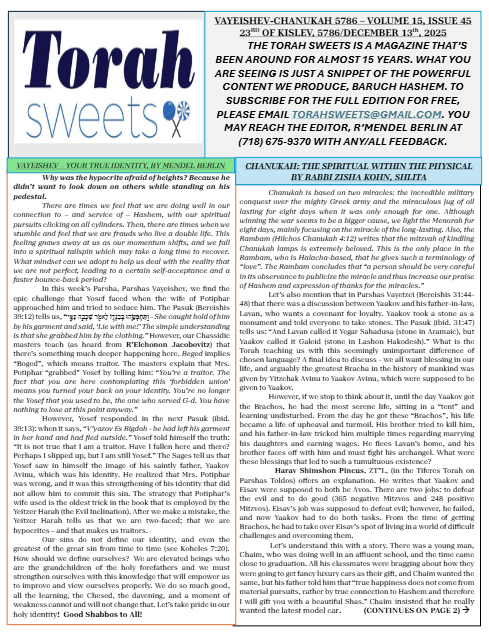
Chanukah is based on two miracles: the incredible military conquest over the mighty Greek army and the miraculous jug of oil lasting for eight days when it was only enough for one. Although winning the war seems to be a bigger cause, we light the Menorah for eight days, mainly focusing on the miracle of the long-lasting. Also, the Rambam (Hilchos Chanukah 4:12) writes that the mitzvah of kindling Chanukah lamps is extremely beloved. This is the only place in the Rambam, who is Halacha-based, that he gives such a terminology of “love”. The Rambam concludes that “a person should be very careful in its observance to publicize the miracle and thus increase our praise of Hashem and expression of thanks for the miracles.”

Let’s also mention that in Parshas Vayetzei (Bereishis 31:44-48) that there was a discussion between Yaakov and his father-in-law, Lavan, who wants a covenant for loyalty. Yaakov took a stone as a monument and told everyone to take stones. The Pasuk (ibid. 31:47) tells us: “And Lavan called it Yegar Sahadusa (stone in Aramaic), but Yaakov called it Galeid (stone in Lashon Hakodesh).” What is the Torah teaching us with this seemingly unimportant difference of chosen language? A final idea to discuss - we all want blessing in our life, and arguably the greatest Bracha in the history of mankind was given by Yitzchak Avinu to Yaakov Avinu, which were supposed to be given to Yaakov.

However, if we stop to think about it, until the day Yaakov got the Brachos, he had the most serene life, sitting in a “tent” and learning undisturbed. From the day he got these “Brachos”, his life became a life of upheaval and turmoil. His brother tried to kill him, and his father-in-law tricked him multiple times regarding marrying his daughters and earning wages. He flees Lavan’s home, and his brother faces off with him and must fight his archangel. What were these blessings that led to such a tumultuous existence?

Harav Shimshon Pincus, ZT”L, (in the Tiferes Torah on Parshas Toldos) offers an explanation. He writes that Yaakov and Eisav were supposed to both be Avos. There are two jobs: to defeat the evil and to do good (365 negative Mitzvos and 248 positive Mitzvos). Eisav’s job was supposed to defeat evil; however, he failed, and now Yaakov had to do both tasks. From the time of getting Brachos, he had to take over Eisav’s spot of living in a world of difficult challenges and overcoming them.

Let’s understand this with a story. There was a young man, Chaim, who was doing well in an affluent school, and the time came close to graduation. All his classmates were bragging about how they were going to get fancy luxury cars as their gift, and Chaim wanted the same, but his father told him that “true happiness does not come from material pursuits, rather by true connection to Hashem and therefore I will gift you with a beautiful Shas.” Chaim insisted that he really wanted the latest model car.

On graduation day, the father presented Chaim with two boxes and a large Shas inside, but Chaim snapped and proclaimed, “I don’t want to have anything to do with you anymore.” The father told Chaim to just open it, but he refused and stormed out. A few weeks later, the father approached Chaim and told him, “I didn’t want to tell you this before – but I am very sick, and I don’t think I have much time left. It would mean the world to me if you would just give this gift a chance.” Chaim ghosted him, and a few weeks later, the father passed away, and Chaim was very upset that he never made up with his father. He put the Shas in the attic, and life moved on, and Chaim got married and started his own family. Fast forward thirty years, Chaim got a call from his mother who told him, “I am getting older, and I decided that I want to sell the house and move into an assisted living facility. Come over with your siblings and look through the house to see if you would like anything before it gets thrown out.”

The following week, Chaim came over and sat with his elderly mother and siblings, reminiscing on younger years, laughing and crying together. Finally, the time comes to go through the items, some of which were very sentimental. Chaim then went to the attic to clean it and suddenly saw the box with “Shas” written on it, and the memories started flashing back, wondering why his father was so insistent on this graduation gift for him. He decided to finally open the box and the first volume, seeing the note that his father wrote on the front cover.

It read as follows: “Dear Chaim, I love you so very much, and I want you to remember that true happiness does not come from the material possessions of this world; the only real pleasure is the connection to Hashem. But I want you to know that I love you so much, and because you wanted it so badly, I also got you a brand-new car and it’s paid in full. It’s in the lot behind David’s car dealership on Main Avenue. Enjoy!” And there, under the note, was the key to the brand-new car that he wanted. In shock, Chaim faints and his siblings run over, splash him with water and ask him what happened. Chaim told them, “Wow - my father loved me so much and all these years I never gave him a chance to explain himself due to my unreasonable frustration.” Of course, we can have a nice house and car, and Hashem gave this to us so we can enjoy life, but the true pleasure from the above comes when one is connected to his ruchneas (spirituality). When we are not connected spiritually, we keep chasing material pleasures, but we never get to enjoy them. This is the Yom Tov of Chanukah: Jews versus the Greeks. In the Friday night Ma’ariv, we mention how we are an Am Medushnei Oneg – a nation fattened in pleasure. We have Shabbos and Yom Tov, and we have a Mitzvah to eat, drink, and enjoy our family, but the more one is connected to Hashem, the more he enjoys and appreciates even the physical pleasures of life (as it’s all with a purpose). The Greeks were into running after pleasure, but what they decreed on us is to write on the horn of our animals that “Ein Lonu Chelek B’Elokei Yisrael - We do not have a portion with Hashem.” This means that maybe religion can exist, but that the Lonu part - which is physicality – has a spiritual component, was antithetical to them, and they sought to eradicate it.

As is seen in the story, the pleasure of the car is in the Gemara! Lavan told Yaakov that he could have the spirituality, but all the physicality belonged to him. They can’t be mixed. When he saw he wasn’t successful, Lavan wanted to make a covenant because he wanted Yaakov to say that the materialism of a Jew can’t be spiritual; rather, to enjoy, you need secularism to be brought into Judaism.

He claimed that “One day I will win, and I will bring secularism to the Jewish world.” Yigar (of Yigar sahadusa that Lavan mentioned) has the Gematria of 213. Lavan was intimating that in the future, in the 213th year of the Second Bais Hamikdash, the Greeks will show you that you can bring a pig on the Altar. Yaakov’s response was that he will stay pure with the Lashon Hakodesh - it’s the same pile, but it won’t be in the goyish world (see the Megaleh Amukos). Now we can understand the Rambam we mentioned. It is true that every Mitzvah is beloved to us, but the Yom Tov of Chanukah is celebrating the conquest over the Greeks, who wanted us to know is that the greatest pleasure comes from superficial physical pleasure totally disconnected from spirituality. The winning of this war by the Kohanim – the ones most connected to Hashem – revealed to us that the success and pleasure that a Jew has is so much greater when connected to spirituality!

The Mitzvah of Chanukah isn’t just another Mitzvah that we also enjoy. Rather, the POINT of the Mitzvah is to enjoy, and unlike the Greek philosophy, the physical pleasure is greater when connected to spirituality. The war was certainly a miracle, but so many times we get carried away, and we start thinking we just must do the physical action. The lighting of the Menorah with pure oil at the end of the war teaches us that the purpose of the war – and the success of the physical – is to bring light, purity, and spirituality into the world, and that’s what they did after they won the war.

Let’s put this all together. The Jewish calendar year starts with Pesach, leading to Shavous; then comes Elul and the Days of Awe (Rosh Hashanah and Yom Kippur), capped off by the joyous time of Sukkos and Simchas Torah. Did we not reach the spiritual climax at that point in the year? What happens on Chanukah that makes it a step above everything that we have gone through? The answer is that until now, we built up the ruchneas, which is the part of Yaakov’s life before he got the Brachos. On Pesach, we start the relationship with Hashem and get married to Him on Shavuos. We then crown Hashem King on Rosh Hashanah and returned to Him on Yom Kippur and live with Him on Sukkos. Then, we go into the long winter months – symbolized by the second part of Yaakov’s life – having to go to work and fight battles against enemies (physicality is symbolized by the long winter nights). That takes place after we have built up the spiritual strength.

We take the spiritual connection of all the Yamim Tovim and bring that into our day-to-day lives. There isn’t a physical world and a spiritual world; the two are intertwined. Everything we do is about light, and everything can be a Mitzvah if we think of it that way - from shopping to doing bedtime with the kids; from going to work to speaking with our spouse. All the bitterness leaves when we realize that every last thing we do is serving Hashem in different ways and that every Mitzvah is precious. It’s not “my day is tough except those 90 minutes that I daven and learn.” If we are doing it for the right reasons, everything we do becomes a Mitzvah. The lesson of Chanukah is that we can enjoy the physical world if we see it through the prism of our spirituality.

PDF Preview