Dont Let Your Spiritual Mistakes Discourage You From Serving Hashem
By Daniel Keren
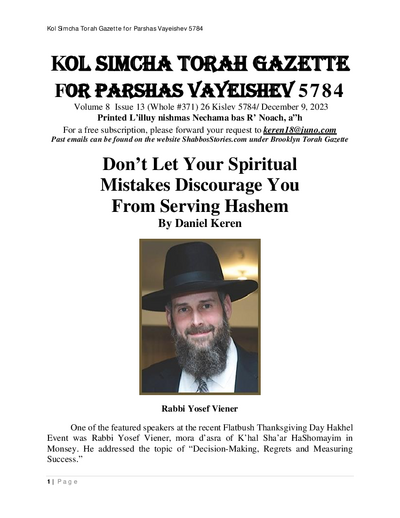
One of the featured speakers at the recent Flatbush Thanksgiving Day Hakhel Event was Rabbi Yosef Viener, mora d’asra of K’hal Sha’ar HaShomayim in Monsey. He addressed the topic of “Decision-Making, Regrets and Measuring Success.”
Rabbi Viener spoke of various major figures in Jewish history who made decisions that may have been wrong, but did not allow themselves to get distracted from their avodas Hashem (spiritual service).
He first spoke of Chizkiyahu Hamelech (King Hezekiah), one of the greatest Jewish kings of Malchus Dovid (the royal house of David). When he realized that he was faced by a hostile army of 180,000 soldiers who had surrounded Yerushalayim (Jerusalem), he understood that with his smaller army, he could not defeat the enemy. Chizkiyahu therefore decreed that everyone in Yerushalayim under threat of death had to go to the Batei Medrashim (Torah study halls) and incredible increases in Torah knowledge was the result and in that merit of that action the king was able to miraculously defeat the much larger enemy forces.
An Action of Chizkiyahu that Chazal Criticized
Some of his other actions at this time to defeat the enemy were highly criticized by Chazal, our Sages of blessed memory, such as his decision to plug the water-fountains in Jerusalem to deny its availability to the enemy that was threatening Chizkiyahu’s kingdom.
Rabbi Viener also referred to the Hashanah Rabba prayers where we recall the “mistake” of Moshe Rabbeinu who had struck the rock in order to bring forth the water for the people in the Midbar (desert of Sinai) and their animals.
Why are these two actions which were of Moshe and Chizkiyahu which were “wrong” listed in the Hashanah Rabbah prayers as zechusim (merits) that we ask Hashem to remember in our behalf for a good year?
Winning the Favor of the Roman General Vespasian
Rav Yochanan ben Zakkai who escaped from the Roman siege of Yerushalayim and after winning favor from the Roman general Vespasian (and future emperor of the Roman Empire) was offered three wishes. Yochanan ben Zakkai used one of those wishes to be given the town of Yavneh as a safe refuge for the Torah sages of Israel. Chazal strongly criticize Yochanan ben Zakkai for not having asked Vespasian to spare Jerusalem. Was that really a mistake or was that the best that Yochanan ben Zakkai could have done under the circumstances?
The yetzer hora (our evil inclination), Rabbi Viener noted, just wants us to get depressed over the decisions that we have made and to give up on our commitment to continuing our avodas Hashem and just fall into great despair.
When Chana was crying bitterly over the fact that she was unable to give birth to any children, her husband Elchanan tried to comfort her by asking her if he as a good husband wasn’t worth more than many children. Was he right in trying to persuade his wife to overcome her sadness and continue with the best of her ability to serve Hashem? Yes, the lesson is that one should not let a great disappointment to take total control of one’s life and stop you from fulfilling the other mitzvahs from the Torah that one is obligated to observe.
Refusing to Protect Himself from His Father-in-Law
When Shaul Hamelech (King Saul) was pursuing Dovid to kill him, a situation in which King David was by halacha (Jewish law) entitled to protect himself by killing his pursuer. On two occasions Dovid had an opportunity to protect himself by killing his father-in-law who was trying to take him out of this world and yet on both occasions he refused to do so. Was this a mistake on Dovid’s part?
Rabbi Viener declared that the rule is not to allow oneself to get down or depressed over a mistake that one makes in life, no matter how serious. One should learn from such mistakes. Rather one should just continue to do the other Torah mitzvahs that come one’s way as best one can.
When Yitzchok realized that he had “mistakenly” given his brocha, blessing that he intended to give to his firstborn son Eisav to Yaakov; instead of getting mad or filled with despair, he realized that this action was his Plan B and he immediately accepted this new reality.
The Unrealized Zevulon-Yissachar Partnership
Initially, Yitzchok’s reason for wanting to give his brocha of abundant gashmius (material wealth) to Eisav was so that his older son would help his brother Yaakov with a Zevulon-Yissachar partnership. When Eisav cried and begged his father for another blessing, Yitzchok after first saying he had no other blessing to bestow, nevertheless was able to come up with a special brocha for Eisav.
This new brocha for Eisav would give Eisav the ability to assist Yaakov from the outside. Thus, when Yaakov’s descendants (the Jewish people) would be careless in observing the holy Torah, Eisav’s descendants would be allowed by Hashem to punish the Jews and thereby push them to do teshuvah (penitence) and return to serving Hashem as per the Torah.
The lesson for us today is not to let our regret for a mistake in our avodas Hashem to cause us to give up on our spiritual obligations. Our avodah is when disappointments happen in our lives, is not to get lost in painful questions and aggravation over our mistakes.
Reprinted from the Jewish Connection.
Related Articles