Public Humiliation
The Weekly Chiddush | December 08, 2023
Print This Article
View Original PDF

Public Humiliation

The Weekly Chiddush | December 31, 2025

Later in the Parsha, when Yehuda finds out that his daughter-in-law Tamar has fallen pregnant while awaiting marriage to his youngest son, he sentences her to death by fire. Even though it was Yehuda’s child that Tamar was carrying and this knowledge would have saved her life, she did not publicly disclose that it was his baby. She simply hinted to Yehuda, hoping he would confess that the child was his and spare her life.

From this, our sages teach that it is better to allow oneself to be thrown into a fiery furnace, than to publicly embarrass someone. In Shulchan Aruch (OC 151:8), the Alter Rebbe rules that it is forbidden to embarrass someone, even in private and certainly in public. This includes calling a person a name that he is embarrassed of or speaking about something that is embarrassing to him. He quotes the ruling of the sages that whoever publicly embarrasses someone, has no share in the World to Come.

In the story of Kamtza and Bar Kamtza, after suffering public humiliation, Bar Kamtza went and slandered the Jewish people to the Roman authorities, ultimately bringing about the destruction of the Beis Hamikdash. The Gemara does not say that he did this because the host had embarrassed him. Rather, it was because the sages who were present and witnessed him being embarrassed in public, said nothing.
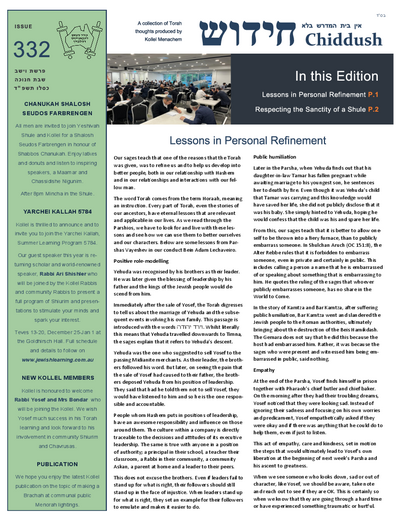

Later in the Parsha, when Yehuda finds out that his daughter-in-law Tamar has fallen pregnant while awaiting marriage to his youngest son, he sentences her to death by fire. Even though it was Yehuda’s child that Tamar was carrying and this knowledge would have saved her life, she did not publicly disclose that it was his baby. She simply hinted to Yehuda, hoping he would confess that the child was his and spare her life.

From this, our sages teach that it is better to allow oneself to be thrown into a fiery furnace, than to publicly embarrass someone. In Shulchan Aruch (OC 151:8), the Alter Rebbe rules that it is forbidden to embarrass someone, even in private and certainly in public. This includes calling a person a name that he is embarrassed of or speaking about something that is embarrassing to him. He quotes the ruling of the sages that whoever publicly embarrasses someone, has no share in the World to Come.

In the story of Kamtza and Bar Kamtza, after suffering public humiliation, Bar Kamtza went and slandered the Jewish people to the Roman authorities, ultimately bringing about the destruction of the Beis Hamikdash. The Gemara does not say that he did this because the host had embarrassed him. Rather, it was because the sages who were present and witnessed him being embarrassed in public, said nothing.

PDF Preview

