We may light them on Chanukah
טיב הקהילה English | December 07, 2023
Print This Article
View Original PDF

We may light them on Chanukah

טיב הקהילה English | December 31, 2025

In Communist Russia, two Jews stood on the first night of Chanukah and with much anticipation, after drawing the curtains, they light the first light of Chanukah. Quietly, he sings the songs so that he is not heard outside, when suddenly there is a banging on the door. They quickly extinguish the lights and open the door. In the doorway stands a KGB officer, to their surprise his look is soft and not harsh. No other police are with him. He asks to come into the house. Once inside, he asks them to continue ‘the ceremony’. Did they have a choice? They relit the light and continued to sing. He sat opposite the lights, his eyes flowing with tears. Sometimes he joined their singing, sometimes he was silent or he was crying. When they finished, he got up to go and he informed them that he would return the next day. And he came, the next day and the rest of the days of Chanukah. He continued to come in the following years until Hashem Yisbarach allowed them and him to leave Russia, from darkness to light.

The holiday of Chanukah is different in its essence from all other holidays, for the days of the holiday are weekdays and we are allowed to work like any other weekday. The holy seforim call it ‘yamim tovim shel yemei hachol’ – ‘holidays of weekdays’, and it is specifically this which is an attribute that the other holidays do not have. This holiday ‘speaks’ to everyone, even simple and distant Jews. The ‘Chidushei HaRim’ explains the teaching of Chazal (Shabbos 21b), ‘Wicks and oils which the Chachamim said, “We may not light with them on the Shabbos”, we may light with them on Chanukah’. We know that 'נר ה' נשמת אדם' – ‘A man’s soul is the lamp of Hashem’ (Mishlei 20:27), the lamp hints at the Jewish soul. There are neshamos [souls] that are so distant that even the Shabbos lamp does not illuminate their neshamos, but the light of Chanukah illuminates even them. Therefore, the mitzvah is specifically in darkness, and specifically in low places, for there it illuminates, in a place where no other light can shine.

Chanukah does not need to be ‘meyuchas’ [privileged] and does not need protektziyos [favoritism]. Everyone is able to merit to receive the light of the lamps and illuminate his neshama through them. You just have to open the eyes. Therefore, it is worthwhile to sit opposite the lights and gaze at them. So is it brought down in seforim, it is appropriate to wait half-an-hour opposite the lamps, and the light will already penetrate into the neshama, kindle it, and warm the heart for avodas Hashem Yisbarach with joy and warmth.

-Tiv HaMoadim - Chanukah
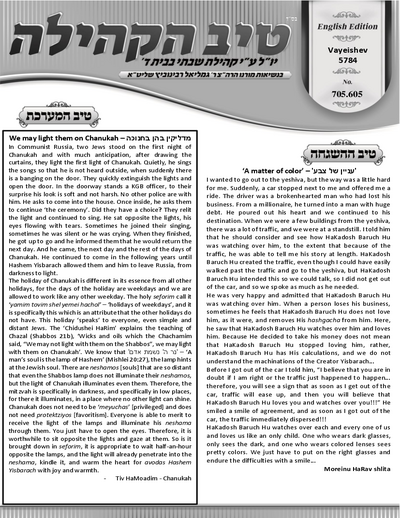
In Communist Russia, two Jews stood on the first night of Chanukah and with much anticipation, after drawing the curtains, they light the first light of Chanukah. Quietly, he sings the songs so that he is not heard outside, when suddenly there is a banging on the door. They quickly extinguish the lights and open the door. In the doorway stands a KGB officer, to their surprise his look is soft and not harsh. No other police are with him. He asks to come into the house. Once inside, he asks them to continue ‘the ceremony’. Did they have a choice? They relit the light and continued to sing. He sat opposite the lights, his eyes flowing with tears. Sometimes he joined their singing, sometimes he was silent or he was crying. When they finished, he got up to go and he informed them that he would return the next day. And he came, the next day and the rest of the days of Chanukah. He continued to come in the following years until Hashem Yisbarach allowed them and him to leave Russia, from darkness to light.

The holiday of Chanukah is different in its essence from all other holidays, for the days of the holiday are weekdays and we are allowed to work like any other weekday. The holy seforim call it ‘yamim tovim shel yemei hachol’ – ‘holidays of weekdays’, and it is specifically this which is an attribute that the other holidays do not have. This holiday ‘speaks’ to everyone, even simple and distant Jews. The ‘Chidushei HaRim’ explains the teaching of Chazal (Shabbos 21b), ‘Wicks and oils which the Chachamim said, “We may not light with them on the Shabbos”, we may light with them on Chanukah’. We know that 'נר ה' נשמת אדם' – ‘A man’s soul is the lamp of Hashem’ (Mishlei 20:27), the lamp hints at the Jewish soul. There are neshamos [souls] that are so distant that even the Shabbos lamp does not illuminate their neshamos, but the light of Chanukah illuminates even them. Therefore, the mitzvah is specifically in darkness, and specifically in low places, for there it illuminates, in a place where no other light can shine.

Chanukah does not need to be ‘meyuchas’ [privileged] and does not need protektziyos [favoritism]. Everyone is able to merit to receive the light of the lamps and illuminate his neshama through them. You just have to open the eyes. Therefore, it is worthwhile to sit opposite the lights and gaze at them. So is it brought down in seforim, it is appropriate to wait half-an-hour opposite the lamps, and the light will already penetrate into the neshama, kindle it, and warm the heart for avodas Hashem Yisbarach with joy and warmth.

-Tiv HaMoadim - Chanukah
PDF Preview