How Pious Should You Be
זכרון יעקב | December 04, 2024
Print This Article
View Original PDF

How Pious Should You Be

זכרון יעקב | June 27, 2025

RABBI YANKI TAUBER (Chabad.org)

"You're holy, but you stink!" That's what the village children would yell at the bechor (first-born animal) who would often be seen wandering about the shtetel. (According to Torah law, the firstborn young of a kosher domestic animal must be brought as an offering in the Holy Temple in Jerusalem. Even when conditions do not allow this — as has been the case since the Temple's destruction more than 1900 years ago — the firstborn animal retains its sacred status, and it is forbidden to eat it or make use of it in any way. In the shtetel, where raising a few head of cattle or a small herd of goats was common practice, these animals would run loose, getting into everything and wreaking general havoc. And since they could not be shorn or groomed, their stench was quite unbeareable).

The lesson in this is that something holy can also stink. You might be this really pious guy, but if people hold their noses when you walk by, you're doing something wrong. In the words of one of the greatest sages in Jewish history, Rabbi Judah HaNassi: "Which is the right path for a person to choose for himself? What is harmonious for the one who does it, and harmonious for one's fellow man."

THIS WEEK WE READ of Yaakov's marriages to Leah and Rachel.

Yaakov loved Rachel, the younger of his uncle Lavan's two daughters. Lavan agrees to give him Rachel's hand in marriage in return for seven years' labor. Yaakov keeps his side of the bargain, but Lavan tricks him: the veiled bride given to Yaakov is Rachel's older sister, Leah, and Yaakov discovers the deception only the next morning. Lavan agrees to let him marry Rachel, too, in return for another seven years of shepherding his flocks.

Marrying more than one wife was common practice in biblical times, and permissible under Jewish law until a rabbinical ordinance forbade it about one thousand years ago. But the Torah expressly forbids to marry two sisters. And while the laws of the Torah were officially commanded to Jewish people at Mount Sinai many years after Yaakov's marriages, the Talmud tells us that Abraham, Isaac and Yaakov observed the Torah even before it was decreed at Sinai. So why did Yaakov marry two sisters, contrary to the code of behavior he had accepted upon himself?

This question is asked by many of the Torah commentaries, and many interesting and innovative explanations are given. The Lubavitcher Rebbe discusses several of these explanations, raises some legal objections to each of them, and then offers a profoundly simple explanation of his own: Yaakov married Rachel because he had promised her that he would.

To accept upon yourself a moral standard beyond what is required by law, explains the Rebbe, is a noble and desirable thing — as long as it only involves a sacrifice on your part. But if your pious conduct also imposes hardship and
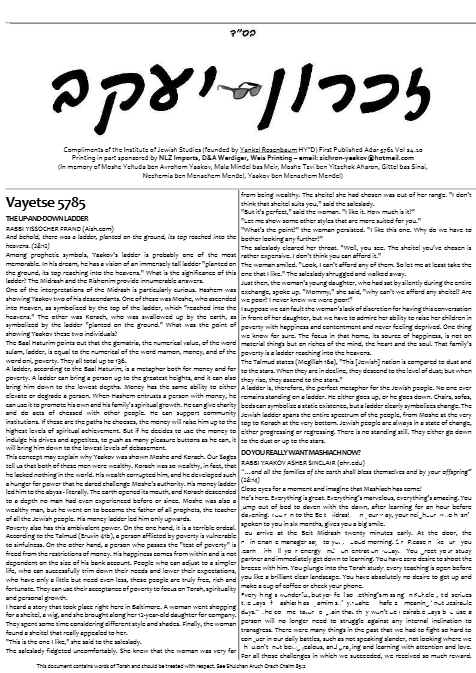

RABBI YANKI TAUBER (Chabad.org)

"You're holy, but you stink!" That's what the village children would yell at the bechor (first-born animal) who would often be seen wandering about the shtetel. (According to Torah law, the firstborn young of a kosher domestic animal must be brought as an offering in the Holy Temple in Jerusalem. Even when conditions do not allow this — as has been the case since the Temple's destruction more than 1900 years ago — the firstborn animal retains its sacred status, and it is forbidden to eat it or make use of it in any way. In the shtetel, where raising a few head of cattle or a small herd of goats was common practice, these animals would run loose, getting into everything and wreaking general havoc. And since they could not be shorn or groomed, their stench was quite unbeareable).

The lesson in this is that something holy can also stink. You might be this really pious guy, but if people hold their noses when you walk by, you're doing something wrong. In the words of one of the greatest sages in Jewish history, Rabbi Judah HaNassi: "Which is the right path for a person to choose for himself? What is harmonious for the one who does it, and harmonious for one's fellow man."

THIS WEEK WE READ of Yaakov's marriages to Leah and Rachel.

Yaakov loved Rachel, the younger of his uncle Lavan's two daughters. Lavan agrees to give him Rachel's hand in marriage in return for seven years' labor. Yaakov keeps his side of the bargain, but Lavan tricks him: the veiled bride given to Yaakov is Rachel's older sister, Leah, and Yaakov discovers the deception only the next morning. Lavan agrees to let him marry Rachel, too, in return for another seven years of shepherding his flocks.

Marrying more than one wife was common practice in biblical times, and permissible under Jewish law until a rabbinical ordinance forbade it about one thousand years ago. But the Torah expressly forbids to marry two sisters. And while the laws of the Torah were officially commanded to Jewish people at Mount Sinai many years after Yaakov's marriages, the Talmud tells us that Abraham, Isaac and Yaakov observed the Torah even before it was decreed at Sinai. So why did Yaakov marry two sisters, contrary to the code of behavior he had accepted upon himself?

This question is asked by many of the Torah commentaries, and many interesting and innovative explanations are given. The Lubavitcher Rebbe discusses several of these explanations, raises some legal objections to each of them, and then offers a profoundly simple explanation of his own: Yaakov married Rachel because he had promised her that he would.

To accept upon yourself a moral standard beyond what is required by law, explains the Rebbe, is a noble and desirable thing — as long as it only involves a sacrifice on your part. But if your pious conduct also imposes hardship and

PDF Preview