The mitzvah of Hakhel and the teaching for our time
טיב הקהילה English | September 21, 2025
Print This Article
View Original PDF

The mitzvah of Hakhel and the teaching for our time

טיב הקהילה English | December 10, 2025

The mitzvah of ‘Hakhel’ and the teaching for our time

When all Israel comes to appear before Hashem, your G-d, in the place that He will choose, you shall read this Torah before all Israel, in their ears. Gather together the people, the men, the women, and the small children, and your stranger who is in your cities, so that they will hear and learn, and they shall fear Hashem, your G-d, and be careful to perform all the words of this Torah. (Devarim 31:11-12)

Behold, these posukim speak of the mitzvah of ‘Hakhel‘, and in their content one sees a point that arouses wonder and calls for explanation. For at first the Torah details all aspects of the mitzvah, and afterward it explains its purpose. Thus, it tells us that this mitzvah is not among the statutes that are a “decree of Scripture,” [gezeiras hakasuv] for it has a revealed purpose and man understands why he fulfills it. Yet when examining the purpose itself, its essence is not understood. It seems like saying that the goal is the very mitzvah itself, as if one said: Give Reuven a gift so that you will give Reuven a gift...

I will explain: After the first posuk before us taught the time of the mitzvah of Hakhel [as a continuation of the posuk before it] and the obligation of its fulfillment at the Mikdash, it informed also the nature of the mitzvah: “You shall read this Torah before all Israel in their ears.” These words are in truth the essence of the mitzvah of Hakhel: to proclaim the Torah before the entire congregation of Israel. “In their ears” means that it is not fulfilled merely by proclaiming in their presence, but also that it be “in their ears”—that they incline their ear to accept the words. That is, the essence of the mitzvah is to hear the Torah from the mouth of the king who reads it.

After we know all the details of the mitzvah, the next posuk tells us its purpose: “that they may hear.” With these words the posuk reveals that this mitzvah has a goal. What is it? Hearing! But this is not understood, for hearing is not the goal but the very mitzvah itself.

The other points brought as purposes—“that they may learn and fear Hashem, your G-d” and so forth—also require explanation. For we do not see that precisely from this hearing one attains all of these, since even in our days, when Hakhel does not apply, there are many who learn Torah, and all who choose fear know that its attainment is not in the hands of Heaven (see Berachos 33b). And Israel is also in our days filled with mitzvos and good deeds.

Yet a great matter the posuk has revealed. To understand, I will first quote a short line from the Malbim in his commentary on Yeshayah (1:11–12), when he spoke about the mitzvah of pilgrimage to Yerushalayim. His words: “He commanded them to ascend to the holy city three times a year, to learn there the fear of Hashem and His ways from the kohanim and the prophets, as it is said (Devorim 14:23): אלקיך ‘למען תלמד ליראה את ה‘ - ’that you may learn to fear Hashem, your G-d.‘” In these words he revealed that words of Torah and rebuke heard in the Mikdash were not like words of Torah and rebuke heard elsewhere. In the Mikdash the influence was different for the better in great measure. Therefore, HaKadosh Baruch Hu desired that Israel not suffice with the Torah and rebuke of their own sages in their towns, but that three times a year they exert themselves to ascend to Zion and receive Torah and rebuke from the kohanim and prophets in Yerushalayim. From their mouths they would merit elevation, fear, and wholeness.

And why was Yerushalayim different from all other lands? Only because of the greatness of holiness that resided there. This holiness caused that whoever entered its gates found his mind elevated, his will awakened with longing for closeness to G-d. Then he strongly desired to hear words that would rouse his heart to repentance and good deeds, that these might help him fulfill “turn from evil,” removing barriers between him and his Creator, and also “do good,” that these deeds serve as means to draw him closer. These desires drew him to the kohanim and prophets to hear from them words stirring correction of deeds, and their words indeed were absorbed in his heart. From this he was able to fulfill his longing, rising in fear and cleaving to G-d. Thus he returned to his city filled with holiness and lofty fear. From then on, his Torah was changed for the better, for the holy seforim explain that so long as man is not cleansed from sin, his Torah is not accepted with favor. But once he purifies himself from sin, the merit of Torah stands for him. Torah of this kind surely adds fear to his fear. And his mitzvos he then fulfilled with pure intent, in all their details without compromise.

From this we may say that the mitzvah of Hakhel too was for this purpose. It was another opportunity to stir the nation in the holiest place, through the greatest among the people reading before them Mishneh Torah, the book that stirs to “turn from evil and do good.” For about half the book is rebuke and moral exhortation, and the other half repeats most of the mitzvos. This hearing supported them and brought them to excellent repentance. From then on, they were worthy of elevation through the power and merit of their Torah.

Now we understand well the intent of the posuk “that they may hear.” For this is not the same hearing mentioned in the body of the mitzvah, where the meaning is the obligation of hearing in its plain sense, as with all mitzvos that depend on hearing. From the Torah‘s view this hearing is no different from other hearings that are obligatory, for all mitzvoss are decrees of Heaven, and by law man must incline his ear even against his will. But after telling you that hearing is an obligation, it informs you that the purpose of this mitzvah is “that they may hear”—that they merit hearing that penetrates the heart. That is, to fulfill the obligation it suffices with hearing by the ear, but the purpose is hearing that comes from the holiness of the place. This kind of hearing greatly stirs man to repentance, correction of deeds, and closeness to G-d. This hearing will bring also to “that they may learn”—that when he returns home his study will be considered true study, for it will be for the sake of Heaven. Such Torah adds fear to his fear, and “they shall fear Hashem, your G-d” will be fulfilled in him. From this he will be careful in fulfilling mitzvos, and “they shall observe to do all the words of this Torah” will be fulfilled.

Nor will it be difficult that even without Hakhel a man has the choice to learn Torah, awaken fear, and increase in mitzvos. For Torah learned before repentance is not like Torah learned after. Torah without repentance is not considered Torah compared to Torah with repentance.

And on the question of “fear of Heaven” not being in the hands of Heaven, that all who choose fear can attain it—though there is truth in this claim—you must know: he who chooses fear can attain it, but to choose it he needs Torah learned with repentance.

And even if you are right that the choice to do mitzvos and good deeds is given even in our days, you must understand: the merit to “do all the words of this Torah” is found only in one who learns Torah with repentance. For he alone merits true fear of his Creator, and fear stands as a shield against the yetzer that tries to cause man to compromise with his Creator...

And now, as we sit in exile, we do not merit the mitzvah of Hakhel. But when we contemplate this mitzvah and understand its purpose, we too must awaken and yearn to attain its goal as much as possible. Before study we must repent, and only then will our Torah be pleasing, raising us higher and higher.

And even though, as said, we do not have Hakhel, and cannot awaken to deep repentance as they merited in the time of the Mikdash through its holiness, still we have hope, if we strive to attain at least the repentance within our reach. Then the merit of our Torah will stand for us, to attain in time the true repentance demanded of us.

This came from the pen of the holy author of Bnei Yissaschar in the introduction to his sefer Agra DeKallah. His words: “Behold, the prophet ‘s saying is not hidden: ‘נירו לכם ניר ואל תזרעו אל הקוצים‘ - ‘Break up for yourselves fallow ground, and do not sow among thorns‘ (Yirmiah 4:3). The Torah and mitzvos that man does while still clothed in the filth of the world‘s impurity are considered like sowing among thorns. Chas v’shalom, he strengthens thorn and thistle, the forces of the Other Side. Yet such is the way of Teshuva. By Torah law, mere annulment suffices until Hashem Yisbarach shines upon him with mercy through Torah study. Torah will teach him knowledge and understanding to correct his traits with great love. This is hinted at in the posuk ’מי פתי יסור הנה‘ - ‘Whoever is simple, let him turn here‘ (Mishlei 9:4). For ‘Mi‘ is the world of repentance, as known, and thus, when the simple one desires to return in repentance, let him turn here, and Torah will teach him knowledge.”

From his words you see: at first, they do not ask of man more than that he do what he is able. If he does so, Torah will aid him to reach the desired Teshuva.
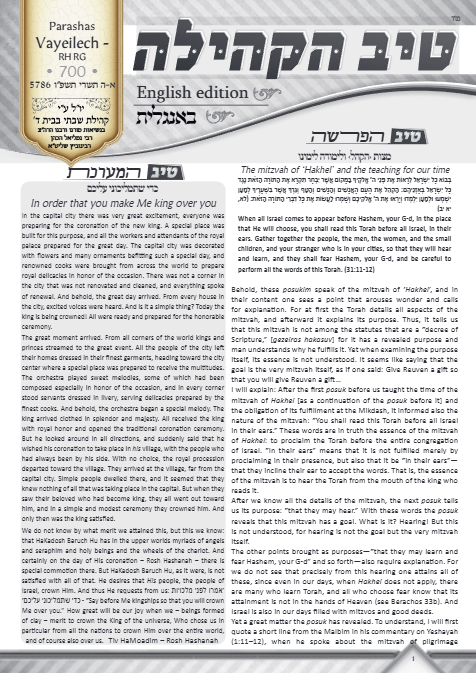
The mitzvah of ‘Hakhel’ and the teaching for our time

When all Israel comes to appear before Hashem, your G-d, in the place that He will choose, you shall read this Torah before all Israel, in their ears. Gather together the people, the men, the women, and the small children, and your stranger who is in your cities, so that they will hear and learn, and they shall fear Hashem, your G-d, and be careful to perform all the words of this Torah. (Devarim 31:11-12)

Behold, these posukim speak of the mitzvah of ‘Hakhel‘, and in their content one sees a point that arouses wonder and calls for explanation. For at first the Torah details all aspects of the mitzvah, and afterward it explains its purpose. Thus, it tells us that this mitzvah is not among the statutes that are a “decree of Scripture,” [gezeiras hakasuv] for it has a revealed purpose and man understands why he fulfills it. Yet when examining the purpose itself, its essence is not understood. It seems like saying that the goal is the very mitzvah itself, as if one said: Give Reuven a gift so that you will give Reuven a gift...

I will explain: After the first posuk before us taught the time of the mitzvah of Hakhel [as a continuation of the posuk before it] and the obligation of its fulfillment at the Mikdash, it informed also the nature of the mitzvah: “You shall read this Torah before all Israel in their ears.” These words are in truth the essence of the mitzvah of Hakhel: to proclaim the Torah before the entire congregation of Israel. “In their ears” means that it is not fulfilled merely by proclaiming in their presence, but also that it be “in their ears”—that they incline their ear to accept the words. That is, the essence of the mitzvah is to hear the Torah from the mouth of the king who reads it.

After we know all the details of the mitzvah, the next posuk tells us its purpose: “that they may hear.” With these words the posuk reveals that this mitzvah has a goal. What is it? Hearing! But this is not understood, for hearing is not the goal but the very mitzvah itself.

The other points brought as purposes—“that they may learn and fear Hashem, your G-d” and so forth—also require explanation. For we do not see that precisely from this hearing one attains all of these, since even in our days, when Hakhel does not apply, there are many who learn Torah, and all who choose fear know that its attainment is not in the hands of Heaven (see Berachos 33b). And Israel is also in our days filled with mitzvos and good deeds.

Yet a great matter the posuk has revealed. To understand, I will first quote a short line from the Malbim in his commentary on Yeshayah (1:11–12), when he spoke about the mitzvah of pilgrimage to Yerushalayim. His words: “He commanded them to ascend to the holy city three times a year, to learn there the fear of Hashem and His ways from the kohanim and the prophets, as it is said (Devorim 14:23): אלקיך ‘למען תלמד ליראה את ה‘ - ’that you may learn to fear Hashem, your G-d.‘” In these words he revealed that words of Torah and rebuke heard in the Mikdash were not like words of Torah and rebuke heard elsewhere. In the Mikdash the influence was different for the better in great measure. Therefore, HaKadosh Baruch Hu desired that Israel not suffice with the Torah and rebuke of their own sages in their towns, but that three times a year they exert themselves to ascend to Zion and receive Torah and rebuke from the kohanim and prophets in Yerushalayim. From their mouths they would merit elevation, fear, and wholeness.

And why was Yerushalayim different from all other lands? Only because of the greatness of holiness that resided there. This holiness caused that whoever entered its gates found his mind elevated, his will awakened with longing for closeness to G-d. Then he strongly desired to hear words that would rouse his heart to repentance and good deeds, that these might help him fulfill “turn from evil,” removing barriers between him and his Creator, and also “do good,” that these deeds serve as means to draw him closer. These desires drew him to the kohanim and prophets to hear from them words stirring correction of deeds, and their words indeed were absorbed in his heart. From this he was able to fulfill his longing, rising in fear and cleaving to G-d. Thus he returned to his city filled with holiness and lofty fear. From then on, his Torah was changed for the better, for the holy seforim explain that so long as man is not cleansed from sin, his Torah is not accepted with favor. But once he purifies himself from sin, the merit of Torah stands for him. Torah of this kind surely adds fear to his fear. And his mitzvos he then fulfilled with pure intent, in all their details without compromise.

From this we may say that the mitzvah of Hakhel too was for this purpose. It was another opportunity to stir the nation in the holiest place, through the greatest among the people reading before them Mishneh Torah, the book that stirs to “turn from evil and do good.” For about half the book is rebuke and moral exhortation, and the other half repeats most of the mitzvos. This hearing supported them and brought them to excellent repentance. From then on, they were worthy of elevation through the power and merit of their Torah.

Now we understand well the intent of the posuk “that they may hear.” For this is not the same hearing mentioned in the body of the mitzvah, where the meaning is the obligation of hearing in its plain sense, as with all mitzvos that depend on hearing. From the Torah‘s view this hearing is no different from other hearings that are obligatory, for all mitzvoss are decrees of Heaven, and by law man must incline his ear even against his will. But after telling you that hearing is an obligation, it informs you that the purpose of this mitzvah is “that they may hear”—that they merit hearing that penetrates the heart. That is, to fulfill the obligation it suffices with hearing by the ear, but the purpose is hearing that comes from the holiness of the place. This kind of hearing greatly stirs man to repentance, correction of deeds, and closeness to G-d. This hearing will bring also to “that they may learn”—that when he returns home his study will be considered true study, for it will be for the sake of Heaven. Such Torah adds fear to his fear, and “they shall fear Hashem, your G-d” will be fulfilled in him. From this he will be careful in fulfilling mitzvos, and “they shall observe to do all the words of this Torah” will be fulfilled.

Nor will it be difficult that even without Hakhel a man has the choice to learn Torah, awaken fear, and increase in mitzvos. For Torah learned before repentance is not like Torah learned after. Torah without repentance is not considered Torah compared to Torah with repentance.

And on the question of “fear of Heaven” not being in the hands of Heaven, that all who choose fear can attain it—though there is truth in this claim—you must know: he who chooses fear can attain it, but to choose it he needs Torah learned with repentance.

And even if you are right that the choice to do mitzvos and good deeds is given even in our days, you must understand: the merit to “do all the words of this Torah” is found only in one who learns Torah with repentance. For he alone merits true fear of his Creator, and fear stands as a shield against the yetzer that tries to cause man to compromise with his Creator...

And now, as we sit in exile, we do not merit the mitzvah of Hakhel. But when we contemplate this mitzvah and understand its purpose, we too must awaken and yearn to attain its goal as much as possible. Before study we must repent, and only then will our Torah be pleasing, raising us higher and higher.

And even though, as said, we do not have Hakhel, and cannot awaken to deep repentance as they merited in the time of the Mikdash through its holiness, still we have hope, if we strive to attain at least the repentance within our reach. Then the merit of our Torah will stand for us, to attain in time the true repentance demanded of us.

This came from the pen of the holy author of Bnei Yissaschar in the introduction to his sefer Agra DeKallah. His words: “Behold, the prophet ‘s saying is not hidden: ‘נירו לכם ניר ואל תזרעו אל הקוצים‘ - ‘Break up for yourselves fallow ground, and do not sow among thorns‘ (Yirmiah 4:3). The Torah and mitzvos that man does while still clothed in the filth of the world‘s impurity are considered like sowing among thorns. Chas v’shalom, he strengthens thorn and thistle, the forces of the Other Side. Yet such is the way of Teshuva. By Torah law, mere annulment suffices until Hashem Yisbarach shines upon him with mercy through Torah study. Torah will teach him knowledge and understanding to correct his traits with great love. This is hinted at in the posuk ’מי פתי יסור הנה‘ - ‘Whoever is simple, let him turn here‘ (Mishlei 9:4). For ‘Mi‘ is the world of repentance, as known, and thus, when the simple one desires to return in repentance, let him turn here, and Torah will teach him knowledge.”

From his words you see: at first, they do not ask of man more than that he do what he is able. If he does so, Torah will aid him to reach the desired Teshuva.

PDF Preview