The Mitzvah of Teshuvah
Chukai Chaim | September 25, 2025
Print This Article
View Original PDF

The Mitzvah of Teshuvah

Chukai Chaim | December 10, 2025

Necessity of Knowing the Halachos

1. Every yom tov has its halachos. Obviously, there is a chiyuv to learn the relevant halachos for each yom tov in order to fulfill them properly. There are many halachos relevant to the mighty month [“ירח האיתנים”] of Tishrei, e.g., blowing shofar, hataras nedarim, the fast of Yom Kippur, daled minim, etc. However, there is a group of halachos which, sadly, is left at the wayside despite the fact that the main kedushah of these days is dependent on it – that is, the halachos of teshuvah.

2. Many people ask shailos to batei hora’ah and rabbanim in Elul and Tishrei about all sorts of halachos and about fulfilling the mitzvos in fine detail. However, only a very small percentage explore or ask shailos about the halachos of teshuvah, which is really the mitzvah of the day. Most people will tell you they never asked a shailah on this topic in their lives, not even about the main principles. Yet the Rishonim and other early rabbanim put in great efforts and toil in this area and wrote special sefarim about it. If so, we have a great responsibility to contemplate and study it well to know how to fulfill it properly (הגרשז"א, הליכות שלמה תשרי עמ' מ"ב ). In fact, inspiration to do teshuvah comes from delving into and learning its halachos (הגר"י סלנט, באגרת המוסר ).

3. Halachah or mussar? The halachos of teshuvah are not cited in one specific place in Shulchan Aruch; several of the halachos are scattered throughout Shulchan Aruch and its commentaries. However, they are primarily explained in Shaarei Teshuvah (Rabbeinu Yonah), Hilchos Teshuvah (the Rambam), and in various other mussar sefarim. Because of this, many people think the topic of teshuvah is a mussar matter, not a halachic chiyuv, and they therefore do not delve into these halachos. They are completely unaware that there are also halachos involved, and when one is missing a fundamental aspect of teshuvah, the teshuvah is invalid.

Chiyuv of Teshuvah

4. All year. We are commanded to do teshuvah in the posuk “ושבת עד ה' אלוקיך ושמעת בקולו” (דברים ל, ב'). However, this is not confined to a particular time. Thus, teshuvah is a mitzvah all year round, but not a complete chiyuv. Like the Rambam says (פ"א תשובה ה"א ): If one violates any of the mitzvos in the Torah – whether an asei or a lo saaseh, whether intentionally or unintentionally – when he does teshuvah and returns from his sin ... Nevertheless, one should strive to do teshuvah promptly, for if he delays doing teshuvah, his punishment weighs on him every day (רבינו יונה, שערי תשובה שער א' פ"ב ).

5. Aseres Yemei Teshuvah. Chazal (גמ' ר"ה דף ח"י ע"א ) derive from the posuk “דרשו ה' בהמצאו קראוהו בהיותו קרוב” (ישעיה נ"ה, ו') that there is a chiyuv to seek out Hashem, daven to Him, and come close to Him during the ten days between Rosh Hashanah and Yom Kippur, as then Hashem is very much among us, as it were, and we can come close to Him. Some explain that the word “דרשו” implies that during these days, one should learn and delve into the halachos and ways to do teshuvah.

6. Thus, each person should search and examine his actions and do teshuvah for them in the Aseres Yemei Teshuvah (רמ"א סי' תר"ג ס"א ). Since during these days Hashem is close to anyone who sincerely calls to Him and He opens His hand to those who do teshuvah, if a person does not call out to Him then with all his heart and soul to return to Him in teshuvah, he will surely be embarrassed and ashamed, and his sins are multiplied many times over (חיד"א, יוסף אומץ סי' תתק"פ ), as he is disregarding a tremendous gift and a great opportunity Hashem gives us in this time period.

7. Yom Kippur. The day of Yom Kippur itself is the day Hashem lights up the path of teshuvah for us, as it were. It is very easy to do teshuvah with the power of this light. Therefore, we have a full chiyuv to do teshuvah in order to utilize the opportunity. As the Rambam writes (פ"ב ה"ז ): Yom Kippur is a time of teshuvah for everyone – the individual and the many – and the end of the forgiveness and atonement for Yisroel. Therefore, everyone must do teshuvah and confess on Yom Kippur.

8. This is derived from the posuk “כי ביום הזה יכפר עליכם לטהר אתכם מכל חטאתיכם לפני ה' תטהרו,” which is a mitzvas asei d’Oraisa for a person to arouse his spirit to do teshuvah on Yom Kippur (שע "ת שער ב' אות ד').

9. When the Beis HaMikdash stood, the Kohen Gadol did a process of Avodah unique to Yom Kippur in order to purify Klal Yisroel from their sins. However, today that the Beis HaMikdash is not around and we do not have a Mizbeiach to atone, all we have is teshuvah. Teshuvah atones for all aveiros. Even if someone who was wicked his entire life did teshuvah at the end, nothing from his wickedness is recalled ... Yom Kippur itself atones for those who do teshuvah, as the posuk says, “כי ביום הזה יכפר עליכם” (רמב"ם פ"א ה"ג ).

10. Yom Kippur only atones with teshuvah. Although the day of Yom Kippur itself atones, that is on condition that it is with teshuvah. Yom Kippur does not atone for one who does not do teshuvah (גמ' יומא דף פ"ה ע"ב, רמב"ם פ"א ה"ג, רמ"א סי' תר"ז סס"ו ). The same is true if one does not do a proper teshuvah with all the fine halachic aspects of hilchos teshuvah – it is considered that he did not do teshuvah, so Yom Kippur does not atone. Thus, it is worthwhile for everyone to understand and learn the halachos of teshuvah so that he can be zocheh to the forgiveness, pardon, and atonement of this holy and wondrous day.

Shabbos Shuvah

11. Value of teshuvah. On Shabbos Shuvah, we read the Haftarah that starts with the posuk “שובה ישראל עד ה' אלקיך” (הושע י"ד, ב'). As Chazal say: R’ Levi said, “Teshuvah is great, as it reaches the Kisei HaKavod, as the posuk says, ‘שובה ישראל עד ה' אלקיך.’” Through teshuvah, one can come close to Hashem – all the way to the actual Kisei HaKavod!

12. Shabbos Shuvah drashah. There is a minhag today to give a Shabbos Shuvah drashah. The main idea is to instruct the people about the ways of Hashem; to teach what to do; and to lay out before them the halachos of Yom Kippur and Sukkos. It is clear that this is a fulfillment of the halachah to inquire and teach the halachos of a yom tov within thirty days of it. The speaker must rouse the people about teshuvah: to do complete teshuvah before Hashem. If it is just analytical or merely a nice speech to display the speaker’s wisdom in Torah, it does not fulfill the chiyuv (מ"ב סי' תכ"ט סק"ב ).
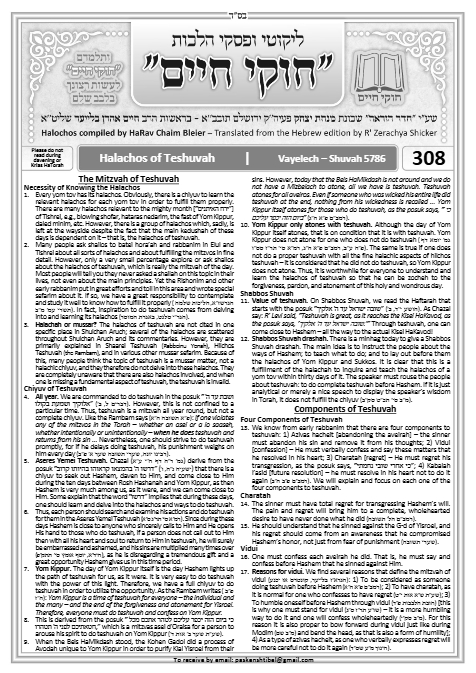
Necessity of Knowing the Halachos

1. Every yom tov has its halachos. Obviously, there is a chiyuv to learn the relevant halachos for each yom tov in order to fulfill them properly. There are many halachos relevant to the mighty month [“ירח האיתנים”] of Tishrei, e.g., blowing shofar, hataras nedarim, the fast of Yom Kippur, daled minim, etc. However, there is a group of halachos which, sadly, is left at the wayside despite the fact that the main kedushah of these days is dependent on it – that is, the halachos of teshuvah.

2. Many people ask shailos to batei hora’ah and rabbanim in Elul and Tishrei about all sorts of halachos and about fulfilling the mitzvos in fine detail. However, only a very small percentage explore or ask shailos about the halachos of teshuvah, which is really the mitzvah of the day. Most people will tell you they never asked a shailah on this topic in their lives, not even about the main principles. Yet the Rishonim and other early rabbanim put in great efforts and toil in this area and wrote special sefarim about it. If so, we have a great responsibility to contemplate and study it well to know how to fulfill it properly (הגרשז"א, הליכות שלמה תשרי עמ' מ"ב ). In fact, inspiration to do teshuvah comes from delving into and learning its halachos (הגר"י סלנט, באגרת המוסר ).

3. Halachah or mussar? The halachos of teshuvah are not cited in one specific place in Shulchan Aruch; several of the halachos are scattered throughout Shulchan Aruch and its commentaries. However, they are primarily explained in Shaarei Teshuvah (Rabbeinu Yonah), Hilchos Teshuvah (the Rambam), and in various other mussar sefarim. Because of this, many people think the topic of teshuvah is a mussar matter, not a halachic chiyuv, and they therefore do not delve into these halachos. They are completely unaware that there are also halachos involved, and when one is missing a fundamental aspect of teshuvah, the teshuvah is invalid.

Chiyuv of Teshuvah

4. All year. We are commanded to do teshuvah in the posuk “ושבת עד ה' אלוקיך ושמעת בקולו” (דברים ל, ב'). However, this is not confined to a particular time. Thus, teshuvah is a mitzvah all year round, but not a complete chiyuv. Like the Rambam says (פ"א תשובה ה"א ): If one violates any of the mitzvos in the Torah – whether an asei or a lo saaseh, whether intentionally or unintentionally – when he does teshuvah and returns from his sin ... Nevertheless, one should strive to do teshuvah promptly, for if he delays doing teshuvah, his punishment weighs on him every day (רבינו יונה, שערי תשובה שער א' פ"ב ).

5. Aseres Yemei Teshuvah. Chazal (גמ' ר"ה דף ח"י ע"א ) derive from the posuk “דרשו ה' בהמצאו קראוהו בהיותו קרוב” (ישעיה נ"ה, ו') that there is a chiyuv to seek out Hashem, daven to Him, and come close to Him during the ten days between Rosh Hashanah and Yom Kippur, as then Hashem is very much among us, as it were, and we can come close to Him. Some explain that the word “דרשו” implies that during these days, one should learn and delve into the halachos and ways to do teshuvah.

6. Thus, each person should search and examine his actions and do teshuvah for them in the Aseres Yemei Teshuvah (רמ"א סי' תר"ג ס"א ). Since during these days Hashem is close to anyone who sincerely calls to Him and He opens His hand to those who do teshuvah, if a person does not call out to Him then with all his heart and soul to return to Him in teshuvah, he will surely be embarrassed and ashamed, and his sins are multiplied many times over (חיד"א, יוסף אומץ סי' תתק"פ ), as he is disregarding a tremendous gift and a great opportunity Hashem gives us in this time period.

7. Yom Kippur. The day of Yom Kippur itself is the day Hashem lights up the path of teshuvah for us, as it were. It is very easy to do teshuvah with the power of this light. Therefore, we have a full chiyuv to do teshuvah in order to utilize the opportunity. As the Rambam writes (פ"ב ה"ז ): Yom Kippur is a time of teshuvah for everyone – the individual and the many – and the end of the forgiveness and atonement for Yisroel. Therefore, everyone must do teshuvah and confess on Yom Kippur.

8. This is derived from the posuk “כי ביום הזה יכפר עליכם לטהר אתכם מכל חטאתיכם לפני ה' תטהרו,” which is a mitzvas asei d’Oraisa for a person to arouse his spirit to do teshuvah on Yom Kippur (שע "ת שער ב' אות ד').

9. When the Beis HaMikdash stood, the Kohen Gadol did a process of Avodah unique to Yom Kippur in order to purify Klal Yisroel from their sins. However, today that the Beis HaMikdash is not around and we do not have a Mizbeiach to atone, all we have is teshuvah. Teshuvah atones for all aveiros. Even if someone who was wicked his entire life did teshuvah at the end, nothing from his wickedness is recalled ... Yom Kippur itself atones for those who do teshuvah, as the posuk says, “כי ביום הזה יכפר עליכם” (רמב"ם פ"א ה"ג ).

10. Yom Kippur only atones with teshuvah. Although the day of Yom Kippur itself atones, that is on condition that it is with teshuvah. Yom Kippur does not atone for one who does not do teshuvah (גמ' יומא דף פ"ה ע"ב, רמב"ם פ"א ה"ג, רמ"א סי' תר"ז סס"ו ). The same is true if one does not do a proper teshuvah with all the fine halachic aspects of hilchos teshuvah – it is considered that he did not do teshuvah, so Yom Kippur does not atone. Thus, it is worthwhile for everyone to understand and learn the halachos of teshuvah so that he can be zocheh to the forgiveness, pardon, and atonement of this holy and wondrous day.

Shabbos Shuvah

11. Value of teshuvah. On Shabbos Shuvah, we read the Haftarah that starts with the posuk “שובה ישראל עד ה' אלקיך” (הושע י"ד, ב'). As Chazal say: R’ Levi said, “Teshuvah is great, as it reaches the Kisei HaKavod, as the posuk says, ‘שובה ישראל עד ה' אלקיך.’” Through teshuvah, one can come close to Hashem – all the way to the actual Kisei HaKavod!

12. Shabbos Shuvah drashah. There is a minhag today to give a Shabbos Shuvah drashah. The main idea is to instruct the people about the ways of Hashem; to teach what to do; and to lay out before them the halachos of Yom Kippur and Sukkos. It is clear that this is a fulfillment of the halachah to inquire and teach the halachos of a yom tov within thirty days of it. The speaker must rouse the people about teshuvah: to do complete teshuvah before Hashem. If it is just analytical or merely a nice speech to display the speaker’s wisdom in Torah, it does not fulfill the chiyuv (מ"ב סי' תכ"ט סק"ב ).

PDF Preview