Parshas Vayigash Insights
Zera Shimshon | January 02, 2025
Print This Article
View Original PDF

Parshas Vayigash Insights

Zera Shimshon | June 27, 2025

On the possuk, "And he (Yosef) sent his brothers, and they went, and he said to them, 'Do not fight or argue on the way'" the Gemorro (Taanis 10/b) comments, "Rebbi Elazar explained; Yosef said to his brothers; Do not argue about halachos, while going on your way, to avoid the risk that the way will 'quarrel' with you (i.e. something bad will happen to you while traveling)."

Zera Shimshon asks what caused Yosef to give them this piece of advice now? Firstly, they probably also knew this halacha without Yosef telling them because they were also Talmedei Chachamim, and even if they didn't know this halacha from themselves, why didn't Yaakov teach it to them before he sent them to Mitzrayim?

Zera Shimshon answers this question according to d'rush.

Introduction

It is written in the sefer, Parshas Derachim (authored by R' Yehuda Rozinus, the author of the Mishne L'melech on the Rambam) that there is machlokos about the status of the descendants of Avraham Yitzchak and Yaakov before the Torah was given. Some say that they were full-fledged Jews, meaning that even regarding halachos that non-Jews are more stringent they were allowed to be lenient like the Jewish nation today.

For instance, both Jewish people and non-Jewish people are prohibited to eat a limb that was cut off of a live animal; aiver min ha'chai. There is a difference, however, between a Jew and non-Jew when an animal that was halachikly shected is considered dead. For a Jewish person the act of shechita establishes that the animal is dead and therefore even if it still spasms after the shechita it is considered dead and it is permitted to cut off a limb, bake it and eat it. For a non-Jew, however, since there is no commandment to shecht, only its complete death renders the animal edible and therefore as long as it spasms it is considered to be living and he is prohibited to eat such meat.

In such a case these opinions hold that Bnei Yisroel were permitted to eat such meat even before the giving of the Torah. There are those who argue and maintain that Avraham and his descendants weren't totally Jewish but had to also keep the laws of the non-Jews before the Torah was given. According to these opinions Bnei Yisroel before the giving of the Torah were prohibited to eat a limb of an animal after shechita as long as the animal was still moving.

Parshas Derachim explains that the brothers of Yosef passkened like the first opinion, that they were one hundred percent Jewish even before the Torah given and Yosef argued and held they have to act according to the stringency of both a Jew and non-Jew.

This explains how could it be that Yosef who was a tzaddik and surely didn't lie reported his brothers, who were also tzaddikim, to Yaakov that they ate aiver min ha'chai. How can it be that they were all tzaddikim?

The answer is that Yosef saw that they ate from an animal after it was shechted before it stopped to spasm. Therefore, in Yosef's eyes they did an avairo since non-Jews are prohibited such meat and Yosef held that they have to keep the stringencies of non-Jews. They themselves held it was permitted since they held they were full-fledged Jews. The reason Yosef reported this to their father was so Yaakov would convince them that Yosef's p'sak is proper.

The Parshas Derachim goes on to explain that not only did Yosef and his brothers argue this point but Hashem, so to speak, and the Attribute of Pure Justice also argued this point!

It is written in the Medrash that when Bnei Yisroel were about to cross Yam Suf the Attribute of Strict Justice claimed that they should not be saved but be killed just like the Mitzriyim because, "hallulu ovdai avodah zarah v'hallulu ovdai avodah zarah- Both Bnei Yisroel and the Mitzriyim served avodah zarah! Therefore, the Attribute of Strict Justice claimed, why should the Mitzriyim get killed and Bnei Yisroel be saved? Hakodesh Baruch Hue responded that Bnei Yisroel served avodah Zarah forcibly and unintentionally (b'shogage), and therefore do not deserve to be punished for what they while the Egyptians served avodah Zarah willingly and therefore deserve to be punished.

The Parshas Derachim asks that this difference is so blatant, how can we understand how the Attribute of Justice even entertained the thought to equate Bnei Yisroel to the Egyptians?

He answers in light of two other differences between a Jew and a non-Jew. The first one is that a Jewish person is prohibited to serve an idol even at the cost of death while a non_Jew is permitted to serve an idol if he is threatened to be killed. The second difference is that if a Jewish person makes a mistake and serves an idol he is exempt from punishment while a non-Jew who mistakably serves an idol is punished for such an act.

According to this, Parshas Derachim explains that the Attribute of Strict Justice maintained, like Yosef, that our ancestors before the giving of the Torah had to act in accordance with the stringencies of both a Jewish person and a non-Jewish person and therefore even though they served avodah zarah in Mitzrayim forcibly they should be punished like a Jewish person and the fact that they served avodah zarah unintentionally they should be punished like a non-Jewish person.

Hakodesh Baruch Hue, on the other hand, maintained, like the brothers, that they were full-fledged Jews that since they had no strength to think clearly because of the severity and brutality that they suffered they were considered as if they made a mistake and therefore they were worthy to be saved.

In short: There are two opinions about the status of our forefathers before the giving of the Torah; they conducted themselves as Jewish even regarding the leniencies of being Jewish or they conducted themselves with the stringencies of being Jewish and also the stringencies of being non-Jewish. Yosef conducted himself according to the latter view and the brothers held like the fist view. At the crossing of the Yam Suf the Attribute of Strict Justice attempted to prevent Hashem saving Bnei Yisroel because they should be judged with the stringencies of being Jewish and being non-Jewish. Hashem rejected the accusation because Hashem judged them as full Jews.

Returning to Yosef's Advice

Returning to the question why Yosef told the brothers to be careful and not to discuss Torah topics when they travel back to Eretz Yisroel.

Before the brothers sold Yosef as a slave Yaakov felt that it was still possible to avoid the whole bondage in Mitzrayim. It was only after the brothers sold Yosef and caused pain to Yaakov did it become inevitable to suffer in Mitzrayim in order to atone for causing so much pain to Yaakov.

Therefore, initially Yosef tried to convince his brothers to take on his view that they conduct themselves also as non-Jews so he reported what they did to Yaakov. The brothers were not convinced and on the contrary, after they successfully sold him as a slave they took this to mean that their p'sak is right, that they are full-fledged Jews and they did nothing wrong by eating meat that was cut off the animal after shechita while it still moved.

However, after they saw that Yosef's becoming a slave was really the beginning of his rise to glory, Yosef was now concerned that would now think that he was really right and that they have to accept on themselves the stringencies of non-Jews like Yosef passkened.

At that time, though, Yosef didn't want this to happen because since after they sold him, exile was unescapable and Yosef knew b'ruach hakodesh that they would inadvertently serve avodah zarah. Therefore, if they would accept his p'sak then when they would be at the Yam Suf the Attribute of Strict Justice's claim would be valid that they also should be punished for serving avodah Zarah. He therefore told them, "al tirgazu b'derech"- don't discuss Torah matters, meaning; don't discuss our old machlokos of what our status is but stay with your opinion that we are one hundred percent Jewish. Like this our descendants will merit to be saved at Yam Suf!
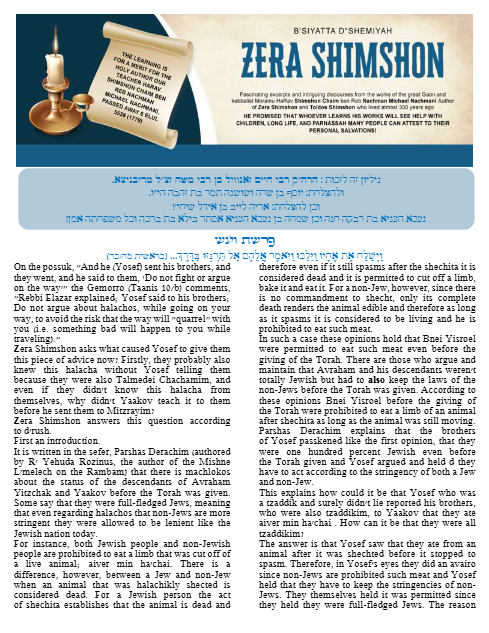
On the possuk, "And he (Yosef) sent his brothers, and they went, and he said to them, 'Do not fight or argue on the way'" the Gemorro (Taanis 10/b) comments, "Rebbi Elazar explained; Yosef said to his brothers; Do not argue about halachos, while going on your way, to avoid the risk that the way will 'quarrel' with you (i.e. something bad will happen to you while traveling)."

Zera Shimshon asks what caused Yosef to give them this piece of advice now? Firstly, they probably also knew this halacha without Yosef telling them because they were also Talmedei Chachamim, and even if they didn't know this halacha from themselves, why didn't Yaakov teach it to them before he sent them to Mitzrayim?

Zera Shimshon answers this question according to d'rush.

Introduction

It is written in the sefer, Parshas Derachim (authored by R' Yehuda Rozinus, the author of the Mishne L'melech on the Rambam) that there is machlokos about the status of the descendants of Avraham Yitzchak and Yaakov before the Torah was given. Some say that they were full-fledged Jews, meaning that even regarding halachos that non-Jews are more stringent they were allowed to be lenient like the Jewish nation today.

For instance, both Jewish people and non-Jewish people are prohibited to eat a limb that was cut off of a live animal; aiver min ha'chai. There is a difference, however, between a Jew and non-Jew when an animal that was halachikly shected is considered dead. For a Jewish person the act of shechita establishes that the animal is dead and therefore even if it still spasms after the shechita it is considered dead and it is permitted to cut off a limb, bake it and eat it. For a non-Jew, however, since there is no commandment to shecht, only its complete death renders the animal edible and therefore as long as it spasms it is considered to be living and he is prohibited to eat such meat.

In such a case these opinions hold that Bnei Yisroel were permitted to eat such meat even before the giving of the Torah. There are those who argue and maintain that Avraham and his descendants weren't totally Jewish but had to also keep the laws of the non-Jews before the Torah was given. According to these opinions Bnei Yisroel before the giving of the Torah were prohibited to eat a limb of an animal after shechita as long as the animal was still moving.

Parshas Derachim explains that the brothers of Yosef passkened like the first opinion, that they were one hundred percent Jewish even before the Torah given and Yosef argued and held they have to act according to the stringency of both a Jew and non-Jew.

This explains how could it be that Yosef who was a tzaddik and surely didn't lie reported his brothers, who were also tzaddikim, to Yaakov that they ate aiver min ha'chai. How can it be that they were all tzaddikim?

The answer is that Yosef saw that they ate from an animal after it was shechted before it stopped to spasm. Therefore, in Yosef's eyes they did an avairo since non-Jews are prohibited such meat and Yosef held that they have to keep the stringencies of non-Jews. They themselves held it was permitted since they held they were full-fledged Jews. The reason Yosef reported this to their father was so Yaakov would convince them that Yosef's p'sak is proper.

The Parshas Derachim goes on to explain that not only did Yosef and his brothers argue this point but Hashem, so to speak, and the Attribute of Pure Justice also argued this point!

It is written in the Medrash that when Bnei Yisroel were about to cross Yam Suf the Attribute of Strict Justice claimed that they should not be saved but be killed just like the Mitzriyim because, "hallulu ovdai avodah zarah v'hallulu ovdai avodah zarah- Both Bnei Yisroel and the Mitzriyim served avodah zarah! Therefore, the Attribute of Strict Justice claimed, why should the Mitzriyim get killed and Bnei Yisroel be saved? Hakodesh Baruch Hue responded that Bnei Yisroel served avodah Zarah forcibly and unintentionally (b'shogage), and therefore do not deserve to be punished for what they while the Egyptians served avodah Zarah willingly and therefore deserve to be punished.

The Parshas Derachim asks that this difference is so blatant, how can we understand how the Attribute of Justice even entertained the thought to equate Bnei Yisroel to the Egyptians?

He answers in light of two other differences between a Jew and a non-Jew. The first one is that a Jewish person is prohibited to serve an idol even at the cost of death while a non_Jew is permitted to serve an idol if he is threatened to be killed. The second difference is that if a Jewish person makes a mistake and serves an idol he is exempt from punishment while a non-Jew who mistakably serves an idol is punished for such an act.

According to this, Parshas Derachim explains that the Attribute of Strict Justice maintained, like Yosef, that our ancestors before the giving of the Torah had to act in accordance with the stringencies of both a Jewish person and a non-Jewish person and therefore even though they served avodah zarah in Mitzrayim forcibly they should be punished like a Jewish person and the fact that they served avodah zarah unintentionally they should be punished like a non-Jewish person.

Hakodesh Baruch Hue, on the other hand, maintained, like the brothers, that they were full-fledged Jews that since they had no strength to think clearly because of the severity and brutality that they suffered they were considered as if they made a mistake and therefore they were worthy to be saved.

In short: There are two opinions about the status of our forefathers before the giving of the Torah; they conducted themselves as Jewish even regarding the leniencies of being Jewish or they conducted themselves with the stringencies of being Jewish and also the stringencies of being non-Jewish. Yosef conducted himself according to the latter view and the brothers held like the fist view. At the crossing of the Yam Suf the Attribute of Strict Justice attempted to prevent Hashem saving Bnei Yisroel because they should be judged with the stringencies of being Jewish and being non-Jewish. Hashem rejected the accusation because Hashem judged them as full Jews.

Returning to Yosef's Advice

Returning to the question why Yosef told the brothers to be careful and not to discuss Torah topics when they travel back to Eretz Yisroel.

Before the brothers sold Yosef as a slave Yaakov felt that it was still possible to avoid the whole bondage in Mitzrayim. It was only after the brothers sold Yosef and caused pain to Yaakov did it become inevitable to suffer in Mitzrayim in order to atone for causing so much pain to Yaakov.

Therefore, initially Yosef tried to convince his brothers to take on his view that they conduct themselves also as non-Jews so he reported what they did to Yaakov. The brothers were not convinced and on the contrary, after they successfully sold him as a slave they took this to mean that their p'sak is right, that they are full-fledged Jews and they did nothing wrong by eating meat that was cut off the animal after shechita while it still moved.

However, after they saw that Yosef's becoming a slave was really the beginning of his rise to glory, Yosef was now concerned that would now think that he was really right and that they have to accept on themselves the stringencies of non-Jews like Yosef passkened.

At that time, though, Yosef didn't want this to happen because since after they sold him, exile was unescapable and Yosef knew b'ruach hakodesh that they would inadvertently serve avodah zarah. Therefore, if they would accept his p'sak then when they would be at the Yam Suf the Attribute of Strict Justice's claim would be valid that they also should be punished for serving avodah Zarah. He therefore told them, "al tirgazu b'derech"- don't discuss Torah matters, meaning; don't discuss our old machlokos of what our status is but stay with your opinion that we are one hundred percent Jewish. Like this our descendants will merit to be saved at Yam Suf!

PDF Preview