Yosef's Destined Mission and the Need to Hurry
Ben Chamesh L'Mikra | December 17, 2023
Print This Article
View Original PDF

Yosef's Destined Mission and the Need to Hurry

Ben Chamesh L'Mikra | December 31, 2025

Destined Mission

The above explanation sheds light on another puzzling detail in Yosef’s words that do not seem to fit in the rest of his conversation. Yosef tells his brothers the following:

Text 13
"...I am your brother Yosef, whom you sold into Egypt. But now do not be sad, and let it not trouble you that you sold me here, for it was to preserve life that G-d sent me before you. For already two years of famine [have passed] in the midst of the land, and [for] another five years, there will be neither plowing nor harvest. And G-d sent me before you to make for you a remnant in the land, and to preserve [it] for you for a great deliverance. And now, you did not send me here, but G-d, and He made me a father to Pharaoh, a lord over all his household, and a ruler over the entire land of Egypt.
Bereishis, 45:4-8

As was explained, the beginning of Yosef’s words expressed an astonishment that his father was still alive, and that the end of his statement let them know that they must go and inform their father of Yosef’s presence in Egypt very quickly.

The above sentences which come in the middle, however, seem to be a tangent. Why was it pertinent right then, to explain at length, the reason that G-d sent him to Egypt?

However, in truth, this statement of Yosef’s was a response to a question that the brothers could have posed to him.

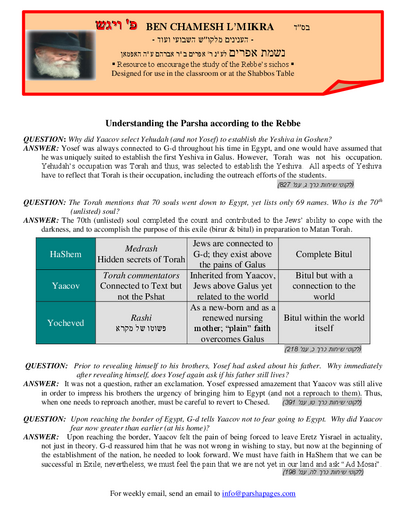
Once Yosef expressed his shock that his father was still living, and expressed the urgency of bringing him to Egypt, one could naturally ask: if it was so important that Yaakov see Yosef, and if every moment that he did not see him his life was endangered, why then did Yosef not return to his father himself?!

Yosef answered this in his explanation concerning his G-d-given mission to be in the land of Egypt, and his statement that he was placed there “for a great deliverance.”

Yosef could not return to Yaakov, since G-d had sent him to Egypt for a reason. He was not there by any choice of his own, but it was his destiny to be there. It was therefore imperative that they bring his father to him in Egypt and not vice versa.

A reason to rush

There is an additional reason for the importance of not tarrying in bringing Yaakov to Egypt, to once again be together with his son.

Rashi explained previously in the Torah, that the 22 years that Yaakov suffered the pain of not seeing his son Yosef, were a punishment for the 22 years that he did not see his father, Yitzchak.

Text 14
...Here are 22 years, corresponding to the 22 years that Yaakov did not fulfill [the mitzvah] to honor his father and mother: 20 years that he was in Lavan’s house, and two years that he was on the road when he returned from Lavan’s house—one and a half years in Succos and six months in Beis-el. This is what he [meant when he] said to Lavan, “This is 20 years for me in your house.” They are for me, upon me, and I will ultimately suffer [for 20 years], corresponding to them.
Rashi, Bereishis, 37:34

Yaakov did not see Yosef for 22 years, as a consequence for not serving his own father for 22 years. As a punishment for not honoring his own father, his son consequently was not able to honor him.

This is another reason that Yosef rushed to bring Yaakov down to Egypt. Once the time for punishment passed, he wished to bring his father to Egypt immediately, and end his pain.
Destined Mission

The above explanation sheds light on another puzzling detail in Yosef’s words that do not seem to fit in the rest of his conversation. Yosef tells his brothers the following:

Text 13
"...I am your brother Yosef, whom you sold into Egypt. But now do not be sad, and let it not trouble you that you sold me here, for it was to preserve life that G-d sent me before you. For already two years of famine [have passed] in the midst of the land, and [for] another five years, there will be neither plowing nor harvest. And G-d sent me before you to make for you a remnant in the land, and to preserve [it] for you for a great deliverance. And now, you did not send me here, but G-d, and He made me a father to Pharaoh, a lord over all his household, and a ruler over the entire land of Egypt.
Bereishis, 45:4-8

As was explained, the beginning of Yosef’s words expressed an astonishment that his father was still alive, and that the end of his statement let them know that they must go and inform their father of Yosef’s presence in Egypt very quickly.

The above sentences which come in the middle, however, seem to be a tangent. Why was it pertinent right then, to explain at length, the reason that G-d sent him to Egypt?

However, in truth, this statement of Yosef’s was a response to a question that the brothers could have posed to him.

Once Yosef expressed his shock that his father was still living, and expressed the urgency of bringing him to Egypt, one could naturally ask: if it was so important that Yaakov see Yosef, and if every moment that he did not see him his life was endangered, why then did Yosef not return to his father himself?!

Yosef answered this in his explanation concerning his G-d-given mission to be in the land of Egypt, and his statement that he was placed there “for a great deliverance.”

Yosef could not return to Yaakov, since G-d had sent him to Egypt for a reason. He was not there by any choice of his own, but it was his destiny to be there. It was therefore imperative that they bring his father to him in Egypt and not vice versa.

A reason to rush

There is an additional reason for the importance of not tarrying in bringing Yaakov to Egypt, to once again be together with his son.

Rashi explained previously in the Torah, that the 22 years that Yaakov suffered the pain of not seeing his son Yosef, were a punishment for the 22 years that he did not see his father, Yitzchak.

Text 14
...Here are 22 years, corresponding to the 22 years that Yaakov did not fulfill [the mitzvah] to honor his father and mother: 20 years that he was in Lavan’s house, and two years that he was on the road when he returned from Lavan’s house—one and a half years in Succos and six months in Beis-el. This is what he [meant when he] said to Lavan, “This is 20 years for me in your house.” They are for me, upon me, and I will ultimately suffer [for 20 years], corresponding to them.
Rashi, Bereishis, 37:34

Yaakov did not see Yosef for 22 years, as a consequence for not serving his own father for 22 years. As a punishment for not honoring his own father, his son consequently was not able to honor him.

This is another reason that Yosef rushed to bring Yaakov down to Egypt. Once the time for punishment passed, he wished to bring his father to Egypt immediately, and end his pain.

PDF Preview