Fourth Reading The Beginnings of Dispute
The Secrets of the Torah and the Beginnings of Dispute
In our discussion of how synthesis works, we mentioned that synthesis is related to the “Workings of the Chariot” (מעשה המרכבה), the general name given to the Torah’s inner dimension, and the numerical allusion is that this phrase has the same value as “right-left-center” (ימין-שמאל-אמצע), which captures the dynamic between the thesis, anti-thesis, and synthesis. All disputes can be seen as thesis and anti-thesis, so disputes are intrinsically related to the Torah’s inner dimension. Where do we find an explicit connection between the two? In the first two mishnayot of the second chapter of tractate Chagigah.
The first mishnah speaks about the Working of the Chariot and is the only mention of this topic in the Mishnah. The second mishnah describes the history of dispute about law within the people of Israel. A connection that could not be more explicit.
The First Dispute
In the first pair, Yossi ben Yoezer and Yossi ben Yochanan, the first Yossi says that it is forbidden to place the hands on the sacrifice on a Yom Tov (one of the three festivals and Rosh Hashanah) and the second Yossi says that it is permissible. In the early generations, there was no substantial dispute that could not be resolved in the Sanhedrin, apart from this law, whether place the hands on an animal offering on Yom Tov is permissible or not.
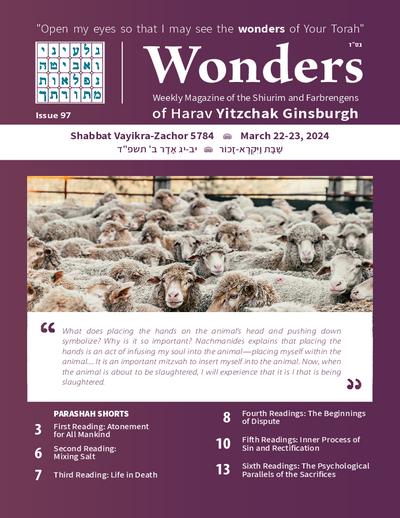
What does placing the hands on the neck of the sacrifice mean? When bringing a sacrifice to the Temple, the person bringing it places his hands upon the head of the sacrifice. He must place both his hands upon it with all his strength. If the sacrifice is for atonement, then while his hands are placed on the head, he must also confess. This is a commandment in the Torah, in the beginning of the Book of Leviticus.
The question whether it is permissible to do so only refers to Yom Tov because on Shabbat, the question is moot because there are no personal sacrifices brought on Shabbat, nor are freewill offerings brought. But, on Yom Tov it is permitted for an individual to bring a sacrifice.
What is the problem with placing the hands on the sacrifice’s head? Why would it not be allowed on a Yom Tov? Apparently, the problem is that doing so makes use of an animal. We see that the primary essential problem on which the sages disagreed is related to the use of animals; it is related to the relationship between humans and animals, a relationship that is captured to a degree in the verse, “You [God] shall save a man and an animal.” According to Maimonides, there is also the additional issue of excessive effort on Yom Tov. In any case, contemporary scholars prove that the main issue is only the use of animals.