Lessons in Likutay Torah Vayikra
Lessons in Likutay Torah | March 19, 2024
Print This Article
View Original PDF

Lessons in Likutay Torah Vayikra

Lessons in Likutay Torah | December 10, 2025

Chapter 1

“Offering Ourselves to Hashem”

“And He [Hashem] called to Moshe, and Hashem spoke to him from the Ohel Moed saying, “When a man will offer from among you an offering to Hashem, it shall be from the domestic animals, [but only] from the cattle or the sheep or goats, shall you bring your offering.” (Vayikra 1:1-2)

The Alter Rebbe asks three questions on the wording of this verse:

  1. We need to understand: Why does the verse start out speaking in the third person, saying, “When a man from you will offer,” but then it concludes in the second person, saying, “You shall bring your offering?”
  2. Also, why does the verse start in the singular “כִּי יַקְרִּיב-when he (one man) will offer,” but it concludes in the plural “תַקְרִּיבוּ- you (plural, many people) shall bring your offering?”
  3. Also, seemingly the verse should have placed the phrase “מִּכֶּם-from among you” before “כִּי יַקְרִּיב-when he will offer”; it should have said, “אָדָם מִּכֶּם כִּי יַקְרִּיב-When a man from among you will offer,” instead of saying “אָדָם כִּי יַקְרִּיב מִּכֶּם-when a man will offer from among you?”

The way the Torah writes seems to imply that the offering is "from among you," i.e., that the person himself is the offering, when in fact, the person is offering an animal?

The Two Souls in Every Jew

However, the matter can be understood based on what is known that in every Jewish person, there are two souls- a Divine soul and an animal soul:

The Divine soul's source is from the level of "Adam/Man," as it is written (Bereshis 1:27), “And Hashem created Adam (the first man) in His image,” and it is written (Yechezkel 1:26), “On the likeness of the Throne was the likeness of the appearance of Adam.”

The name of the first man “אָדָם-Adam” represents the concept of completely selfless dedication to Hashem (ביטול). The numerical value of א -ד-ם is 45, which in Hebrew is “מה," which means "what is it?" This is referring to something transparent that is hardly noticeable, and therefore we must ask about what it is.

The Divine soul comes from a level that is entirely transparent to Hashem's revelation, called "the world of Atzilus.” This level is called “אָדָם-Adam” since this word is related to the word “אֶדַמֶּה - I will be compared" in the verse "אֶדַמֶּה לְעֶלְיוֹן - I will be compared to Above" (Yeshaya 14:14). This level reflects the Truth of Hashem as it really is, and is therefore "compared" to Hashem's Infinite Light, which is "Above" all worlds.

The verse from Yeshaya, which describes Hashem's "Throne," is referring to the level of Malchus of Atzilus. This level is compared to a throne: Just like when one sits on a throne, he lowers his head and body, so too, through this level of Malchus Hashem lowers His Wisdom and Attributes of kindness and severity to be able to interact with limited created beings.

By saying that on this "Throne" there were things like "the appearance of Adam," this means that the level of "Adam" is a level higher in Atzilus than Malchus, more elevated than being the source of existence and interaction with created beings.

Since the Divine soul comes from the level of "Adam," which is beyond creation, it is, therefore, able to reveal the real truth of Hashem into the created beings in this world.

This soul descends below through a chain-like series of spiritual levels through the aspect of “the face of Adam” (Yechezkal 1:10) as it appears in the Merkavah.

The Merkavah and the Animal Soul

The word “מֶרְכָּבָה-Merkavah" literally means ‘chariot’ or ‘vehicle.’ It refers to a spiritual level of angels that are totally subservient to Hashem. Their total lack of ego and self-nullification before Hashem is compared to how a chariot is subservient to its rider; it goes where the rider wants, with no say of its own.

At this level of angels known as the "Merkavah," there are four "faces," meaning four aspects. These are described in the vision of Yechezkal as the “faces” of an “Adam, lion, ox, and eagle.” The highest aspect is the "face of Adam." Since this level is the highest and most refined level of the angels, it can serve as an "intermediary" level through which the Divine soul can come through on its way down into the physical world.

The animal soul derives directly from the "dregs of the Ofanim angels." On a higher level, it is rooted in the level of angels known as "the face of the Ox."

The animal soul, as we experience it, derives from the lowest spiritual levels, known as the "dregs" of the Ofanim angels. Dregs, or sediment, is what remains from the wine after the drinkable part is strained off. Similarly, the spirituality of the animal soul becomes "drained" from the revelation of Hashem that it experienced in its source in the angels. It is for this reason that its passion and yearning, which were originally a passion and longing for Hashem, have turned into a love and desire for pure physicality.

The source of the Ofanim angels is from the level of "the face of the Ox," from the level of angels known as the Merkavah. We explained above that Merkavah means ‘chariot’ or ‘vehicle,’ and represents a total dedication and submission to Hashem, like a chariot to a rider. This means that in the ultimate source of the animal soul, he is derived from a level of angels that were totally dedicated to Hashem. The level of "the face of Adam" is a much higher level of angels in the "Merkavah" than the "face of the Ox." However, the level of "the face of the Ox" is also part of the "Merkavah." Its ego is totally nullified by Hashem. This is what enables the animal soul (which ultimately derives from this level also) to be genuinely dedicated to Hashem, even though it cannot be on the same level of dedication as the Divine soul.

The Purpose of the Descent

The purpose of the descent of the Divine soul into this world is to refine the animal soul so that it should be tamed and transformed.

This is accomplished through the Divine soul becoming invested in the animal soul. Then, when the Divine soul contemplates the fact that "Hashem is One" when reciting Krias Shema “Hear Yisroel, Hashem is our G-d, Hashem is One,” this gets the animal soul to also think about Hashem’s Oneness.

Through this a person will come to experience what is described in the following verse, “And you shall love Hashem...with all your heart,” meaning, with both inclinations, the inclination of the Divine soul and the inclination of the animal soul.

The word לְבָבְךָ – ‘heart’ is usually spelled with one letter ב, לבך. It is spelled here with letter ב twice to shows us that it is referring to two different "hearts," i.e., two sets of feelings, the feelings of the Divine soul (which are always directed towards Hashem) and the feelings of the animal soul (which are directed towards physicality now, but in its spiritual source were also directed towards Hashem).

Both should come to love Hashem when a Jew thinks about Hashem's Oneness while reciting the Shema.

The Blessings Before Shema

However, before saying Shema, the Sages instated to recite "two blessings before it," to facilitate the proper fulfillment of the Mitzva of saying Shema.

The need for reciting these blessings is because it is impossible to completely subdue and conquer the desires of the animal soul to be under the control of the Divine soul without first revealing the spiritual source of the animal soul.

The source from which it originates is from the level of angels known as the “Holy Chayos,” who make up the “Merkavah,” specifically from the aspects of the “face of the Lion” and the “face of the Ox.”

The name “Chayos" literally means "lively creatures" and usually refers to wild animals. Here, it refers to angels that have tremendous liveliness and excitement in their connection to Hashem, and are compared to a lion and ox in terms of their strength and energy in serving Hashem. These "lively" angels make up the "Merkavah" of angels that are totally dedicated to Hashem like a chariot to its rider. These are a higher level than the "dregs of the Ofanim” and the “Ofanim" angels, and are the highest source for the animal soul in the created worlds.

The reason that we need to reveal the source of the animal soul is because “things that appear harsh in this world cannot be turned into revealed good except by revealing their source in Holiness.”

Through this process, there is a great spiritual ascent for the Divine soul as well, similar to the concept that “the Chayos ‘lift up’ Hashem’s Throne.”

In the Midrash, it mentions that the Chayos angels that make up the Merkavah ‘lift up’ Hashem’s ‘Throne.’ We explained above that the Throne represents Malchus, through which Hashem lowers Himself to interact with the creations. ‘Lifting up’ Hashem’s Throne means that they bring about an elevation in the level of Malchus. This is because these angels are derived from the world of Tohu, which is higher than Tikun. Since Malchus of Atzilus -the Throne- is of the world of Tikun and these angels have a connection to Tohu, when Malchus refines these angels, it receives an elevation stemming from the Light of Tohu, which was previously trapped in these angels. This is how the Chayos ‘lift up’ the Throne.

Similarly, since the Divine soul comes from Atzilus -Tikun- and the animal soul has a connection to Tohu, by the Divine soul refining the animal soul, it receives the Light of Tohu previously trapped in the animal soul. This is the elevation that the Divine soul receives through refining the animal soul.

Isarusa Dele’sata and Isarusa Dele’eila

Now, through the person picking himself up spiritually through prayer, to be able to receive Hashem’s revelation, and the “Isarusa Dele’sata-awakening from the person below,” this brings about an “Isarusa Dele’eila-awakening from Hashem Above,” that Hashem should want to shine His Light into the person during prayer.

This process is referred to in regards to offerings as “רֵיחַ נִיחוֹחַ לַהֲוָיָה - an aroma that is pleasing to Hashem.” (Vayikra 1:9)

In the maamarim for Parshas Pinchas in Likutei Torah, the Alter Rebbe explains the mystical meaning behind this phrase:

  • “רֵיחַ -aroma/smell" is something that wafts upwards into the air like smoke that rises. This is a reference to our service of prayer, where we lift ourselves up spiritually, just like a smell (or smoke) rises up.
  • “נִיחוֹחַ -pleasing” is related to the word “חות” which means to descend or go down in level.
  • “לַהֲוָיָה-to Hashem” meaning that through our spiritual elevation accomplished during prayer (רֵיחַ ) we cause that Hashem (לַהֲוָיָה) should want to descend (נִיחוֹחַ ) in order to be revealed in us.

Now, this process follows the system that first there needs to be an “Isarusa Dele’sata” from one’s own initiative, and afterward, this brings about an “Isarusa Dele’eila.”

However, there is also another system, where there is first an “Isarusa Dele’eila,” which is initiated from Above and comes to wake up the person to have an “Isarusa Dele’sata.”

Meaning that it comes to awaken the person from his spiritual “sleep” in the vanities of this physical world.

This process is similar to how it was at the beginning of the creation of the world, when there was a bestowal of Hashem's Undeserved Kindness, as it says, “For He [Hashem] desires kindness” (Micha 7:18).

When Hashem first made the world, it was just an expression of Hashem's Kindness. No one was around to serve Hashem, so no one was "deserving" of this kindness. Instead, Hashem, of His own initiative, decided to be kind and create the world.

So too, at the beginning of a person's service of Hashem, Hashem comes first to wake up the person to His service, even if the person doesn't deserve it.
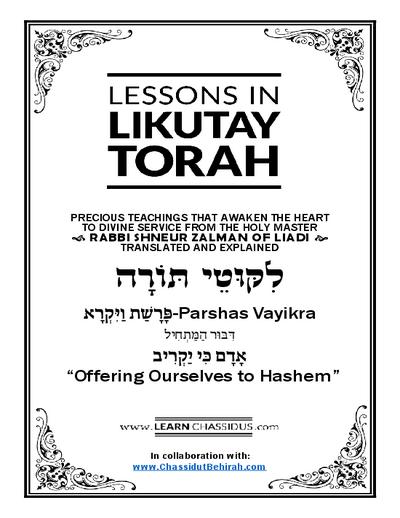

Chapter 1

“Offering Ourselves to Hashem”

“And He [Hashem] called to Moshe, and Hashem spoke to him from the Ohel Moed saying, “When a man will offer from among you an offering to Hashem, it shall be from the domestic animals, [but only] from the cattle or the sheep or goats, shall you bring your offering.” (Vayikra 1:1-2)

The Alter Rebbe asks three questions on the wording of this verse:

  1. We need to understand: Why does the verse start out speaking in the third person, saying, “When a man from you will offer,” but then it concludes in the second person, saying, “You shall bring your offering?”
  2. Also, why does the verse start in the singular “כִּי יַקְרִּיב-when he (one man) will offer,” but it concludes in the plural “תַקְרִּיבוּ- you (plural, many people) shall bring your offering?”
  3. Also, seemingly the verse should have placed the phrase “מִּכֶּם-from among you” before “כִּי יַקְרִּיב-when he will offer”; it should have said, “אָדָם מִּכֶּם כִּי יַקְרִּיב-When a man from among you will offer,” instead of saying “אָדָם כִּי יַקְרִּיב מִּכֶּם-when a man will offer from among you?”

The way the Torah writes seems to imply that the offering is "from among you," i.e., that the person himself is the offering, when in fact, the person is offering an animal?

The Two Souls in Every Jew

However, the matter can be understood based on what is known that in every Jewish person, there are two souls- a Divine soul and an animal soul:

The Divine soul's source is from the level of "Adam/Man," as it is written (Bereshis 1:27), “And Hashem created Adam (the first man) in His image,” and it is written (Yechezkel 1:26), “On the likeness of the Throne was the likeness of the appearance of Adam.”

The name of the first man “אָדָם-Adam” represents the concept of completely selfless dedication to Hashem (ביטול). The numerical value of א -ד-ם is 45, which in Hebrew is “מה," which means "what is it?" This is referring to something transparent that is hardly noticeable, and therefore we must ask about what it is.

The Divine soul comes from a level that is entirely transparent to Hashem's revelation, called "the world of Atzilus.” This level is called “אָדָם-Adam” since this word is related to the word “אֶדַמֶּה - I will be compared" in the verse "אֶדַמֶּה לְעֶלְיוֹן - I will be compared to Above" (Yeshaya 14:14). This level reflects the Truth of Hashem as it really is, and is therefore "compared" to Hashem's Infinite Light, which is "Above" all worlds.

The verse from Yeshaya, which describes Hashem's "Throne," is referring to the level of Malchus of Atzilus. This level is compared to a throne: Just like when one sits on a throne, he lowers his head and body, so too, through this level of Malchus Hashem lowers His Wisdom and Attributes of kindness and severity to be able to interact with limited created beings.

By saying that on this "Throne" there were things like "the appearance of Adam," this means that the level of "Adam" is a level higher in Atzilus than Malchus, more elevated than being the source of existence and interaction with created beings.

Since the Divine soul comes from the level of "Adam," which is beyond creation, it is, therefore, able to reveal the real truth of Hashem into the created beings in this world.

This soul descends below through a chain-like series of spiritual levels through the aspect of “the face of Adam” (Yechezkal 1:10) as it appears in the Merkavah.

The Merkavah and the Animal Soul

The word “מֶרְכָּבָה-Merkavah" literally means ‘chariot’ or ‘vehicle.’ It refers to a spiritual level of angels that are totally subservient to Hashem. Their total lack of ego and self-nullification before Hashem is compared to how a chariot is subservient to its rider; it goes where the rider wants, with no say of its own.

At this level of angels known as the "Merkavah," there are four "faces," meaning four aspects. These are described in the vision of Yechezkal as the “faces” of an “Adam, lion, ox, and eagle.” The highest aspect is the "face of Adam." Since this level is the highest and most refined level of the angels, it can serve as an "intermediary" level through which the Divine soul can come through on its way down into the physical world.

The animal soul derives directly from the "dregs of the Ofanim angels." On a higher level, it is rooted in the level of angels known as "the face of the Ox."

The animal soul, as we experience it, derives from the lowest spiritual levels, known as the "dregs" of the Ofanim angels. Dregs, or sediment, is what remains from the wine after the drinkable part is strained off. Similarly, the spirituality of the animal soul becomes "drained" from the revelation of Hashem that it experienced in its source in the angels. It is for this reason that its passion and yearning, which were originally a passion and longing for Hashem, have turned into a love and desire for pure physicality.

The source of the Ofanim angels is from the level of "the face of the Ox," from the level of angels known as the Merkavah. We explained above that Merkavah means ‘chariot’ or ‘vehicle,’ and represents a total dedication and submission to Hashem, like a chariot to a rider. This means that in the ultimate source of the animal soul, he is derived from a level of angels that were totally dedicated to Hashem. The level of "the face of Adam" is a much higher level of angels in the "Merkavah" than the "face of the Ox." However, the level of "the face of the Ox" is also part of the "Merkavah." Its ego is totally nullified by Hashem. This is what enables the animal soul (which ultimately derives from this level also) to be genuinely dedicated to Hashem, even though it cannot be on the same level of dedication as the Divine soul.

The Purpose of the Descent

The purpose of the descent of the Divine soul into this world is to refine the animal soul so that it should be tamed and transformed.

This is accomplished through the Divine soul becoming invested in the animal soul. Then, when the Divine soul contemplates the fact that "Hashem is One" when reciting Krias Shema “Hear Yisroel, Hashem is our G-d, Hashem is One,” this gets the animal soul to also think about Hashem’s Oneness.

Through this a person will come to experience what is described in the following verse, “And you shall love Hashem...with all your heart,” meaning, with both inclinations, the inclination of the Divine soul and the inclination of the animal soul.

The word לְבָבְךָ – ‘heart’ is usually spelled with one letter ב, לבך. It is spelled here with letter ב twice to shows us that it is referring to two different "hearts," i.e., two sets of feelings, the feelings of the Divine soul (which are always directed towards Hashem) and the feelings of the animal soul (which are directed towards physicality now, but in its spiritual source were also directed towards Hashem).

Both should come to love Hashem when a Jew thinks about Hashem's Oneness while reciting the Shema.

The Blessings Before Shema

However, before saying Shema, the Sages instated to recite "two blessings before it," to facilitate the proper fulfillment of the Mitzva of saying Shema.

The need for reciting these blessings is because it is impossible to completely subdue and conquer the desires of the animal soul to be under the control of the Divine soul without first revealing the spiritual source of the animal soul.

The source from which it originates is from the level of angels known as the “Holy Chayos,” who make up the “Merkavah,” specifically from the aspects of the “face of the Lion” and the “face of the Ox.”

The name “Chayos" literally means "lively creatures" and usually refers to wild animals. Here, it refers to angels that have tremendous liveliness and excitement in their connection to Hashem, and are compared to a lion and ox in terms of their strength and energy in serving Hashem. These "lively" angels make up the "Merkavah" of angels that are totally dedicated to Hashem like a chariot to its rider. These are a higher level than the "dregs of the Ofanim” and the “Ofanim" angels, and are the highest source for the animal soul in the created worlds.

The reason that we need to reveal the source of the animal soul is because “things that appear harsh in this world cannot be turned into revealed good except by revealing their source in Holiness.”

Through this process, there is a great spiritual ascent for the Divine soul as well, similar to the concept that “the Chayos ‘lift up’ Hashem’s Throne.”

In the Midrash, it mentions that the Chayos angels that make up the Merkavah ‘lift up’ Hashem’s ‘Throne.’ We explained above that the Throne represents Malchus, through which Hashem lowers Himself to interact with the creations. ‘Lifting up’ Hashem’s Throne means that they bring about an elevation in the level of Malchus. This is because these angels are derived from the world of Tohu, which is higher than Tikun. Since Malchus of Atzilus -the Throne- is of the world of Tikun and these angels have a connection to Tohu, when Malchus refines these angels, it receives an elevation stemming from the Light of Tohu, which was previously trapped in these angels. This is how the Chayos ‘lift up’ the Throne.

Similarly, since the Divine soul comes from Atzilus -Tikun- and the animal soul has a connection to Tohu, by the Divine soul refining the animal soul, it receives the Light of Tohu previously trapped in the animal soul. This is the elevation that the Divine soul receives through refining the animal soul.

Isarusa Dele’sata and Isarusa Dele’eila

Now, through the person picking himself up spiritually through prayer, to be able to receive Hashem’s revelation, and the “Isarusa Dele’sata-awakening from the person below,” this brings about an “Isarusa Dele’eila-awakening from Hashem Above,” that Hashem should want to shine His Light into the person during prayer.

This process is referred to in regards to offerings as “רֵיחַ נִיחוֹחַ לַהֲוָיָה - an aroma that is pleasing to Hashem.” (Vayikra 1:9)

In the maamarim for Parshas Pinchas in Likutei Torah, the Alter Rebbe explains the mystical meaning behind this phrase:

  • “רֵיחַ -aroma/smell" is something that wafts upwards into the air like smoke that rises. This is a reference to our service of prayer, where we lift ourselves up spiritually, just like a smell (or smoke) rises up.
  • “נִיחוֹחַ -pleasing” is related to the word “חות” which means to descend or go down in level.
  • “לַהֲוָיָה-to Hashem” meaning that through our spiritual elevation accomplished during prayer (רֵיחַ ) we cause that Hashem (לַהֲוָיָה) should want to descend (נִיחוֹחַ ) in order to be revealed in us.

Now, this process follows the system that first there needs to be an “Isarusa Dele’sata” from one’s own initiative, and afterward, this brings about an “Isarusa Dele’eila.”

However, there is also another system, where there is first an “Isarusa Dele’eila,” which is initiated from Above and comes to wake up the person to have an “Isarusa Dele’sata.”

Meaning that it comes to awaken the person from his spiritual “sleep” in the vanities of this physical world.

This process is similar to how it was at the beginning of the creation of the world, when there was a bestowal of Hashem's Undeserved Kindness, as it says, “For He [Hashem] desires kindness” (Micha 7:18).

When Hashem first made the world, it was just an expression of Hashem's Kindness. No one was around to serve Hashem, so no one was "deserving" of this kindness. Instead, Hashem, of His own initiative, decided to be kind and create the world.

So too, at the beginning of a person's service of Hashem, Hashem comes first to wake up the person to His service, even if the person doesn't deserve it.

PDF Preview