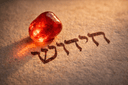
Purim
The Talmud tells us that the Purim Megillah might be read on several different days. The normal time nowadays is 14 Adar, and in some ancient cities like Jerusalem, which had a wall round them in the time of Joshua, it is read the next day on the 15th, termed ‘Shushan Purim’. But at an earlier stage of our history, the Megillah might also be read on the 11th, 12th, or 13th.
The reason for the earlier dates was because for people who lived in small villages, it was convenient to hear the Megillah when many people would gather together on market days, held on Mondays and Thursdays. Those who lived in larger cities would read it on the 14th, as we generally do today, and those who live in ancient walled cities, like Jerusalem, read it on the 15th.
This means in practice, as Tractate Megillah states in its opening line, the Megillah can be read on the 11th, 12th, 13th, 14th and 15th. Chabad teachings explain, based on the book Two Tablets of the Covenant, that the 11th signifies the lower two letters Vav (gematria 6) and Heh (5) of the Divine Name, and the 15th signifies the upper two letters of the Divine Name, Yud (10) and Heh (5).
The eleventh therefore signifies the lower level of spirituality, as if at the bottom rung of the ladder, and then one ascends higher to the fifteenth, the highest level, the ‘top of the ladder reaching the heavens’. The differing stages of village, then city, and then ancient walled city are like steps in a form of spiritual progress.
Halachically, a city is defined as a place when there are ten people who do not do ordinary work but are preoccupied with Torah study and with caring for the spiritual needs of the community. The idea that a ‘city’ represents spiritual fulfilment is also seen in the verse ‘Great is G-d and very much praised, in the City of our G-d’.
However, even in the village, at the bottom of the spiritual ladder, there is the positive atmosphere of ‘the Jews had radiance and joy and happiness and glory’ (Esth.8:16), and the spiritual power of the reading of the Megillah on the eleventh of Adar, signifying the lower letters of the Divine Name, Vav and Heh.
Then one rises, higher and higher, till one reaches the level of the fifteenth of the month, when the moon is full, expressing the first two letters of the Divine Name, Yud and Heh.
These different levels are all aspects of the festival of Purim. The Sages tell us that Purim is closely connected with wine (in the large banquet with which the Megillah begins, and in the private banquets organized by Queen Esther for Ahasuerus and Haman) and wine signifies Understanding, the Divine Attribute Binah. This is the first Heh in the Divine Name. Further, the letter Yud, the initial letter of the Divine Name, signifying Wisdom, Hokhmah, flows into that letter Heh.
Although this is a very great spiritual attainment, the essence of Purim is actually much higher, altogether beyond understanding: the level of ‘not knowing’. While hearing the Megillah being read, one should be able to focus on the text and understand, but ultimately Purim is about reaching beyond the limitations of understanding, which means reaching the level not just of the Yud (Wisdom) which is higher than Heh (Understanding), but beyond the Yud itself to the ‘crown’ on the Yud which reaches upwards, beyond Wisdom, to the realm of not knowing.
While this is the inner meaning of the experience of Purim, reaching the Divine at the level of ‘not knowing’, an important further goal is that this exalted level should be drawn down into all the following days of the year. Every single day should be impregnated with that infinite aspect of the Divine which transcends all understanding.
This has an eternal quality, because Purim itself is eternal, as the Megillah states ‘these days of Purim will never disappear from the Jews’ (Est.9:28), and the Jewish people themselves are eternal, fulfilling their mission in this world, bringing about the building of the Third Temple which will also be eternal.
All this will be in a way of ‘revelation’, which is what the word Megillah means, according to the Kabbalah: a form of the word giluy, revelation. The revelation will be, as Isaiah states about the time of Moshiach: ‘the glory of G-d will be revealed, and all flesh will see that G-d has spoken’ (Is.40:5).