The Meaning of the Olah Sacrifice
“And the Olah shall be skinned, and you shall cut it into pieces.” (Vayikra 1:6)
This Parsha introduces the korbanos, the various sacrifices that would be offered by the Jewish People to Hashem. There is much discussion amongst the commentaries as to the purpose of these sacrifices, but the bottom line is that they were intended to be a way for us to create closeness with Hashem. That is why the root of the word ‘korban’ is ‘karov’, meaning close.
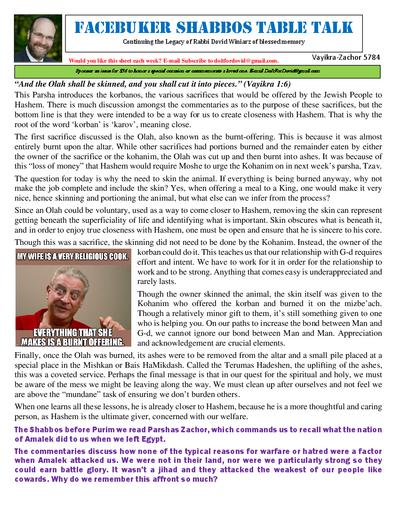
The first sacrifice discussed is the Olah, also known as the burnt-offering. This is because it was almost entirely burnt upon the altar. While other sacrifices had portions burned and the remainder eaten by either the owner of the sacrifice or the kohanim, the Olah was cut up and then burnt into ashes. It was because of this “loss of money” that Hashem would require Moshe to urge the Kohanim on in next week’s parsha, Tzav.
The question for today is why the need to skin the animal. If everything is being burned anyway, why not make the job complete and include the skin? Yes, when offering a meal to a King, one would make it very nice, hence skinning and portioning the animal, but what else can we infer from the process?
Since an Olah could be voluntary, used as a way to come closer to Hashem, removing the skin can represent getting beneath the superficiality of life and identifying what is important. Skin obscures what is beneath it, and in order to enjoy true closeness with Hashem, one must be open and ensure that he is sincere to his core.
Though this was a sacrifice, the skinning did not need to be done by the Kohanim. Instead, the owner of the korban could do it. This teaches us that our relationship with G-d requires effort and intent. We have to work for it in order for the relationship to work and to be strong. Anything that comes easy is underappreciated and rarely lasts.
Though the owner skinned the animal, the skin itself was given to the Kohanim who offered the korban and burned it on the mizbe’ach. Though a relatively minor gift to them, it’s still something given to one who is helping you. On our paths to increase the bond between Man and G-d, we cannot ignore our bond between Man and Man. Appreciation and acknowledgement are crucial elements.
Finally, once the Olah was burned, its ashes were to be removed from the altar and a small pile placed at a special place in the Mishkan or Bais HaMikdash. Called the Terumas Hadeshen, the uplifting of the ashes, this was a coveted service. Perhaps the final message is that in our quest for the spiritual and holy, we must be aware of the mess we might be leaving along the way. We must clean up after ourselves and not feel we are above the “mundane” task of ensuring we don’t burden others.
When one learns all these lessons, he is already closer to Hashem, because he is a more thoughtful and caring person, as Hashem is the ultimate giver, concerned with our welfare.