Moshe's Role in Teaching Torah and the Establishment of Judges
Ben Chamesh L'Mikra | January 29, 2024
Print This Article
View Original PDF

Moshe's Role in Teaching Torah and the Establishment of Judges

Ben Chamesh L'Mikra | December 10, 2025

A man prefers a kav (portion) of his own to nine of his neighbor’s.
Talmud, Bava Metzia 38a

They therefore requested from Moshe that they hear the Torah on the spiritual level that they were truly holding. In order that they would truly internalize Torah with their own abilities, they requested to hear the Torah from Moshe instead of from G-d.

G-d agreed with the Jewish people, because through them receiving Torah on their true level, they would be internally affected by the Torah.

Moshe’s wording

When Moshe expressed his displeasure that the Israelites did not want to receive the Torah directly from G-d, he used the phrase, “You weakened my strength as that of a female.” This expression seems rather strange.

What does receiving the Torah through an intermediary have anything to do with the weakening of Moshe himself? It would make sense were Moshe to have expressed that he was pained by their choice of hearing the Commandments from him instead of from G-d, but why was Moshe weakened by their request?

According to the above explanation though, this is understood.

Switching from the mode of hearing the Torah from G-d to having it said over by Moshe, was not merely a change of source from which they heard the Ten Commandments, but, in order to enable that transition, Moshe was forced to restrain the way that he expressed himself to his nation.

In order for Moshe Rabbeinu to teach the Jewish people Torah on their own level, as they wished to receive it, he needed to ensure that he limit his own expression so that they would not only be inspired by Moshe, and reach a level that was not truly their own.

Were Moshe to have expressed himself naturally, as he had done prior to their request—according to his own lofty spiritual level—he would have automatically lifted them to a level that was not truly their own.

For the Jewish nation to receive the Torah on their own level, Moshe Rabbeinu was forced to weaken himself, so-to-speak. Only then, was he able to impart the Torah to them in the manner that they wished to receive it. The transition was thus not merely a shift of hearing it from Moshe, but was a change in the entire way that Moshe dealt with his flock.

Teaching Torah to the Jewish people

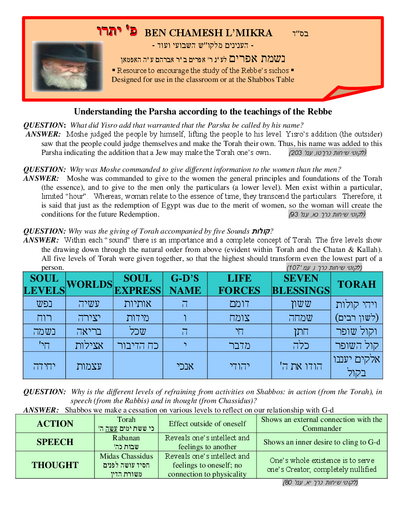
According to the above explanation regarding the giving of the Torah, we can now understand the reason why Moshe believed that it was he alone who was to teach the people Torah.

When Moshe began teaching the Torah to the Jewish people after the Torah was given, he operated under the assumption that they must hear all of its directives directly from him, as through them learning the Torah from him—the one who had directly received it from the Almighty—it would be as if they had heard it from G-d.

Moshe believed that since had heard the Torah directly from G-d, he was the only one who was able to properly convey its true intent, and with its full intensity.

This is expressed as well in the following verse:

I stood between the Lord and you at that time, to tell you the word of the Lord.
Devarim 5:5

Moshe Rabbeinu was the conduit to completely express G-d’s words. It was completely G-d’s words that Moshe uttered when he taught Torah, without any admixture of his personal identity. Moshe therefore understood that if the Jewish people would hear the Torah from him, it would be as if they had heard it from G-d directly.

Moshe desired as much as possible to give over the true intent of Torah from G-d Himself, and to do so he needed to be the one that taught them.

This idea is expressed in Moshe’s exchange with his father-in-law. When Moshe was asked why he sits the entire day, judging the Jewish people, Moshe responded:

For the people come to me to seek G-d.
Devarim 18:15

Rashi comments there, that Moshe was saying that the Jewish people come “to seek teaching from before the Lord.” He was answering Yisro that hearing the Torah from him was as if they had come before G-d. Moshe was not only a teacher of Torah, he was the true conveyer of Torah, as coming to learn from Moshe was as if they had come to learn from G-d Himself.

As mentioned above, the level in which Jewish people learned the Torah directly from Moshe was heightened, for when the Israelites were in his presence they were automatically raised to a higher plane.

When Moshe received the Torah from G-d he didn’t only hear the Torah, but he experienced it in a revealed way. Thus, when Moshe taught the Jewish people Torah, he didn’t merely teach them, he raised them to a level where they too were able to experience the Torah in a revealed manner, in a similar manner to the way he perceived it.

When the Israelites were taught Torah in such a manner of being raised to a level where they too could experience Torah, they would have been able to learn directly from Moshe without it causing him to be worn out.

Yisro’s standpoint

As an outsider however, Yisro viewed the Jewish people for who they were themselves, not in the way that they were uplifted through standing in Moshe’s presence.

He therefore argued, that though it was of great value for the Jewish people to be taught Torah on the highest level possible, concerning the judgment of the Jewish people’s own quarrels and disputes, this should be done on the level that they were holding on their own.

When dealing with their own issues they are not living in Moshe’s reality, and therefore he believed that Moshe should not be the only one to judge them. When they are involved in their own quarrels he believed that they would not be able to raise themselves beyond their pettiness and to enter a higher plane.

He therefore suggested that Moshe should establish a system of smaller courts, which would be able to settle the Jewish people’s disputes and deal with the Jewish people’s quarrels and disputes on their own level.

In truth, Moshe’s stance was true, being that even when dealing with their own issues, as they stood before Moshe, the Jewish people were indeed affected by his presence.

(This concept can also be understood simply, in the case of a student who stands in the same room as his teacher. The student’s behavior will automatically be different, and on a higher level than if his teacher would not be present.)

This lifted them to a level in which they became proper receptacles and were indeed able to receive Moshe’s guidance even concerning their personal quarrels.

Yisro’s discussion with Moshe was not only concerning about whether it should be Moshe who judged them or others but it was about the entire manner that they would be judged. Moshe believed that the Jewish people should be uplifted beyond their pettiness and receive the Torah in its pure form, whereas Yisro countered that although this may be possible when they are studying the Torah, this would not be possible when the people were thinking about their personal quarrels.

G-d agrees

G-d ultimately agreed with Yisro’s proposition—not because Moshe was wrong—but in order to ensure that there would be a system for instructing the Jewish people, even after Moshe’s passing. G-d therefore instituted a system in which the Jewish people could receive the word of G-d even in a situation where Moshe was no longer alive.

Moshe himself however, did not think of adapting to a different system for two reasons:

  • A) He was the leader of the generation that he was in. The leader of a generation is charged with the mission of leading his own generation. He therefore did not think to prepare for a time after his passing.
  • B) Were it not have been for a later sin, Moshe Rabbeinu would have indeed entered the Holy Land along with the Jewish people, and the redemption would have arrived and the Jewish people would have continued to benefit from learning Torah in this higher form.

Yet, being that the Almighty was aware of this future outcome, He agreed to Yisro’s suggestions, and allowed for a new system of judges to be set up.

Set up by Moshe

However, even this system of judges, established ultimately for the generations who would follow Moshe’s time, needed to be set up by Moshe himself. All matters concerning Torah, even for later generations, needed to come through the medium of Moshe.

For, any novelty in Torah, even that which would be revealed at a later time, was given to Moshe at Sinai, along with the Ten Commandments.

R. Chiyya ben Abba also said in the name of R. Yochanan: “What is the meaning of the verse, ‘And on them was written according to all the words which the Lord spoke with you in the mount?’ It teaches us that the Holy One, blessed be He, showed Moshe the minutiae of the Torah, and the minutiae of the Scribes, and the innovations which would be introduced by the Scribes.”
Talmud, Megilah 19b

In order for the innovations of later generations to be considered a part of the Torah, it needed to be set up by Moshe. Only then would these innovations be considered to have come from G-d himself. Were knew innovations to be indeed new, and not embedded in a previous teaching of Moshe, they would not be considered to be a part of Torah.

It was therefore up to Moshe to set up the system of judges, so that this be not merely a practical solution to solving judicial disputes after Moshe’s passing but a part of Torah.

Yisro therefore entreated Moshe, “you shall see [choose].” He wished that it specifically be Moshe who would choose the judges.

Rashi comments accordingly on the verse, with the following words:

With the Holy Spirit that is upon you.
Rashi, Shemos 18:21

When Moshe set up the judicial system, he didn’t do so merely based on his own logic but with the G-dly spirit that rested upon him.

Moshe’s establishment of the new judicial system ensured that the continuum of judges be from the judges that were enacted by G-d, and that the ruling of the judges of future generations, be the ruling of Torah and therefore an expression of the will of G-d.

And you shall see

For Moshe to acquiesce to Yisro’s wish he needed to lower himself from the way that he related to the Torah in order to find judges that could relate to the Jewish people on their own level.

This concept is expressed in Yisro’s words: When Yisro tells Moshe to choose judges, he tells him, “you shall see [to choose].” The words that the Torah employs for this expression are, “v’ata tech’eze.”

The word “techeze” is not a Hebrew word, but the Aramaic translation of the word for sight. Rather than using the normal Hebew term, the Torah uses a translation of the word which expresses a lesser degree of holiness.

This is fitting with the essential act of the appointment of judges. In order for Moshe to appoint judges to guide the nation on their true level, he needed to lower himself from the way that he saw the Jewish people, and to view them on a lower level—a level on which they were in need of judges other than himself.

This is why the name for this parsha is Yisro. Being that Moshe himself did not see the Jewish people in the way that Yisro saw them, it was specifically through Yisro’s perspective of the Jewish people that this section of the Torah was added, and the new system of judgment was put in place.

The ultimate point

Although this seemed to be a lowering of the level for those that were not able to receive the Torah directly from Moshe, in truth, this is the ultimate purpose.

The goal of the world is to transform even the lowest parts of the world and this is done through dealing with individuals that are on this lower level.

Through lowering oneself to the level of to uplift even those that are on the lowest of levels we fulfill the ultimate purpose of transforming this lowly world into an abode for G-d Himself!

(Based on Likutei Sichos 16, Yisro 2, reworked by Rabbi Dovid Markel. To see other projects and to partner in our work, see: www.Neirot.com.)
A man prefers a kav (portion) of his own to nine of his neighbor’s.
Talmud, Bava Metzia 38a

They therefore requested from Moshe that they hear the Torah on the spiritual level that they were truly holding. In order that they would truly internalize Torah with their own abilities, they requested to hear the Torah from Moshe instead of from G-d.

G-d agreed with the Jewish people, because through them receiving Torah on their true level, they would be internally affected by the Torah.

Moshe’s wording

When Moshe expressed his displeasure that the Israelites did not want to receive the Torah directly from G-d, he used the phrase, “You weakened my strength as that of a female.” This expression seems rather strange.

What does receiving the Torah through an intermediary have anything to do with the weakening of Moshe himself? It would make sense were Moshe to have expressed that he was pained by their choice of hearing the Commandments from him instead of from G-d, but why was Moshe weakened by their request?

According to the above explanation though, this is understood.

Switching from the mode of hearing the Torah from G-d to having it said over by Moshe, was not merely a change of source from which they heard the Ten Commandments, but, in order to enable that transition, Moshe was forced to restrain the way that he expressed himself to his nation.

In order for Moshe Rabbeinu to teach the Jewish people Torah on their own level, as they wished to receive it, he needed to ensure that he limit his own expression so that they would not only be inspired by Moshe, and reach a level that was not truly their own.

Were Moshe to have expressed himself naturally, as he had done prior to their request—according to his own lofty spiritual level—he would have automatically lifted them to a level that was not truly their own.

For the Jewish nation to receive the Torah on their own level, Moshe Rabbeinu was forced to weaken himself, so-to-speak. Only then, was he able to impart the Torah to them in the manner that they wished to receive it. The transition was thus not merely a shift of hearing it from Moshe, but was a change in the entire way that Moshe dealt with his flock.

Teaching Torah to the Jewish people

According to the above explanation regarding the giving of the Torah, we can now understand the reason why Moshe believed that it was he alone who was to teach the people Torah.

When Moshe began teaching the Torah to the Jewish people after the Torah was given, he operated under the assumption that they must hear all of its directives directly from him, as through them learning the Torah from him—the one who had directly received it from the Almighty—it would be as if they had heard it from G-d.

Moshe believed that since had heard the Torah directly from G-d, he was the only one who was able to properly convey its true intent, and with its full intensity.

This is expressed as well in the following verse:

I stood between the Lord and you at that time, to tell you the word of the Lord.
Devarim 5:5

Moshe Rabbeinu was the conduit to completely express G-d’s words. It was completely G-d’s words that Moshe uttered when he taught Torah, without any admixture of his personal identity. Moshe therefore understood that if the Jewish people would hear the Torah from him, it would be as if they had heard it from G-d directly.

Moshe desired as much as possible to give over the true intent of Torah from G-d Himself, and to do so he needed to be the one that taught them.

This idea is expressed in Moshe’s exchange with his father-in-law. When Moshe was asked why he sits the entire day, judging the Jewish people, Moshe responded:

For the people come to me to seek G-d.
Devarim 18:15

Rashi comments there, that Moshe was saying that the Jewish people come “to seek teaching from before the Lord.” He was answering Yisro that hearing the Torah from him was as if they had come before G-d. Moshe was not only a teacher of Torah, he was the true conveyer of Torah, as coming to learn from Moshe was as if they had come to learn from G-d Himself.

As mentioned above, the level in which Jewish people learned the Torah directly from Moshe was heightened, for when the Israelites were in his presence they were automatically raised to a higher plane.

When Moshe received the Torah from G-d he didn’t only hear the Torah, but he experienced it in a revealed way. Thus, when Moshe taught the Jewish people Torah, he didn’t merely teach them, he raised them to a level where they too were able to experience the Torah in a revealed manner, in a similar manner to the way he perceived it.

When the Israelites were taught Torah in such a manner of being raised to a level where they too could experience Torah, they would have been able to learn directly from Moshe without it causing him to be worn out.

Yisro’s standpoint

As an outsider however, Yisro viewed the Jewish people for who they were themselves, not in the way that they were uplifted through standing in Moshe’s presence.

He therefore argued, that though it was of great value for the Jewish people to be taught Torah on the highest level possible, concerning the judgment of the Jewish people’s own quarrels and disputes, this should be done on the level that they were holding on their own.

When dealing with their own issues they are not living in Moshe’s reality, and therefore he believed that Moshe should not be the only one to judge them. When they are involved in their own quarrels he believed that they would not be able to raise themselves beyond their pettiness and to enter a higher plane.

He therefore suggested that Moshe should establish a system of smaller courts, which would be able to settle the Jewish people’s disputes and deal with the Jewish people’s quarrels and disputes on their own level.

In truth, Moshe’s stance was true, being that even when dealing with their own issues, as they stood before Moshe, the Jewish people were indeed affected by his presence.

(This concept can also be understood simply, in the case of a student who stands in the same room as his teacher. The student’s behavior will automatically be different, and on a higher level than if his teacher would not be present.)

This lifted them to a level in which they became proper receptacles and were indeed able to receive Moshe’s guidance even concerning their personal quarrels.

Yisro’s discussion with Moshe was not only concerning about whether it should be Moshe who judged them or others but it was about the entire manner that they would be judged. Moshe believed that the Jewish people should be uplifted beyond their pettiness and receive the Torah in its pure form, whereas Yisro countered that although this may be possible when they are studying the Torah, this would not be possible when the people were thinking about their personal quarrels.

G-d agrees

G-d ultimately agreed with Yisro’s proposition—not because Moshe was wrong—but in order to ensure that there would be a system for instructing the Jewish people, even after Moshe’s passing. G-d therefore instituted a system in which the Jewish people could receive the word of G-d even in a situation where Moshe was no longer alive.

Moshe himself however, did not think of adapting to a different system for two reasons:

  • A) He was the leader of the generation that he was in. The leader of a generation is charged with the mission of leading his own generation. He therefore did not think to prepare for a time after his passing.
  • B) Were it not have been for a later sin, Moshe Rabbeinu would have indeed entered the Holy Land along with the Jewish people, and the redemption would have arrived and the Jewish people would have continued to benefit from learning Torah in this higher form.

Yet, being that the Almighty was aware of this future outcome, He agreed to Yisro’s suggestions, and allowed for a new system of judges to be set up.

Set up by Moshe

However, even this system of judges, established ultimately for the generations who would follow Moshe’s time, needed to be set up by Moshe himself. All matters concerning Torah, even for later generations, needed to come through the medium of Moshe.

For, any novelty in Torah, even that which would be revealed at a later time, was given to Moshe at Sinai, along with the Ten Commandments.

R. Chiyya ben Abba also said in the name of R. Yochanan: “What is the meaning of the verse, ‘And on them was written according to all the words which the Lord spoke with you in the mount?’ It teaches us that the Holy One, blessed be He, showed Moshe the minutiae of the Torah, and the minutiae of the Scribes, and the innovations which would be introduced by the Scribes.”
Talmud, Megilah 19b

In order for the innovations of later generations to be considered a part of the Torah, it needed to be set up by Moshe. Only then would these innovations be considered to have come from G-d himself. Were knew innovations to be indeed new, and not embedded in a previous teaching of Moshe, they would not be considered to be a part of Torah.

It was therefore up to Moshe to set up the system of judges, so that this be not merely a practical solution to solving judicial disputes after Moshe’s passing but a part of Torah.

Yisro therefore entreated Moshe, “you shall see [choose].” He wished that it specifically be Moshe who would choose the judges.

Rashi comments accordingly on the verse, with the following words:

With the Holy Spirit that is upon you.
Rashi, Shemos 18:21

When Moshe set up the judicial system, he didn’t do so merely based on his own logic but with the G-dly spirit that rested upon him.

Moshe’s establishment of the new judicial system ensured that the continuum of judges be from the judges that were enacted by G-d, and that the ruling of the judges of future generations, be the ruling of Torah and therefore an expression of the will of G-d.

And you shall see

For Moshe to acquiesce to Yisro’s wish he needed to lower himself from the way that he related to the Torah in order to find judges that could relate to the Jewish people on their own level.

This concept is expressed in Yisro’s words: When Yisro tells Moshe to choose judges, he tells him, “you shall see [to choose].” The words that the Torah employs for this expression are, “v’ata tech’eze.”

The word “techeze” is not a Hebrew word, but the Aramaic translation of the word for sight. Rather than using the normal Hebew term, the Torah uses a translation of the word which expresses a lesser degree of holiness.

This is fitting with the essential act of the appointment of judges. In order for Moshe to appoint judges to guide the nation on their true level, he needed to lower himself from the way that he saw the Jewish people, and to view them on a lower level—a level on which they were in need of judges other than himself.

This is why the name for this parsha is Yisro. Being that Moshe himself did not see the Jewish people in the way that Yisro saw them, it was specifically through Yisro’s perspective of the Jewish people that this section of the Torah was added, and the new system of judgment was put in place.

The ultimate point

Although this seemed to be a lowering of the level for those that were not able to receive the Torah directly from Moshe, in truth, this is the ultimate purpose.

The goal of the world is to transform even the lowest parts of the world and this is done through dealing with individuals that are on this lower level.

Through lowering oneself to the level of to uplift even those that are on the lowest of levels we fulfill the ultimate purpose of transforming this lowly world into an abode for G-d Himself!

(Based on Likutei Sichos 16, Yisro 2, reworked by Rabbi Dovid Markel. To see other projects and to partner in our work, see: www.Neirot.com.)

PDF Preview