Is It Ok To Kill A Sick Person
26:3 “אם בחקתי תלכו ואת מצותי תשמרו ועשיתם אותם”
Why, in regard to חוקים, does the Torah say “תלכו”, while for mishpatim, the Torah says “תשמרו”?
R’ Yonasan Eybeshitz explains that malachim (angels) are referred to as “עומדים,” standing, while man is referred to as “הולך,” capable of moving. Malachim understand the reasons behind all of the mitzvos. Therefore, the malachim’s singing praises of Hashem does not entitle them to much reward. They stay on the same level of kedushah; they are עומדים – remain in the same place. Man, on the other hand, as a corporeal being, lacks the capability to understand all of the directives of Hashem. The reward that he receives for the fulfillment of Hashem’s commandments is therefore much greater. Man is referred to as a “הולך” because he has the opportunities to move up in levels of kedushah.
Man’s observance of mishpatim is equivalent to the ob- servance of malachim. Man understands mishpatim because they make sense to him, and therefore, he receives a lower level of reward. One who follows the chukim of Hashem is considered a “הולך”. Regarding the chukim, the posuk uses the terminology of “תלכו”. We need to “follow” the chukim so that we can attain higher levels of kedushah.
If one has emunah in Hashem, it is very easy to be me- kayem a chok. Hashem instructs, and we obey. There is no thought process involved as to whether or not we think it makes sense. We do not understand the reason for chukim; we just follow orders. However, in regard to mishpatim, we think that we understand the reason for the mitzvah. We be- gin our thought process using our reasoning for the mitzvah. We might say, “Oh, that mitzvah does not apply because....” For example, the Torah tells us not to kill. What happens when someone is in great pain and is begging to be killed? One might think that in this situation, it is proper to kill. Per- haps we can even call doing so a good deed. The Torah tells us not to kill even when we think it is proper. Perhaps this is why regarding mishpatim, the Torah uses the word, “תשמרו,” from a lashon of guarding. One should not use his “common sense” to determine how to act. Rather, he should guard the Torah as the Chachamim have taught us and not change it one iota.
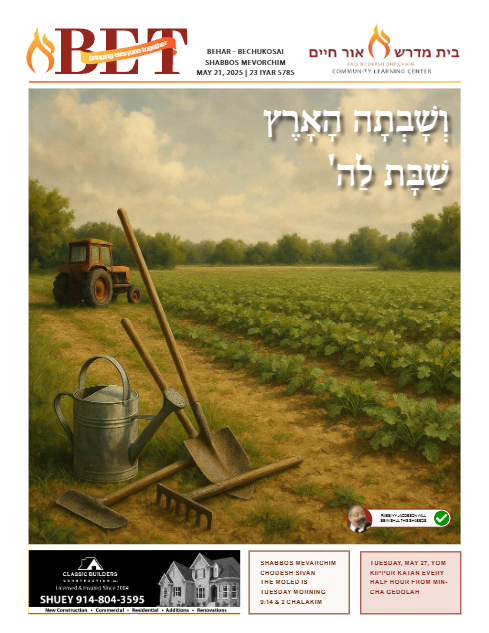
The Torah tell us that if a person will ask how will we have food to eat in the Shemitta year, Hashem tells us not to worry, for He will provide enough for three years. The lashon of the Torah here is quite unique. The Torah is generally not written in a question-and-answer format. This sounds like a Gemara. The Torah is telling us of two possible outcomes. If one does not ask how he will survive Shemitta, he has emunah in Ha- kodosh Boruch Hu, then Hashem will make him be satiated with less. Obviously, if Hashem says do not work the field, one can survive. However, if one does not have the proper emunah and asks Hashem how he will survive, Hashem will provide it for him. There is one caveat: he will have to work very hard the year before Shemitta. In one year, he will have to harvest the amount of produce that is generally produced in three years.
We must perform the mishpatim because Hashem said to, not because we think we understand them.
Related Articles