A True Story
Hashgacha Pratis | January 19, 2026
Print This Article
View Original PDF

A True Story

Hashgacha Pratis | January 30, 2026

In introducing the topic of reward discussed near the end of Chapter 4 of Shaar Habitachon, it is appropriate to bring the words of the heilige sefer Kav Hayashar.

This sefer was accepted by gedolei Yisrael as a central mussar sefer. The holy Reb Elimelech of Lizhensk zy”a learned the entire sefer 102 times. The Saar Shalom of Belz did the same, and he said that he derived his yiras Shamayim from the words written there.

Now let us indulge in the pleasure of understanding what is written in this sefer in Chapter 61. It is brought there in the name of the Zohar: Rabi Chizkiyah and Rabi Yissa were walking along, and Rabi Chizkiyah said, “I am thinking about the passuk that Shlomo Hamelech wrote in Koheles (3:19-20), which describes how the same fate will meet both man and animal: ‘Just as this one dies, so that one dies...there is no superiority of man over animal...all came from dust, and all return to dust.’”

Shlomo Hamelech fasted forty fasts before writing his sefarim – Mishlei, Shir Hashirim, and Koheles, in which are hidden deep words of wisdom. Rabi Chizkiyah asked: What did the wisest of men mean when he equated man with animal?! Isn’t it one of the foundational principles of emunah that when a man is called to the Yeshivah she Maalah, he comes to the Next World and receives his reward?

A man met them and asked them for a drink. In answer to their queries, he told them that he was he Jew, and they gave him some of their water. After he drank, the three of them turned toward the nearby mountain, where there was a wellspring of water from which a thin stream of water emerged. They used it to refill Rabi Yissa’s water pouch. Then they sat peacefully and asked the Jew whether he knew how to learn. In his humility, the man answered that he had sent his son to learn, and whatever his son learned, he knew as well. While the chachamim were not impressed, the Jew told them that it was possible for a pearl to be found in the rucksack of a poor man as well, and he suggested that they ask him about what was bothering them.

Rabi Chizkiyah asked him about the aforementioned passuk, and the Yid began explaining it to them: The words in this passuk do not come from the wisdom of Shlomo Hamelech; rather, Shlomo is quoting the words of the fools who are lacking emunah, who claim that there is the same fate for all. These wicked men claim that life here is transitory and passes exactly as the life of an animal, and that all that is left for man to do here is to eat, drink, and be merry, for tomorrow he shall die, exactly like an animal.

But the truth, says Shlomo Hamelech, is completely different: The spirit of man goes up, and there in the Upper World a person receives his great reward for all his good deeds that he was zocheh to do in this world, and to enjoy the splendor of the Shechinah. But the spirit of an animal goes down to the earth.

Shlomo continues and says there: “I said in my heart” — I thought about “the words of human beings,” which these wicked fools talk about, those who separate themselves from people of faith, and they themselves are like animals. These kinds of people think of themselves as animals, and indeed this is what will be their end: In the World to Come they will not merit the high levels of people who lived with emunah, and they will suffer punishments for their sins.

The Jew continued with his words of Torah, and it became clear that he was very righteous and wise. Afterward, when Rabi Chizkiyah and Rabi Yissa met the group to which this Jew belonged, they learned that this great talmid chacham was Rabi Chagai, who had been sent to learn wisdom from Rabi Shimon bar Yochai and to teach it to his friends in Bavel.

Once they knew his identity, they wanted him to continue accompanying them and speaking words of Torah to them, but Rabi Chagai said, “I came to you as a messenger from on High in order to explain the verses from Koheles, and now I must continue on my way.”

How amazing is this story! We see how Hakadosh Baruch Hu arranged for us to know the basic idea that there is a world of reward and punishment. How fortunate we are that we are zocheh to be baalei emunah who learn and delve into the sugya of emunah, and we know that the soul of a human being goes ever higher, in order to receive his reward.

This knowledge is a foundational basis in all matters of bitachon. In light of this, even when it seems in the here and now that we are gaining nothing, we gain the strength to act in accordance with daas Torah. As Shlomo Hamelech concluded Sefer Koheles: “Fear Hashem, and keep His mitzvos, for this is the totality of man!”
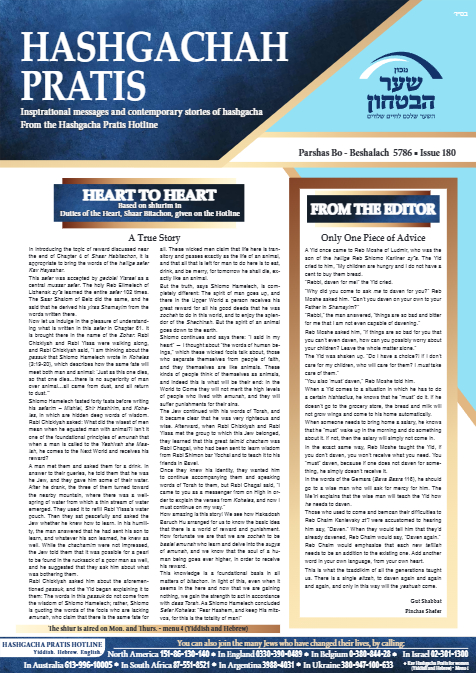

In introducing the topic of reward discussed near the end of Chapter 4 of Shaar Habitachon, it is appropriate to bring the words of the heilige sefer Kav Hayashar.

This sefer was accepted by gedolei Yisrael as a central mussar sefer. The holy Reb Elimelech of Lizhensk zy”a learned the entire sefer 102 times. The Saar Shalom of Belz did the same, and he said that he derived his yiras Shamayim from the words written there.

Now let us indulge in the pleasure of understanding what is written in this sefer in Chapter 61. It is brought there in the name of the Zohar: Rabi Chizkiyah and Rabi Yissa were walking along, and Rabi Chizkiyah said, “I am thinking about the passuk that Shlomo Hamelech wrote in Koheles (3:19-20), which describes how the same fate will meet both man and animal: ‘Just as this one dies, so that one dies...there is no superiority of man over animal...all came from dust, and all return to dust.’”

Shlomo Hamelech fasted forty fasts before writing his sefarim – Mishlei, Shir Hashirim, and Koheles, in which are hidden deep words of wisdom. Rabi Chizkiyah asked: What did the wisest of men mean when he equated man with animal?! Isn’t it one of the foundational principles of emunah that when a man is called to the Yeshivah she Maalah, he comes to the Next World and receives his reward?

A man met them and asked them for a drink. In answer to their queries, he told them that he was he Jew, and they gave him some of their water. After he drank, the three of them turned toward the nearby mountain, where there was a wellspring of water from which a thin stream of water emerged. They used it to refill Rabi Yissa’s water pouch. Then they sat peacefully and asked the Jew whether he knew how to learn. In his humility, the man answered that he had sent his son to learn, and whatever his son learned, he knew as well. While the chachamim were not impressed, the Jew told them that it was possible for a pearl to be found in the rucksack of a poor man as well, and he suggested that they ask him about what was bothering them.

Rabi Chizkiyah asked him about the aforementioned passuk, and the Yid began explaining it to them: The words in this passuk do not come from the wisdom of Shlomo Hamelech; rather, Shlomo is quoting the words of the fools who are lacking emunah, who claim that there is the same fate for all. These wicked men claim that life here is transitory and passes exactly as the life of an animal, and that all that is left for man to do here is to eat, drink, and be merry, for tomorrow he shall die, exactly like an animal.

But the truth, says Shlomo Hamelech, is completely different: The spirit of man goes up, and there in the Upper World a person receives his great reward for all his good deeds that he was zocheh to do in this world, and to enjoy the splendor of the Shechinah. But the spirit of an animal goes down to the earth.

Shlomo continues and says there: “I said in my heart” — I thought about “the words of human beings,” which these wicked fools talk about, those who separate themselves from people of faith, and they themselves are like animals. These kinds of people think of themselves as animals, and indeed this is what will be their end: In the World to Come they will not merit the high levels of people who lived with emunah, and they will suffer punishments for their sins.

The Jew continued with his words of Torah, and it became clear that he was very righteous and wise. Afterward, when Rabi Chizkiyah and Rabi Yissa met the group to which this Jew belonged, they learned that this great talmid chacham was Rabi Chagai, who had been sent to learn wisdom from Rabi Shimon bar Yochai and to teach it to his friends in Bavel.

Once they knew his identity, they wanted him to continue accompanying them and speaking words of Torah to them, but Rabi Chagai said, “I came to you as a messenger from on High in order to explain the verses from Koheles, and now I must continue on my way.”

How amazing is this story! We see how Hakadosh Baruch Hu arranged for us to know the basic idea that there is a world of reward and punishment. How fortunate we are that we are zocheh to be baalei emunah who learn and delve into the sugya of emunah, and we know that the soul of a human being goes ever higher, in order to receive his reward.

This knowledge is a foundational basis in all matters of bitachon. In light of this, even when it seems in the here and now that we are gaining nothing, we gain the strength to act in accordance with daas Torah. As Shlomo Hamelech concluded Sefer Koheles: “Fear Hashem, and keep His mitzvos, for this is the totality of man!”

PDF Preview