The Dialogue Between Paroh and His Servants
Ohr Hachaim Hakadosh | January 29, 2025
Print This Article
View Original PDF

The Dialogue Between Paroh and His Servants

Ohr Hachaim Hakadosh | June 27, 2025

And Moshe and Ahron were returned to Par’oh and he said to them, “go and serve Hashem your G-d, who will be going?”

The Ohr Hachaim is bothered by the conversation between Par’oh and his servants. What was their opinion? How did things change when Moshe said that all of Klal Yisroel would have to go and serve Hashem? The dialogue does not seem to flow.

The Ohr Hachaim explains that the servants of Par’oh were afraid of Moshe’s warning of the plague of locust; they knew that Moshe’s warnings were potent and would actually come true. Their experiences had taught them this difficult lesson. That is why they told Par’oh, עַד מָתַי יִהְיֶה זֶה לָנוּ לְמוֹקֵשׁ שַׁלַח אֶת הָאֲנָשִׁים וְ יַעַבְדוּ אֶת ה' א -לֹהֵיהֶם הֲטֶרֶם תֵדַע כִי אָבְדָה מִצְרָיִם – until when will this one be a stumbling block for us, send the people away and they will serve Hashem their G-d. Do you not know yet that Mitzrayim is doomed? However, when they heard the words of Moshe Rabbeinu that the young and the old were all to go and serve Hashem, they agreed with Par’oh and did not protest.

The Ohr Hachaim explains that the entire discussion of Par’oh’s does not make sense. How could Par’oh withstand the pressures of the Makkos? He saw himself and his nation battered and beaten, as so many lost their money, their possessions, their animals, their crops, and their lives. Why was he so foolish as to fight against Hashem in this manner? Although he was certainly incorrect, as we see in the end that he was killed and his nation destroyed, the Yetzer Hara always uses some logic to defend his indefensible position. Hashem indeed hardened his heart, but how did Hashem do so? What did he convince him of to get him to refuse Moshe’s warning?

He explains that Moshe Rabbeinu first only requested from Par’oh that he release the slaves for a three-day trip to the desert to serve Hashem. Klal Yisroel never demanded their complete freedom, all they wanted was three days of bringing Korbanos to Hashem. Par’oh saw that Hashem had left some wiggle room in His request.

Par’oh was unsure of Moshe’s and Hashem’s intentions. Was it indeed true that all Hashem wanted was that His people should serve Him somewhat, and they could then return to Par’oh? Or was this all a trick, a way to help them escape the jail that was Mitzrayim?

Par’oh did not accept that Hashem was all-powerful; his arrogance was such that he believed himself to be Hashem's equal. This request of Hashem’s served as ‘proof’ to his haughty position. He was sure that Hashem was using subterfuge to free His nation. If so, he reasoned, Hashem was not all that powerful, and He needed Par’oh to be fooled into redeeming Klal Yisroel because He could not redeem them by force. Par’oh saw this loophole, this weakness in Hashem, and he attempted to exploit it. He thought that Hashem’s powers were limited and that he could outride the temporary plagues and declare victory. In the end, he reasoned, he would be vindicated.

After seven difficult, deadly plagues, the resolve of Par’oh’s servants began to waver. Was it possible that Hashem truthfully only wanted them for three days? Perhaps they had miscalculated, and Hashem could outwait them and destroy the entire Mitzrayim. They told Par’oh that he needed to act with more caution and consider the chance that Hashem was more powerful than him. After all, look at the plagues that He had performed until then. Par’oh could not perform these plagues, how could he consider himself Hashem’s equal?

Par’oh decided to test Moshe and Aharon, and he called them back. He asked them who will be going along with them and what they wished to do. When he heard that they were planning on bringing their children along with them, he realized that this was a trick and that he could continue fighting against Hashem.

Par’oh continued to harden his heart, and Hashem allowed this. As the Torah tells us, Hashem wanted to punish Mitzrayim until the bitter end, with no opportunity to do Teshuva.
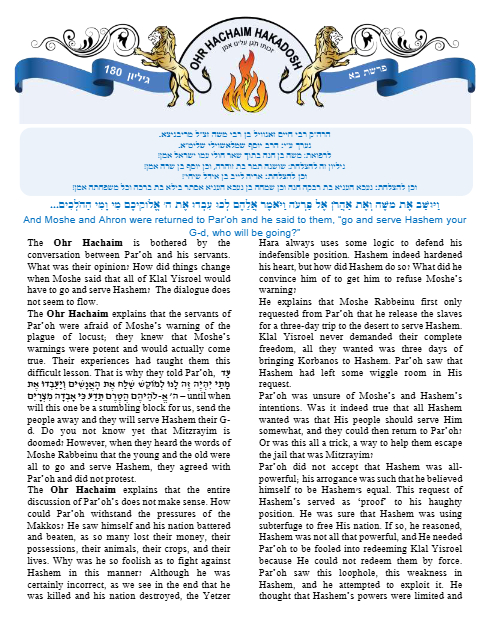

And Moshe and Ahron were returned to Par’oh and he said to them, “go and serve Hashem your G-d, who will be going?”

The Ohr Hachaim is bothered by the conversation between Par’oh and his servants. What was their opinion? How did things change when Moshe said that all of Klal Yisroel would have to go and serve Hashem? The dialogue does not seem to flow.

The Ohr Hachaim explains that the servants of Par’oh were afraid of Moshe’s warning of the plague of locust; they knew that Moshe’s warnings were potent and would actually come true. Their experiences had taught them this difficult lesson. That is why they told Par’oh, עַד מָתַי יִהְיֶה זֶה לָנוּ לְמוֹקֵשׁ שַׁלַח אֶת הָאֲנָשִׁים וְ יַעַבְדוּ אֶת ה' א -לֹהֵיהֶם הֲטֶרֶם תֵדַע כִי אָבְדָה מִצְרָיִם – until when will this one be a stumbling block for us, send the people away and they will serve Hashem their G-d. Do you not know yet that Mitzrayim is doomed? However, when they heard the words of Moshe Rabbeinu that the young and the old were all to go and serve Hashem, they agreed with Par’oh and did not protest.

The Ohr Hachaim explains that the entire discussion of Par’oh’s does not make sense. How could Par’oh withstand the pressures of the Makkos? He saw himself and his nation battered and beaten, as so many lost their money, their possessions, their animals, their crops, and their lives. Why was he so foolish as to fight against Hashem in this manner? Although he was certainly incorrect, as we see in the end that he was killed and his nation destroyed, the Yetzer Hara always uses some logic to defend his indefensible position. Hashem indeed hardened his heart, but how did Hashem do so? What did he convince him of to get him to refuse Moshe’s warning?

He explains that Moshe Rabbeinu first only requested from Par’oh that he release the slaves for a three-day trip to the desert to serve Hashem. Klal Yisroel never demanded their complete freedom, all they wanted was three days of bringing Korbanos to Hashem. Par’oh saw that Hashem had left some wiggle room in His request.

Par’oh was unsure of Moshe’s and Hashem’s intentions. Was it indeed true that all Hashem wanted was that His people should serve Him somewhat, and they could then return to Par’oh? Or was this all a trick, a way to help them escape the jail that was Mitzrayim?

Par’oh did not accept that Hashem was all-powerful; his arrogance was such that he believed himself to be Hashem's equal. This request of Hashem’s served as ‘proof’ to his haughty position. He was sure that Hashem was using subterfuge to free His nation. If so, he reasoned, Hashem was not all that powerful, and He needed Par’oh to be fooled into redeeming Klal Yisroel because He could not redeem them by force. Par’oh saw this loophole, this weakness in Hashem, and he attempted to exploit it. He thought that Hashem’s powers were limited and that he could outride the temporary plagues and declare victory. In the end, he reasoned, he would be vindicated.

After seven difficult, deadly plagues, the resolve of Par’oh’s servants began to waver. Was it possible that Hashem truthfully only wanted them for three days? Perhaps they had miscalculated, and Hashem could outwait them and destroy the entire Mitzrayim. They told Par’oh that he needed to act with more caution and consider the chance that Hashem was more powerful than him. After all, look at the plagues that He had performed until then. Par’oh could not perform these plagues, how could he consider himself Hashem’s equal?

Par’oh decided to test Moshe and Aharon, and he called them back. He asked them who will be going along with them and what they wished to do. When he heard that they were planning on bringing their children along with them, he realized that this was a trick and that he could continue fighting against Hashem.

Par’oh continued to harden his heart, and Hashem allowed this. As the Torah tells us, Hashem wanted to punish Mitzrayim until the bitter end, with no opportunity to do Teshuva.

PDF Preview