Your Clothes Did Not Wear Out
מגדל אור | August 03, 2023
Print This Article
View Original PDF

Your Clothes Did Not Wear Out

מגדל אור | December 31, 2025

“Your clothes did not wear out from upon you, nor did your feet swell, these forty years.” (Devarim 8:4)

Rashi and the Midrash explain that the clothing of the Jews remained intact for the duration of their sojourn in the Wilderness, even growing with the people as they grew (no word on whether they morphed to keep up with style trends.) The Clouds of Glory cleaned them, and the Mon and Well of Miriam prevented the Jews from producing sweat, reducing the wear on them. Even so, it was a miraculous occurrence that their clothes remained whole and wearable because time takes its toll on things.

The next part of the verse says that their feet didn’t swell. Again, Rashi explains that it is the nature of those who walk barefoot that their feet swell up, but this didn’t happen. The Sifsei Chachamim and others explain, however, that the reason this didn’t happen was because, as we see elsewhere, their shoes ALSO remained intact, so the Jews did not walk barefoot.

The question is, if the reason their feet didn’t swell was because their shoes remained whole, why not just say that their shoes didn’t wear out? Especially since that was what was said about the clothing, the Torah could have saved words and simply said, “Your clothes and shoes didn’t wear out...” Why the change?

Perhaps the posuk was bringing out an important lesson. We need to not only recognize the good Hashem does for us, but the underlying good beneath the surface which we may not notice. Not only did we have the miracle that our shoes didn’t wear out, but because of that, our feet were protected from the rigors of walking barefoot, and we were saved from the pain of swollen feet. The good Hashem did for us also prevented bad from befalling us, and we ought to be appreciative and aware of all of it.

Therefore, the posuk mentions the fact that our clothing didn’t wear out, and then goes a level deeper to focus on the results of a similar miracle, that our feet didn’t swell, because, our shoes didn’t wear out. This lesson is not just for appreciating the miracles of the Wilderness, because that time was intended to mold us and prepare us for living in the Promised Land, Eretz Yisrael.

There, we will have to depend on Hashem for rain and follow His Torah and mitzvos in order to remain there. Learning to appreciate every little thing, and the things that bring those little things about, will help us to see Hashem’s hand in our lives on a constant basis, and that will help us to love Him and serve Him more and more every day, with joy and gratitude.
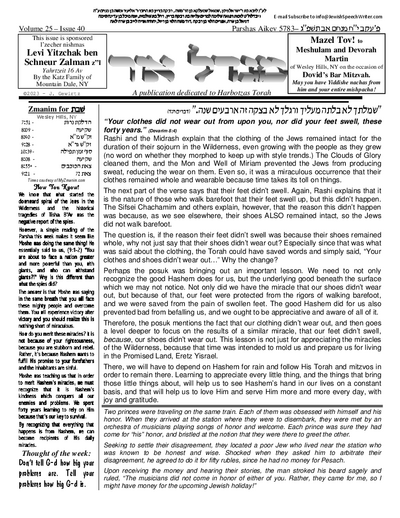

“Your clothes did not wear out from upon you, nor did your feet swell, these forty years.” (Devarim 8:4)

Rashi and the Midrash explain that the clothing of the Jews remained intact for the duration of their sojourn in the Wilderness, even growing with the people as they grew (no word on whether they morphed to keep up with style trends.) The Clouds of Glory cleaned them, and the Mon and Well of Miriam prevented the Jews from producing sweat, reducing the wear on them. Even so, it was a miraculous occurrence that their clothes remained whole and wearable because time takes its toll on things.

The next part of the verse says that their feet didn’t swell. Again, Rashi explains that it is the nature of those who walk barefoot that their feet swell up, but this didn’t happen. The Sifsei Chachamim and others explain, however, that the reason this didn’t happen was because, as we see elsewhere, their shoes ALSO remained intact, so the Jews did not walk barefoot.

The question is, if the reason their feet didn’t swell was because their shoes remained whole, why not just say that their shoes didn’t wear out? Especially since that was what was said about the clothing, the Torah could have saved words and simply said, “Your clothes and shoes didn’t wear out...” Why the change?

Perhaps the posuk was bringing out an important lesson. We need to not only recognize the good Hashem does for us, but the underlying good beneath the surface which we may not notice. Not only did we have the miracle that our shoes didn’t wear out, but because of that, our feet were protected from the rigors of walking barefoot, and we were saved from the pain of swollen feet. The good Hashem did for us also prevented bad from befalling us, and we ought to be appreciative and aware of all of it.

Therefore, the posuk mentions the fact that our clothing didn’t wear out, and then goes a level deeper to focus on the results of a similar miracle, that our feet didn’t swell, because, our shoes didn’t wear out. This lesson is not just for appreciating the miracles of the Wilderness, because that time was intended to mold us and prepare us for living in the Promised Land, Eretz Yisrael.

There, we will have to depend on Hashem for rain and follow His Torah and mitzvos in order to remain there. Learning to appreciate every little thing, and the things that bring those little things about, will help us to see Hashem’s hand in our lives on a constant basis, and that will help us to love Him and serve Him more and more every day, with joy and gratitude.

PDF Preview

