MESHECH CHOCHMAH
Parsha Pages | May 13, 2024
Print This Article
View Original PDF

MESHECH CHOCHMAH

Parsha Pages | June 27, 2025

Ch. 21, v. 2: "L'imo u'l'oviv"

Here by the regular Kohein, where the Torah permits defiling oneself to a deceased parent the Torah mentions a mother first, to indicate that even when the Kohein's father is still living he may defile himself to his mother. One might have thought that this would only be permitted when the Kohein's father is no longer living and in some circumstances his mother has no one else to involve himself with her burial except for her son the Kohein.

By the case of the Kohein Godol's parents death, where the Torah prohibits his defiling himself (21:11), the Torah first mentions his father to tell you that even if the Kohein Godol's father has already died, his son may not defile himself to his mother, even though her husband is not alive to tend to her burial needs. (MESHECH CHOCHMOH)

Ch. 21, v. 9: "Es ovihoh hi m'chaleles bo'eish tisoreif"

The gemara Makkos 2a tells us that if witnesses are found guilty of lying in the manner called "hazomoh", the Torah mandates a reciprocal punishment. The gemara Sanhedrin 90a says that if witnesses were caught lying about the daughter of a Kohein having committed adultery, they do not receive the punishment of the Kohein's daughter, "sreifoh," but rather the punishment which would be meted out to the adulterer who has committed this sin, "chenek." This is derived from the word "l'ochiv" in Dvorim 19:19.

The MESHECH CHOCHMOH explains that since the Torah stresses that when a Kohein's daughter commits this sin, it is not only a blemish upon her, but also a great disgrace for her father, once found innocent, the Torah does not want to reciprocate with the punishment for adultery which is administered uniquely to the daughter of a Kohein. The fanfare created by killing by way of "sreifoh," even if applied to the false witnesses, would advertise that the Kohein's daughter was accused of this terrible sin, and would undeservedly heap shame upon the Kohein. Therefore the false witnesses receive the punishment reserved for the man and not the woman.

Ch. 23, v. 3: "Shabbos hee laShem b'chole moshvoseichem"

What do we learn from the words "b'chole moshvoseichem" - in all your dwellings? Rashi in parshas Mishpotim _ _ writes that the Saducees misinterpreted the Torah and derived from the words "bechorish uvkotzir tishbose" that one is required to keep the Shabbos holy only when there is a Shabbos restriction to not plow nor harvest. During the "shmitoh" year when there is a prohibition to plow or harvest every day of the week there is no Shabbos. Following their mistaken reasoning, Shabbos would still apply outside of Eretz Yisroel even on a "shmitoh" year, as plowing and harvesting are always permitted outside of Eretz Yisroel. We would thus have an anomaly of Having Shabbos outside of Eretz Yisroel during a "shmitoh" year, while there would be no Shabbos in Eretz Yisroel. The Torah is teaching us that the ruling of the Saducees is false, by stating that Shabbos applies "b'chole moshvoseichem," in all your dwellings, whether they be in or outside of Eretz Yisroel. (MESHECH CHOCHMOH)

Ch. 23, v. 10: "Ho'oretz asher ani NOSEIN"

In Bmidbar 32:5 the verse says, "Yutan es ho'oretz hazose laavo'decho," may this land be given to your servants (Reuvein and Gad). The recital when bringing "bikurim," the first-ripened fruit to the Beis Hamikdosh, includes thanks for living in the Holy Land, "V'eis ho'adomoh asher nosatoh lonu ...... eretz zovas cholov udvosh," and the land that You gave us ...... a land that flows milk and honey (Dvorim 26:15). The gemara Yerushalmi Bikurim 1:8 states two opinions regarding land requirements for the mitzvoh of bringing bikurim. One opinion is that bikurim can only be brought from produce grown in Eretz Yisroel, since the verse says "eretz zovas cholov udvosh." Only west of the Jordan Eretz Yisroel has this accolade. A second opinion is that the stress should be placed on the words "asher nosatoh lonu," meaning that only Eretz Yisroel that was GIVEN to us, is the land from which bikurim may be brought. (The parcels of land that were given to the tribes of Reuvein and Gad were REQUESTED by these tribes.) The gemara says that there is a difference in law between these two reasons. According to the opinion that we require a land that flows milk and honey, even the land parcel of half the tribe of Menasheh that was outside Eretz Yisroel is exempt from bikurim, while according to the opinion that bikurim is brought only from a land that was GIVEN, there is a requirement to bring bikurim from the land of Menasheh even though it does not flow milk and honey, but nevertheless, because the tribe of Menasheh did not request this land bikurim must be brought.

Based on this we have an answer to a difficulty the MESHECH CHOCHMOH raises on the opinion of Rashi in Sanhedrin 10b. Rashi states that the "omer" meal offering may be brought from barley grown on the Trans-Jordanian side. The Ran in his commentary on the gemara N'dorim disagrees and says that it may only be brought from the western side of the Jordan. MESHECH CHOCHMOH, based on the derivation of "asher nosatoh lonu," and not that which was requested, says that we should likewise derive from the words of our verse, "ho'oretz asher ani NOSEIN" that "omer" can only be brought from the west of the Jordan, as the Trans-Jordanian lands were requested.

However, it seems that this should present no difficulty for Rashi, based on the above gemara Yerushalmi. The land given to the half of Menasheh tribe was not by virtue of their request, and there is no reason to exclude it from "omer," and this could well be Rashi's intention, that omer may be brought from the area of Menasheh. (Nirreh li)

Ch. 23, v.31: "Kol m'lochoh lo saasu chukas olom l'doroseichem"

The MESHECH CHOCHMOH asks why the verse only mentions the restriction to work as a statute for all time, and not the restriction to eat or drink. He answers that since King Shlomo waived the restriction to eat or drink on Yom Kippur when the Beis Hamikdosh was completed, the prohibition to eat and drink is not for all times. Therefore, our verse only mentions the restriction to work as a law for all times.

I have a bit of difficulty with this from Vayikra 16:31 which says, "Shabbas Shabbosone hee lochem v'ini'sem es nafshoseichem chukas olom." We see the Torah mentioning that the law applies to all times regarding both the restraint from work and to afflict oneself (fasting). Perhaps the word "l'doroseichem" missing in 16:31 and appearing in 23:31 makes a difference.

Ch. 23, v. 32: "Shabbos shabbosone HU lochem"

In parshas Acharei Mose (16:31) it says "Shabbos shabbosone HEE lochem." The MESHECH CHOCHMOH says that our verse refers to the DAY (DAY being masculine) of Yom Kippur being a day of total rest, refraining from even doing "m'leches ocheil nefesh," just as Shabbos is called "Shabbos shabbosone" in numerous places (as in Shmos 16:23, 31:15, 35:2). The verse in Acharei Mose tells us that the "shvisoh" (feminine), the refraining from activities, belongs to you. As explained by the Ra"n on the gemara Yoma 76a, the Torah requires more deprivation on Yom Kippur than just refraining from eating and drinking. Which deprivations these are, is given to the Rabbis to decide. This is expressed in the words "Shabbos shobbosone HEE LOCHEM" that the decision of what is considered an appropriate "shvisoh," manner of refraining, is LOCHEM, is given into the hands of the Rabbis.
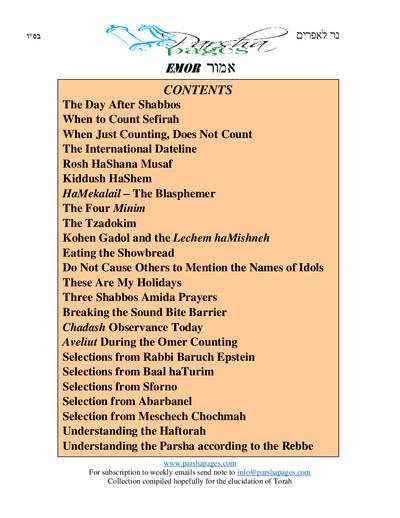
Ch. 21, v. 2: "L'imo u'l'oviv"

Here by the regular Kohein, where the Torah permits defiling oneself to a deceased parent the Torah mentions a mother first, to indicate that even when the Kohein's father is still living he may defile himself to his mother. One might have thought that this would only be permitted when the Kohein's father is no longer living and in some circumstances his mother has no one else to involve himself with her burial except for her son the Kohein.

By the case of the Kohein Godol's parents death, where the Torah prohibits his defiling himself (21:11), the Torah first mentions his father to tell you that even if the Kohein Godol's father has already died, his son may not defile himself to his mother, even though her husband is not alive to tend to her burial needs. (MESHECH CHOCHMOH)

Ch. 21, v. 9: "Es ovihoh hi m'chaleles bo'eish tisoreif"

The gemara Makkos 2a tells us that if witnesses are found guilty of lying in the manner called "hazomoh", the Torah mandates a reciprocal punishment. The gemara Sanhedrin 90a says that if witnesses were caught lying about the daughter of a Kohein having committed adultery, they do not receive the punishment of the Kohein's daughter, "sreifoh," but rather the punishment which would be meted out to the adulterer who has committed this sin, "chenek." This is derived from the word "l'ochiv" in Dvorim 19:19.

The MESHECH CHOCHMOH explains that since the Torah stresses that when a Kohein's daughter commits this sin, it is not only a blemish upon her, but also a great disgrace for her father, once found innocent, the Torah does not want to reciprocate with the punishment for adultery which is administered uniquely to the daughter of a Kohein. The fanfare created by killing by way of "sreifoh," even if applied to the false witnesses, would advertise that the Kohein's daughter was accused of this terrible sin, and would undeservedly heap shame upon the Kohein. Therefore the false witnesses receive the punishment reserved for the man and not the woman.

Ch. 23, v. 3: "Shabbos hee laShem b'chole moshvoseichem"

What do we learn from the words "b'chole moshvoseichem" - in all your dwellings? Rashi in parshas Mishpotim _ _ writes that the Saducees misinterpreted the Torah and derived from the words "bechorish uvkotzir tishbose" that one is required to keep the Shabbos holy only when there is a Shabbos restriction to not plow nor harvest. During the "shmitoh" year when there is a prohibition to plow or harvest every day of the week there is no Shabbos. Following their mistaken reasoning, Shabbos would still apply outside of Eretz Yisroel even on a "shmitoh" year, as plowing and harvesting are always permitted outside of Eretz Yisroel. We would thus have an anomaly of Having Shabbos outside of Eretz Yisroel during a "shmitoh" year, while there would be no Shabbos in Eretz Yisroel. The Torah is teaching us that the ruling of the Saducees is false, by stating that Shabbos applies "b'chole moshvoseichem," in all your dwellings, whether they be in or outside of Eretz Yisroel. (MESHECH CHOCHMOH)

Ch. 23, v. 10: "Ho'oretz asher ani NOSEIN"

In Bmidbar 32:5 the verse says, "Yutan es ho'oretz hazose laavo'decho," may this land be given to your servants (Reuvein and Gad). The recital when bringing "bikurim," the first-ripened fruit to the Beis Hamikdosh, includes thanks for living in the Holy Land, "V'eis ho'adomoh asher nosatoh lonu ...... eretz zovas cholov udvosh," and the land that You gave us ...... a land that flows milk and honey (Dvorim 26:15). The gemara Yerushalmi Bikurim 1:8 states two opinions regarding land requirements for the mitzvoh of bringing bikurim. One opinion is that bikurim can only be brought from produce grown in Eretz Yisroel, since the verse says "eretz zovas cholov udvosh." Only west of the Jordan Eretz Yisroel has this accolade. A second opinion is that the stress should be placed on the words "asher nosatoh lonu," meaning that only Eretz Yisroel that was GIVEN to us, is the land from which bikurim may be brought. (The parcels of land that were given to the tribes of Reuvein and Gad were REQUESTED by these tribes.) The gemara says that there is a difference in law between these two reasons. According to the opinion that we require a land that flows milk and honey, even the land parcel of half the tribe of Menasheh that was outside Eretz Yisroel is exempt from bikurim, while according to the opinion that bikurim is brought only from a land that was GIVEN, there is a requirement to bring bikurim from the land of Menasheh even though it does not flow milk and honey, but nevertheless, because the tribe of Menasheh did not request this land bikurim must be brought.

Based on this we have an answer to a difficulty the MESHECH CHOCHMOH raises on the opinion of Rashi in Sanhedrin 10b. Rashi states that the "omer" meal offering may be brought from barley grown on the Trans-Jordanian side. The Ran in his commentary on the gemara N'dorim disagrees and says that it may only be brought from the western side of the Jordan. MESHECH CHOCHMOH, based on the derivation of "asher nosatoh lonu," and not that which was requested, says that we should likewise derive from the words of our verse, "ho'oretz asher ani NOSEIN" that "omer" can only be brought from the west of the Jordan, as the Trans-Jordanian lands were requested.

However, it seems that this should present no difficulty for Rashi, based on the above gemara Yerushalmi. The land given to the half of Menasheh tribe was not by virtue of their request, and there is no reason to exclude it from "omer," and this could well be Rashi's intention, that omer may be brought from the area of Menasheh. (Nirreh li)

Ch. 23, v.31: "Kol m'lochoh lo saasu chukas olom l'doroseichem"

The MESHECH CHOCHMOH asks why the verse only mentions the restriction to work as a statute for all time, and not the restriction to eat or drink. He answers that since King Shlomo waived the restriction to eat or drink on Yom Kippur when the Beis Hamikdosh was completed, the prohibition to eat and drink is not for all times. Therefore, our verse only mentions the restriction to work as a law for all times.

I have a bit of difficulty with this from Vayikra 16:31 which says, "Shabbas Shabbosone hee lochem v'ini'sem es nafshoseichem chukas olom." We see the Torah mentioning that the law applies to all times regarding both the restraint from work and to afflict oneself (fasting). Perhaps the word "l'doroseichem" missing in 16:31 and appearing in 23:31 makes a difference.

Ch. 23, v. 32: "Shabbos shabbosone HU lochem"

In parshas Acharei Mose (16:31) it says "Shabbos shabbosone HEE lochem." The MESHECH CHOCHMOH says that our verse refers to the DAY (DAY being masculine) of Yom Kippur being a day of total rest, refraining from even doing "m'leches ocheil nefesh," just as Shabbos is called "Shabbos shabbosone" in numerous places (as in Shmos 16:23, 31:15, 35:2). The verse in Acharei Mose tells us that the "shvisoh" (feminine), the refraining from activities, belongs to you. As explained by the Ra"n on the gemara Yoma 76a, the Torah requires more deprivation on Yom Kippur than just refraining from eating and drinking. Which deprivations these are, is given to the Rabbis to decide. This is expressed in the words "Shabbos shobbosone HEE LOCHEM" that the decision of what is considered an appropriate "shvisoh," manner of refraining, is LOCHEM, is given into the hands of the Rabbis.

PDF Preview