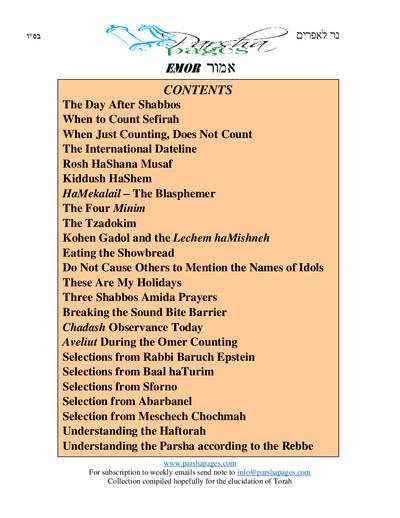
The Day After Shabbos
Parsha Pages | May 13, 2024
Print This Article
View Original PDF

The Day After Shabbos

Parsha Pages | June 27, 2025

VaYikra 23,11 & 23,15: "Mimochoras haShabbos y'ni'fenu hakohein, Usfartem lochem mimochoras haShabbos" – “On the morning after the ‘Shabbos’ the Cohen should wave it (the Omer), and you shall count for yourselves from the morning after the Shabbos.” Rashi (Menachos 65b) says that the word "Shabbos" in these verses means the first day of Pesach. Menachos (65b-66a) brings no less than 8 proofs (and some others) that "Shabbos" means the first day of Pesach, and not Shabbos the 7th day of the week, contrary to the incorrect position of the Tzedokim.

Why indeed does the Torah express itself with the word "Shabbos," rather than simply stating "mimochoras haPesach" or the like?

1) Shabbos means cessation. We count the days of the week as the first day, the second day, etc., until we reach Shabbos. We then start again from the first day. Thus, Shabbos brings to an end and ceases the previous count and the following day is the beginning of a new count. The requirement to start counting from the day after the first day of Pesach justifiably gives it the nature of Shabbos and therefore the same appellation. (Mahara"l of Prague in Gur Aryeh)

2) Rambam (hilchos chometz u'matzoh 7:1) derives that from the words "Zochor es ha'yom ha'zeh asher y'tzo'sem miMitzrayim" (Shmos 13:3) it is a mitzvah on the first night of Pesach to relate the miracles and exodus which took place on this night, similar to that which is written, "Zochor es yom haShabbos l'kadsho (Shmos 20:8)." What is the intention of the Rambam in equating Pesach to Shabbos because of the common word ZOCHOR found by both? One can view the calendar anniversary of a Yom Tov as a commemoration of that which took place in the ancient past. However, in the Rambam’s Haggadah, “It is incumbent upon a person to consider himself as one who NOW personally left Egypt.” This is not a commemorative vicarious experience, but rather it should be considered as our personal event. Shabbos likewise is not a commemoration. It is our active testimony that HaShem made the world in six days and ceased from further creation on the seventh. This might be the intention of the Rambam in his comparison. Perhaps this is also the reason the Torah calls Pesach “Shabbos”, to teach us that the Pesach experience is to be viewed as our own present-day occurrence. (Sedrah Selections by Rabbi Akiva Fleischer)

3) If the verse were to say either "mimochoras haCHAG" or "mimochoras haMO'EID" we would mistakenly understand this to mean the day after the 7-day holiday of Pesach ends. If the verse were to say "mimochoras haPESACH" we would still incorrectly interpret this to mean the morning after sacrificing the Paschal lamb, the 15th of Nissan, as we find in Bemidbar 33:3, "Mimochoras haPesach yotzu vnei Yisroel." By saying "mimochoras haShabbos" it is clear that the intention is the day following the day of restriction from work, the 16th of Nissan. (Malbi"m)

Shaa'rei Aharon asks that it still remains to be explained why the verse didn't say "mimochoras Yom (Tov) horishon shel Pesach." Perhaps this can be answered by saying that the first Pesach lasted only one day so there was no second section of Yom Tov, and although here we are discussing Pesach for later generations, the Torah did not want to express itself in a manner that is not consistent with the original Pesach, the forerunner for all later P'sachim.

4) Since the verse is discussing an offering in the Beis HaMikdash, there is no difference between Shabbos and Yom Tov. Although regarding our own activities there is the difference of the leniency of "ochel nefesh," and that is why Yom Tov is sometimes called "Shabbosone" with the added diminutive letters Vov-Nun (Vayikroh 23:24,29), in the Beis HaMikdash there is no difference, as any sacrifice that is a requirement and has a set time is to be processed even at the expense of the laws of Shabbos. (Abarbanel and N'tzi"v in Haa'meik Dovor)

This explanation is more readily understood in verse 11 where we have the command to bring the "omer" offerings, but in verse 15, where the thrust is the mitzvah of counting, even though the verse uses the day of the offerings as the starting point for counting, this is less well understood.

5) As long as the bnei Yisroel were in Egypt they were in a defiled environment. This ended on the 15th of Nissan, the day they left Egypt. They then began counting days and weeks of purity, in preparation for receiving the Holy Torah. Therefore, this day is called Shabbos, the day of cessation of defilement. (Ohr HaChaim)

6) We derive from the words "reishis k'tzirchem" - the first of your harvest - in the previous verse, that one may not begin to harvest his crop until the "omer" offering is brought (Gemara M'nochos 71a). Not harvesting is one aspect of not pursuing normal agricultural activities. This restraint is called "Shabbos" in Vayikroh 25:2, "V'shovsoh ho'oretz SHABBOS laShem." Since the day before the "omer" offering is brought still has this restriction, it is called "Shabbos." (Rabbi S.R. Hirsch)

7) In "Kiddush" of Shabbos we say that Shabbos is "Zeicher litzias Mitzroyim." In what way is Shabbos a reminder of the exodus from Egypt? The Mahara"l of Prague in Gevuros HaShem chapter #44 writes that a day of rest is only appropriate for one who has a clearly defined direction and goal. Gentiles do not have this and they are therefore forbidden to set aside a regular day of rest, "aku"m sheshovas chayov misoh" (Sanhedrin 58b). It is only by virtue of HaShem's taking us out of Egypt to serve him that we have Divine direction and goals. This intertwining of Shabbos and Pesach gives Pesach the title of “Shabbos”, as it is the source of our being allowed (and required) to cease from many worldly pursuits. (Rabbi Akiva Fleischer)

8) Ariza”l states that at the time to go out of Egypt the Jews were in the 49th level of Tumah. HaShem then lifted the Jews to the higher level to experience the Exodus to a level called “Shabbos.” However, HaShem returned them to level “zero”, so that the Jews would have to go up level by level, so each Jew would have to increase slowly of their own service, returning to the level of “Shabbos.” Thus, the first day of Pesach is called “Shabbos.”

8) One is responsible to have his leavened food cease to exist by the 15th of Nissan, as expressed in the verse, "Ba'yom horishon TASHBISU s'ore mibo'teichem" (Shmos 12:15). "Mimochoras haShabbos" means the morning after you cause your "chometz" to CEASE to exist. (HaKsav V'Hakaboloh and Meshech Chochmah) It is a bit difficult to understand since the verse of "tashbisu" refers to the 14th of Nissan. Perhaps during the first half of the day "chometz" is permitted, the 14th is not considered a complete day of cessation.

9) We find that Yom Tov allows us to involve others in serving HaShem with us in unity. For example, it is permitted to cook and bake on Yom Tov itself. It is also permitted to carry food items from one domain to another. These two leniencies allow us to accommodate guests in joining us in our meals even if we had no prior notice. This allows for joining in a group in the service of HaShem in celebrating Yom Tov. The above-mentioned leniencies do not exist on Shabbos. On Shabbos the service of HaShem is as individuals, although the service of each individual is towards the same goal (somewhat like the individual spokes of a wheel that all lead to one central point). However, the Pesach in Egypt had the characteristics of Shabbos, as there was a restriction to leave one's home (Shmos 12:22). In remembrance of the unique character of the original Pesach the Torah calls Pesach’s first day Shabbos. (Meshech Chochmah)

10) This command was given in the year 2449 from Creation. This is the 17th year in the 127th cycle of 19-year cycles. The 17th year of the 19t-year cycle is "m'uberres," i.e., it has 13 months. Given that the bnei Yisroel left Egypt on a Thursday and applying some other rules of when specific Yomim Tovim can and cannot fall on certain days of the week, we find that the first day of Pesach of year 2449 fell on Shabbos. (Droshos HaRav in Yad Shluchoh)

11) Before the giving of the Torah calendar days ran from daybreak to daybreak. Thus, when the bnei Yisroel were commanded to "process the Pesach offering," meaning to consume it, refers to the night, but it was still the 14th of Nissan. "Mimochoras haPesach" of eating the Paschal lamb would mean on the 15th of Nissan. Our verse was transmitted before the second Pesach. When our verse mentions "mimochoras haShabbos," it refers to the day after eating the lamb at night, but now that was on the 15th. Had our verse said "mimochoras haPesach" it would have been unclear if it means on the 15th as it did the previous year, or the 16th. The verse therefore expresses itself with "mimochoras haShabbos," the day after the restraint from work, which was the 15th in the previous year as well, and "mimochoras haShabbos" is unambiguously the 16th. (R' Yaakov Kameneski)

12) “You should count for yourselves” this is the service of rectifying one’s animal soul. “From the day after Shabbos” the ability to rectify is from the level of Shabbos (which is beyond the level of Pesach) which precedes the creation process. This reflects the purpose of Creation is to rectify specifically this world. (Lubavitcher Rebbe)

VaYikra 23,11 & 23,15: "Mimochoras haShabbos y'ni'fenu hakohein, Usfartem lochem mimochoras haShabbos" – “On the morning after the ‘Shabbos’ the Cohen should wave it (the Omer), and you shall count for yourselves from the morning after the Shabbos.” Rashi (Menachos 65b) says that the word "Shabbos" in these verses means the first day of Pesach. Menachos (65b-66a) brings no less than 8 proofs (and some others) that "Shabbos" means the first day of Pesach, and not Shabbos the 7th day of the week, contrary to the incorrect position of the Tzedokim.

Why indeed does the Torah express itself with the word "Shabbos," rather than simply stating "mimochoras haPesach" or the like?

1) Shabbos means cessation. We count the days of the week as the first day, the second day, etc., until we reach Shabbos. We then start again from the first day. Thus, Shabbos brings to an end and ceases the previous count and the following day is the beginning of a new count. The requirement to start counting from the day after the first day of Pesach justifiably gives it the nature of Shabbos and therefore the same appellation. (Mahara"l of Prague in Gur Aryeh)

2) Rambam (hilchos chometz u'matzoh 7:1) derives that from the words "Zochor es ha'yom ha'zeh asher y'tzo'sem miMitzrayim" (Shmos 13:3) it is a mitzvah on the first night of Pesach to relate the miracles and exodus which took place on this night, similar to that which is written, "Zochor es yom haShabbos l'kadsho (Shmos 20:8)." What is the intention of the Rambam in equating Pesach to Shabbos because of the common word ZOCHOR found by both? One can view the calendar anniversary of a Yom Tov as a commemoration of that which took place in the ancient past. However, in the Rambam’s Haggadah, “It is incumbent upon a person to consider himself as one who NOW personally left Egypt.” This is not a commemorative vicarious experience, but rather it should be considered as our personal event. Shabbos likewise is not a commemoration. It is our active testimony that HaShem made the world in six days and ceased from further creation on the seventh. This might be the intention of the Rambam in his comparison. Perhaps this is also the reason the Torah calls Pesach “Shabbos”, to teach us that the Pesach experience is to be viewed as our own present-day occurrence. (Sedrah Selections by Rabbi Akiva Fleischer)

3) If the verse were to say either "mimochoras haCHAG" or "mimochoras haMO'EID" we would mistakenly understand this to mean the day after the 7-day holiday of Pesach ends. If the verse were to say "mimochoras haPESACH" we would still incorrectly interpret this to mean the morning after sacrificing the Paschal lamb, the 15th of Nissan, as we find in Bemidbar 33:3, "Mimochoras haPesach yotzu vnei Yisroel." By saying "mimochoras haShabbos" it is clear that the intention is the day following the day of restriction from work, the 16th of Nissan. (Malbi"m)

Shaa'rei Aharon asks that it still remains to be explained why the verse didn't say "mimochoras Yom (Tov) horishon shel Pesach." Perhaps this can be answered by saying that the first Pesach lasted only one day so there was no second section of Yom Tov, and although here we are discussing Pesach for later generations, the Torah did not want to express itself in a manner that is not consistent with the original Pesach, the forerunner for all later P'sachim.

4) Since the verse is discussing an offering in the Beis HaMikdash, there is no difference between Shabbos and Yom Tov. Although regarding our own activities there is the difference of the leniency of "ochel nefesh," and that is why Yom Tov is sometimes called "Shabbosone" with the added diminutive letters Vov-Nun (Vayikroh 23:24,29), in the Beis HaMikdash there is no difference, as any sacrifice that is a requirement and has a set time is to be processed even at the expense of the laws of Shabbos. (Abarbanel and N'tzi"v in Haa'meik Dovor)

This explanation is more readily understood in verse 11 where we have the command to bring the "omer" offerings, but in verse 15, where the thrust is the mitzvah of counting, even though the verse uses the day of the offerings as the starting point for counting, this is less well understood.

5) As long as the bnei Yisroel were in Egypt they were in a defiled environment. This ended on the 15th of Nissan, the day they left Egypt. They then began counting days and weeks of purity, in preparation for receiving the Holy Torah. Therefore, this day is called Shabbos, the day of cessation of defilement. (Ohr HaChaim)

6) We derive from the words "reishis k'tzirchem" - the first of your harvest - in the previous verse, that one may not begin to harvest his crop until the "omer" offering is brought (Gemara M'nochos 71a). Not harvesting is one aspect of not pursuing normal agricultural activities. This restraint is called "Shabbos" in Vayikroh 25:2, "V'shovsoh ho'oretz SHABBOS laShem." Since the day before the "omer" offering is brought still has this restriction, it is called "Shabbos." (Rabbi S.R. Hirsch)

7) In "Kiddush" of Shabbos we say that Shabbos is "Zeicher litzias Mitzroyim." In what way is Shabbos a reminder of the exodus from Egypt? The Mahara"l of Prague in Gevuros HaShem chapter #44 writes that a day of rest is only appropriate for one who has a clearly defined direction and goal. Gentiles do not have this and they are therefore forbidden to set aside a regular day of rest, "aku"m sheshovas chayov misoh" (Sanhedrin 58b). It is only by virtue of HaShem's taking us out of Egypt to serve him that we have Divine direction and goals. This intertwining of Shabbos and Pesach gives Pesach the title of “Shabbos”, as it is the source of our being allowed (and required) to cease from many worldly pursuits. (Rabbi Akiva Fleischer)

8) Ariza”l states that at the time to go out of Egypt the Jews were in the 49th level of Tumah. HaShem then lifted the Jews to the higher level to experience the Exodus to a level called “Shabbos.” However, HaShem returned them to level “zero”, so that the Jews would have to go up level by level, so each Jew would have to increase slowly of their own service, returning to the level of “Shabbos.” Thus, the first day of Pesach is called “Shabbos.”

8) One is responsible to have his leavened food cease to exist by the 15th of Nissan, as expressed in the verse, "Ba'yom horishon TASHBISU s'ore mibo'teichem" (Shmos 12:15). "Mimochoras haShabbos" means the morning after you cause your "chometz" to CEASE to exist. (HaKsav V'Hakaboloh and Meshech Chochmah) It is a bit difficult to understand since the verse of "tashbisu" refers to the 14th of Nissan. Perhaps during the first half of the day "chometz" is permitted, the 14th is not considered a complete day of cessation.

9) We find that Yom Tov allows us to involve others in serving HaShem with us in unity. For example, it is permitted to cook and bake on Yom Tov itself. It is also permitted to carry food items from one domain to another. These two leniencies allow us to accommodate guests in joining us in our meals even if we had no prior notice. This allows for joining in a group in the service of HaShem in celebrating Yom Tov. The above-mentioned leniencies do not exist on Shabbos. On Shabbos the service of HaShem is as individuals, although the service of each individual is towards the same goal (somewhat like the individual spokes of a wheel that all lead to one central point). However, the Pesach in Egypt had the characteristics of Shabbos, as there was a restriction to leave one's home (Shmos 12:22). In remembrance of the unique character of the original Pesach the Torah calls Pesach’s first day Shabbos. (Meshech Chochmah)

10) This command was given in the year 2449 from Creation. This is the 17th year in the 127th cycle of 19-year cycles. The 17th year of the 19t-year cycle is "m'uberres," i.e., it has 13 months. Given that the bnei Yisroel left Egypt on a Thursday and applying some other rules of when specific Yomim Tovim can and cannot fall on certain days of the week, we find that the first day of Pesach of year 2449 fell on Shabbos. (Droshos HaRav in Yad Shluchoh)

11) Before the giving of the Torah calendar days ran from daybreak to daybreak. Thus, when the bnei Yisroel were commanded to "process the Pesach offering," meaning to consume it, refers to the night, but it was still the 14th of Nissan. "Mimochoras haPesach" of eating the Paschal lamb would mean on the 15th of Nissan. Our verse was transmitted before the second Pesach. When our verse mentions "mimochoras haShabbos," it refers to the day after eating the lamb at night, but now that was on the 15th. Had our verse said "mimochoras haPesach" it would have been unclear if it means on the 15th as it did the previous year, or the 16th. The verse therefore expresses itself with "mimochoras haShabbos," the day after the restraint from work, which was the 15th in the previous year as well, and "mimochoras haShabbos" is unambiguously the 16th. (R' Yaakov Kameneski)

12) “You should count for yourselves” this is the service of rectifying one’s animal soul. “From the day after Shabbos” the ability to rectify is from the level of Shabbos (which is beyond the level of Pesach) which precedes the creation process. This reflects the purpose of Creation is to rectify specifically this world. (Lubavitcher Rebbe)

PDF Preview