Remember the Days of Yore
Peninim on the Torah | September 30, 2025
Print This Article
View Original PDF

Remember the Days of Yore

Peninim on the Torah | December 10, 2025

זכור ימות עולם בינו שנות דור ודור
Remember the days of yore; understand the years of generation after generation (32:7)

HoRav Elchanan Wasserman z”l (Kovetz Maamarim 91), teaches that, as Yidden, we should study (and incorporate into our lives) the teachings of the Sifrei Tanach, Shas, Rambam, and the Shulchan Aruch. We should however, study one major “sefer” (or discipline). This is the book of history of Am Yisrael, not just a record of dates and events, but a delving into the hashkafah, Torah perspective, of our gedolei Yisrael, so that we are able to discern and learn from the way Hashem has guided our lives. When we study the patterns of history, we are able to deduce what the ratzon Hashem is, what He wants from us, how He wants us to live, and what our purpose in this world is.

One of the areas of Jewish history that takes center stage is antisemitism. This scourge has accompanied us from the beginning of the Jew/gentile encounter, when Yaakov and Eisav were yet in the womb. It concretized with Lavan and Yaakov and came to its prominence at Har Sinai, she’misham yardah sinaah, l’olam, “from our point” (from the moment that the Jew was singled out to be distinct from the nations,) sinah, hatred, enmity, descended to the world.

No matter what our location, wherever we may live some form of sinah will be directed towards us. This is due to the fact that we are surrounded by the proverbial seventy wolves (nations); regardless of our being a minority among the world’s minorities, we are Jewish and, as such, we are different. It is in the blood/instinct of the gentile that the Jew is someone to revile — some more, others less- and it has been shown time and again throughout the generations that antisemitism is part and parcel of the DNA of being an eino Yehudi. Understandably, all types of people are in this world, but the Jew is distinct. For that reason, he has become the scapegoat of history--theological hostility towards the Jewish people. Indeed, the Yaavetz writes that the greatest miracle — even greater than the splitting of the Red Sea — is the continued existence of the Jewish people; despite the pogroms, exiles, and holocausts.

If we take a short journey through history to the earliest periods in which society was somewhat civil, we see an undeniable, underlying pattern that has characterized anti-Jewish sentiment. [This, of course, skims over the periods of the early Catholic Church, in which the Jews were reviled for the “murder” of their savior. This led to the Crusades and Martin Luther’s rabid loathing, which laid the foundation and became the backdrop of the Nazi doctrine.]

Following the French Revolution which resulted in European Emancipation, the walls of the Jewish ghetto came tumbling down, and Jews were granted equal rights. Along with this newfound freedom/equality, the Haskalah, Enlightenment movement, arose. The Haskalah was the forerunner of the secular Jewish streams and “isms” which preached that, as long we appear and act different from our gentile counterparts, they will hate us. Thus, they sanctioned eschewing Jewish observance and aligning with the goyim in their depraved culture. Once and for all, be and act like a goy. This theory almost destroyed all of German Jewry, as thousands drank from the baptismal font during the nineteenth century. Sadly, it was from Berlin that the greatest manifestation of antisemitism, the Holocaust, emerged.

The Russians with their versions of Enlightenment, Communism, Bundism, and Yiddishist succeeded in assimilating more Jews, but were unable to curb the gentile’s appetite for murdering Jews. This was followed by the secular Zionists, whose manifesto was that, as long as the Jews did not have a land they could call their own, we would not achieve the respect of the world. Apparently, that did not work out very well either.

Am Yisrael is an am kadosh, holy nation, who is to remain distinct in everything we do. We are guided by the Torah, which is our lodestar for living — both physically and spiritually, since everything in life falls under the rubric of the spirit. Either we belong to Hashem or we belong to the goyim. This has been proven time and again. As the Bais Halevi famously said, “When the Yid does not make Kiddush (sanctify himself, being distinct in his beliefs and behavior), the goy will make Havdalah, separation. (They will see to it that we are disconnected and excluded from them.) The Kelmer Maggid declared that, while the German Reform Movement sanctioned intermarriage as a means to gain acceptance in the eyes of the gentile community, years later, an edict went forth from Berlin (Nazi government) prohibiting Germans from marrying Jews.

This has been the painful paradox, the irony that has shadowed us through our history: when we attempt to gravitate to the goyim, to assimilate into their culture, their innate hatred emerges to remind us of our Jewish identity. When the world rejects us, we gravitate back home to our people- to Hashem. Indeed, antisemitism has painfully saved us from total assimilation. The lesson to be derived: If they continue to hate us, it is an indication that we are still “us,” Jews. No exit strategy from Judaism exists.

This has been the pattern that has followed us through history. In Medieval Spain, the Jews rose to power and prestige- the assimilation that followed was the precursor to the Inquisition. In nineteenth century Western Europe and especially Germany, assimilation was rampant. We know what followed. Even in the twenty-first century, a time in which Jews attempt to shed their identities, they are painfully reminded by terror attacks, campus hate, and politicians whose shameless crude remarks against us have no parameters.

At times, however, the worst attacks can spark powerful reminders. Mark was a secular Jew who, in 1999, lived in a quiet neighborhood in Sacramento, California. He lived near a synagogue, but, as an assimilated Jew who had married out, even a secular synagogue was an anomaly to him. He was not interested in his biological Jewish background, because, as a "liberated" Jew, it meant nothing to him. Then, two white supremacists, brothers for whom hatred of Jews was their unifying cause in life, firebombed the synagogue, causing serious damage. This was repeated in two other synagogues. [The religious leanings of these edifices has no bearing on the story, because, to Mark, even the most left-leaning synagogue was distant from him, since, in his mind, he had severed his relationship with Judaism]

The near-tragedy changed his life. He attended a vigil, where a young rabbi asked him whether he wanted to do something meaningful, like put on Tefillin. This led to Shabbos observance, kashrus and Torah study. The fire that was to burn down his identity, instead kindled a dormant spark in his neshamah until he no longer ran from his heritage. Hatred hurts — but it preserves.
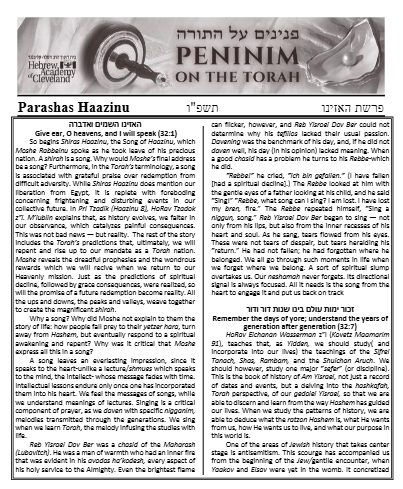

זכור ימות עולם בינו שנות דור ודור
Remember the days of yore; understand the years of generation after generation (32:7)

HoRav Elchanan Wasserman z”l (Kovetz Maamarim 91), teaches that, as Yidden, we should study (and incorporate into our lives) the teachings of the Sifrei Tanach, Shas, Rambam, and the Shulchan Aruch. We should however, study one major “sefer” (or discipline). This is the book of history of Am Yisrael, not just a record of dates and events, but a delving into the hashkafah, Torah perspective, of our gedolei Yisrael, so that we are able to discern and learn from the way Hashem has guided our lives. When we study the patterns of history, we are able to deduce what the ratzon Hashem is, what He wants from us, how He wants us to live, and what our purpose in this world is.

One of the areas of Jewish history that takes center stage is antisemitism. This scourge has accompanied us from the beginning of the Jew/gentile encounter, when Yaakov and Eisav were yet in the womb. It concretized with Lavan and Yaakov and came to its prominence at Har Sinai, she’misham yardah sinaah, l’olam, “from our point” (from the moment that the Jew was singled out to be distinct from the nations,) sinah, hatred, enmity, descended to the world.

No matter what our location, wherever we may live some form of sinah will be directed towards us. This is due to the fact that we are surrounded by the proverbial seventy wolves (nations); regardless of our being a minority among the world’s minorities, we are Jewish and, as such, we are different. It is in the blood/instinct of the gentile that the Jew is someone to revile — some more, others less- and it has been shown time and again throughout the generations that antisemitism is part and parcel of the DNA of being an eino Yehudi. Understandably, all types of people are in this world, but the Jew is distinct. For that reason, he has become the scapegoat of history--theological hostility towards the Jewish people. Indeed, the Yaavetz writes that the greatest miracle — even greater than the splitting of the Red Sea — is the continued existence of the Jewish people; despite the pogroms, exiles, and holocausts.

If we take a short journey through history to the earliest periods in which society was somewhat civil, we see an undeniable, underlying pattern that has characterized anti-Jewish sentiment. [This, of course, skims over the periods of the early Catholic Church, in which the Jews were reviled for the “murder” of their savior. This led to the Crusades and Martin Luther’s rabid loathing, which laid the foundation and became the backdrop of the Nazi doctrine.]

Following the French Revolution which resulted in European Emancipation, the walls of the Jewish ghetto came tumbling down, and Jews were granted equal rights. Along with this newfound freedom/equality, the Haskalah, Enlightenment movement, arose. The Haskalah was the forerunner of the secular Jewish streams and “isms” which preached that, as long we appear and act different from our gentile counterparts, they will hate us. Thus, they sanctioned eschewing Jewish observance and aligning with the goyim in their depraved culture. Once and for all, be and act like a goy. This theory almost destroyed all of German Jewry, as thousands drank from the baptismal font during the nineteenth century. Sadly, it was from Berlin that the greatest manifestation of antisemitism, the Holocaust, emerged.

The Russians with their versions of Enlightenment, Communism, Bundism, and Yiddishist succeeded in assimilating more Jews, but were unable to curb the gentile’s appetite for murdering Jews. This was followed by the secular Zionists, whose manifesto was that, as long as the Jews did not have a land they could call their own, we would not achieve the respect of the world. Apparently, that did not work out very well either.

Am Yisrael is an am kadosh, holy nation, who is to remain distinct in everything we do. We are guided by the Torah, which is our lodestar for living — both physically and spiritually, since everything in life falls under the rubric of the spirit. Either we belong to Hashem or we belong to the goyim. This has been proven time and again. As the Bais Halevi famously said, “When the Yid does not make Kiddush (sanctify himself, being distinct in his beliefs and behavior), the goy will make Havdalah, separation. (They will see to it that we are disconnected and excluded from them.) The Kelmer Maggid declared that, while the German Reform Movement sanctioned intermarriage as a means to gain acceptance in the eyes of the gentile community, years later, an edict went forth from Berlin (Nazi government) prohibiting Germans from marrying Jews.

This has been the painful paradox, the irony that has shadowed us through our history: when we attempt to gravitate to the goyim, to assimilate into their culture, their innate hatred emerges to remind us of our Jewish identity. When the world rejects us, we gravitate back home to our people- to Hashem. Indeed, antisemitism has painfully saved us from total assimilation. The lesson to be derived: If they continue to hate us, it is an indication that we are still “us,” Jews. No exit strategy from Judaism exists.

This has been the pattern that has followed us through history. In Medieval Spain, the Jews rose to power and prestige- the assimilation that followed was the precursor to the Inquisition. In nineteenth century Western Europe and especially Germany, assimilation was rampant. We know what followed. Even in the twenty-first century, a time in which Jews attempt to shed their identities, they are painfully reminded by terror attacks, campus hate, and politicians whose shameless crude remarks against us have no parameters.

At times, however, the worst attacks can spark powerful reminders. Mark was a secular Jew who, in 1999, lived in a quiet neighborhood in Sacramento, California. He lived near a synagogue, but, as an assimilated Jew who had married out, even a secular synagogue was an anomaly to him. He was not interested in his biological Jewish background, because, as a "liberated" Jew, it meant nothing to him. Then, two white supremacists, brothers for whom hatred of Jews was their unifying cause in life, firebombed the synagogue, causing serious damage. This was repeated in two other synagogues. [The religious leanings of these edifices has no bearing on the story, because, to Mark, even the most left-leaning synagogue was distant from him, since, in his mind, he had severed his relationship with Judaism]

The near-tragedy changed his life. He attended a vigil, where a young rabbi asked him whether he wanted to do something meaningful, like put on Tefillin. This led to Shabbos observance, kashrus and Torah study. The fire that was to burn down his identity, instead kindled a dormant spark in his neshamah until he no longer ran from his heritage. Hatred hurts — but it preserves.

PDF Preview