Shabbos Shuva and the Eagle's Lesson
מגדל אור | September 20, 2023
Print This Article
View Original PDF

Shabbos Shuva and the Eagle's Lesson

מגדל אור | December 31, 2025

The Shabbos between Rosh HaShana and Yom Kippur is known as Shabbos Shuva, based on the words of the Haftarah, “Shuva Yisrael ad Hashem Elokeichem,” Return, O Israel, to Hashem your G-d.

We are exhorted to awaken and turn back to Hashem; to seek to renew our relationship as it once was, before we sinned and pursued foreign gods and pleasures.

At the beginning of Haazinu, Hashem’s relationship to the Jews is likened to that of an eagle and its young.

Rashi describes how an eagle is concerned for its children and does not suddenly enter the nest, lest they be frightened. Instead, it flaps its wings as it moves from tree to tree nearby, so the young are ready to accept the parent into the nest.

Similarly, Hashem is constantly in our lives, but without the blunt force of constant announcing of His presence. Instead, He makes His presence known through the rustling of the leaves, as it were, with gentle implications in our lives that He is there.

Haazinu means to listen. When we listen for that which we cannot see, we must think about it and discern what is going on. Hashem is making sounds that He wants us to realize are intended to arouse us to long for His arrival.

Like the eaglets which anticipate the arrival of their parent, and the sustenance, protection and love which accompany it, this is the time for us to hear our Beloved approaching, and anxiously seek out His embrace.

Thought of the week:

Time invested in improving ourselves cuts down on time wasted disapproving of others.
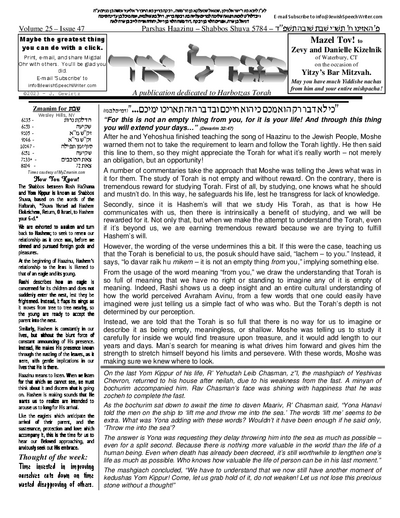
The Shabbos between Rosh HaShana and Yom Kippur is known as Shabbos Shuva, based on the words of the Haftarah, “Shuva Yisrael ad Hashem Elokeichem,” Return, O Israel, to Hashem your G-d.

We are exhorted to awaken and turn back to Hashem; to seek to renew our relationship as it once was, before we sinned and pursued foreign gods and pleasures.

At the beginning of Haazinu, Hashem’s relationship to the Jews is likened to that of an eagle and its young.

Rashi describes how an eagle is concerned for its children and does not suddenly enter the nest, lest they be frightened. Instead, it flaps its wings as it moves from tree to tree nearby, so the young are ready to accept the parent into the nest.

Similarly, Hashem is constantly in our lives, but without the blunt force of constant announcing of His presence. Instead, He makes His presence known through the rustling of the leaves, as it were, with gentle implications in our lives that He is there.

Haazinu means to listen. When we listen for that which we cannot see, we must think about it and discern what is going on. Hashem is making sounds that He wants us to realize are intended to arouse us to long for His arrival.

Like the eaglets which anticipate the arrival of their parent, and the sustenance, protection and love which accompany it, this is the time for us to hear our Beloved approaching, and anxiously seek out His embrace.

Thought of the week:

Time invested in improving ourselves cuts down on time wasted disapproving of others.

PDF Preview