The Broken Luchos of the Nefesh
Bilvavi | March 06, 2026
Print This Article
View Original PDF

The Broken Luchos of the Nefesh

Bilvavi | March 06, 2026

The Torah has 613 mitzvos, and they are expressed in a summarized form. These are the Aseres HaDibros, which is a shortened version of the entire Torah. Even further summarized are the first two of the Aseres HaDibros, אנכי ה’ אלקיך and לא יהיה לך, the mitzvah to believe in Hashem and the prohibition against avodah zarah. All “positive commandments” (mitzvos asei) are included in the mitzvah to believe in Hashem, and all “negative commandments” of the Torah are included within the prohibition of worshiping avodah zarah.

The luchos that Moshe received from Hakadosh Baruch Hu broke and the letters of the Aseres HaDibros flew up into the air. Something similar, can happen, chalilah, to a Jewish nefesh. The entire Torah is engraved on his nefesh, and in a shortened version, these are the Aseres HaDibros. Even more succinctly, these are the first two commandments of the Aseres HaDibros, the mitzvah to believe in Hashem, and the prohibition of idolatry (avodah zarah). These two commandments are the roots of all positive and negative commands of the Torah. If a person doesn’t keep the mitzvos, the Aseres HaDibros of his soul can, chalilah, fly into the air and the luchos of his heart breaks.

The solution is to keep at least the two roots of the Aseres HaDibros, which are a mitzvah asei and a mitzvah lo saasei.

PRACTICAL APPLICATION

Every person should choose one asei and one lo saasei, which he will always keep. If at times he can’t keep them entirely, he should keep them partially, but he must always have a connection with these two mitzvos. He should choose the mitzvos that are associated with his nefesh. For example, if a person is generous, by nature, he can choose the mitzvah of tzedakah. When an opportunity for tzedakah arises, he should perform the mitzvah – if not entirely, at least, in some small manner. This will be his mitzvah that connects him to the Aseres HaDibros of his nefesh. If a person understands that it is very important for his nefesh to avoid hatred, the aveirah of lo sisna es achichah, hating one’s fellow man, can be his lo saasei, which he keeps at all times, at least to an extent.

”He threw down the luchos from his hands and shattered them” (שמות לב, יט)ַוַיַּשְׁלֵךְ מִיָּדָיו אֶת הַלֻּחֹת וַיְשַׁבֵּר אֹתָם תַּחַת הָהָר

THE BROKEN LUCHOS OF THE NEFESH

Just as the two luchos which were given by Hakadosh Baruch Hu to Moshe were broken, so, too, there is the concept of broken luchos of the nefesh.

The Aseres HaDibros written on the luchos are the roots of the entire Torah. The luchos broke, but the “letters flew into the air.”

The same is with the nefesh. The nefesh has ten primary strengths, and when one foundations are not firm, the luchos of the nefesh are broken.

The foundations of the Aseres HaDibros are the “positive commandments” (mitzvos asei) and the “negative commandments” (mitzvos lo sa’asei). The root for all mitzvos asei is אנכי ה’ אלקיך, and the root for all the mitzvos lo saasei is לא יהיה לך.

IN PRACTICE

Every person has to have at least one primary asei, and one primary lo sa’asei – which is essential for his soul. When a person can perform this primary asei, he must do so, always, whether a lot or a little. When he can keep his particular lo saasei, he should do so, either entirely or partially. In this manner, a person strengthens the root and the foundations of his soul.

שבירת הלוחות בנפש

שהיה שבירת הלוחות בלוחות שנתנו למשה מהקב”ה, כשם כן יש שבירת הלוחות בנפש.

בלוחות היו כתובים עשרת הדברות, שהם הם שרשי התורה. הלוחות נשברו אולם ה’אותיות פורחות באויר’.

כן הוא בנפש, יש לה עשרה כוחות עיקרים. וכאשר אינו חזק ותקיף על עקרונותיו, זהו שבירת הלוחות שבנפש.

שורש כל עשרת הדברות הוא; עשה, ולא תעשה. שורש העשה – ‘אנוכי ה’ אלקיך וג’ו’. ושורש הלא תעשה – ‘לא יהיה לך וג’ו’.

למעשה

אדם צריך שיהא לפחות עקרון אחד של עשה, ועקרון לכל אחד של לא תעשה, עקרון בדבר עיקרי בנפשו. כשמזדמן לידיו העיקרון של עשה, הוא תמיד עושה, אם רב אם מעט. וכמזדמן לידיו עקרון של לא תעשה הפרטי, הוא נמנע ולא עושה, או כולו או לפחות חלקו. ומכח כך האדם מחזק את שורש נפשו ויסודתיה.
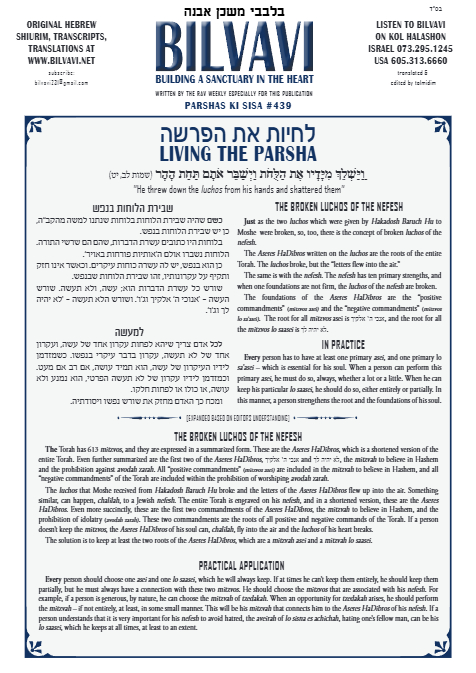
The Torah has 613 mitzvos, and they are expressed in a summarized form. These are the Aseres HaDibros, which is a shortened version of the entire Torah. Even further summarized are the first two of the Aseres HaDibros, אנכי ה’ אלקיך and לא יהיה לך, the mitzvah to believe in Hashem and the prohibition against avodah zarah. All “positive commandments” (mitzvos asei) are included in the mitzvah to believe in Hashem, and all “negative commandments” of the Torah are included within the prohibition of worshiping avodah zarah.

The luchos that Moshe received from Hakadosh Baruch Hu broke and the letters of the Aseres HaDibros flew up into the air. Something similar, can happen, chalilah, to a Jewish nefesh. The entire Torah is engraved on his nefesh, and in a shortened version, these are the Aseres HaDibros. Even more succinctly, these are the first two commandments of the Aseres HaDibros, the mitzvah to believe in Hashem, and the prohibition of idolatry (avodah zarah). These two commandments are the roots of all positive and negative commands of the Torah. If a person doesn’t keep the mitzvos, the Aseres HaDibros of his soul can, chalilah, fly into the air and the luchos of his heart breaks.

The solution is to keep at least the two roots of the Aseres HaDibros, which are a mitzvah asei and a mitzvah lo saasei.

PRACTICAL APPLICATION

Every person should choose one asei and one lo saasei, which he will always keep. If at times he can’t keep them entirely, he should keep them partially, but he must always have a connection with these two mitzvos. He should choose the mitzvos that are associated with his nefesh. For example, if a person is generous, by nature, he can choose the mitzvah of tzedakah. When an opportunity for tzedakah arises, he should perform the mitzvah – if not entirely, at least, in some small manner. This will be his mitzvah that connects him to the Aseres HaDibros of his nefesh. If a person understands that it is very important for his nefesh to avoid hatred, the aveirah of lo sisna es achichah, hating one’s fellow man, can be his lo saasei, which he keeps at all times, at least to an extent.

”He threw down the luchos from his hands and shattered them” (שמות לב, יט)ַוַיַּשְׁלֵךְ מִיָּדָיו אֶת הַלֻּחֹת וַיְשַׁבֵּר אֹתָם תַּחַת הָהָר

THE BROKEN LUCHOS OF THE NEFESH

Just as the two luchos which were given by Hakadosh Baruch Hu to Moshe were broken, so, too, there is the concept of broken luchos of the nefesh.

The Aseres HaDibros written on the luchos are the roots of the entire Torah. The luchos broke, but the “letters flew into the air.”

The same is with the nefesh. The nefesh has ten primary strengths, and when one foundations are not firm, the luchos of the nefesh are broken.

The foundations of the Aseres HaDibros are the “positive commandments” (mitzvos asei) and the “negative commandments” (mitzvos lo sa’asei). The root for all mitzvos asei is אנכי ה’ אלקיך, and the root for all the mitzvos lo saasei is לא יהיה לך.

IN PRACTICE

Every person has to have at least one primary asei, and one primary lo sa’asei – which is essential for his soul. When a person can perform this primary asei, he must do so, always, whether a lot or a little. When he can keep his particular lo saasei, he should do so, either entirely or partially. In this manner, a person strengthens the root and the foundations of his soul.

שבירת הלוחות בנפש

שהיה שבירת הלוחות בלוחות שנתנו למשה מהקב”ה, כשם כן יש שבירת הלוחות בנפש.

בלוחות היו כתובים עשרת הדברות, שהם הם שרשי התורה. הלוחות נשברו אולם ה’אותיות פורחות באויר’.

כן הוא בנפש, יש לה עשרה כוחות עיקרים. וכאשר אינו חזק ותקיף על עקרונותיו, זהו שבירת הלוחות שבנפש.

שורש כל עשרת הדברות הוא; עשה, ולא תעשה. שורש העשה – ‘אנוכי ה’ אלקיך וג’ו’. ושורש הלא תעשה – ‘לא יהיה לך וג’ו’.

למעשה

אדם צריך שיהא לפחות עקרון אחד של עשה, ועקרון לכל אחד של לא תעשה, עקרון בדבר עיקרי בנפשו. כשמזדמן לידיו העיקרון של עשה, הוא תמיד עושה, אם רב אם מעט. וכמזדמן לידיו עקרון של לא תעשה הפרטי, הוא נמנע ולא עושה, או כולו או לפחות חלקו. ומכח כך האדם מחזק את שורש נפשו ויסודתיה.

PDF Preview