The Orphans Tefillah
Torah Papers | March 13, 2025
Print This Article
View Original PDF

The Orphans Tefillah

Torah Papers | June 27, 2025

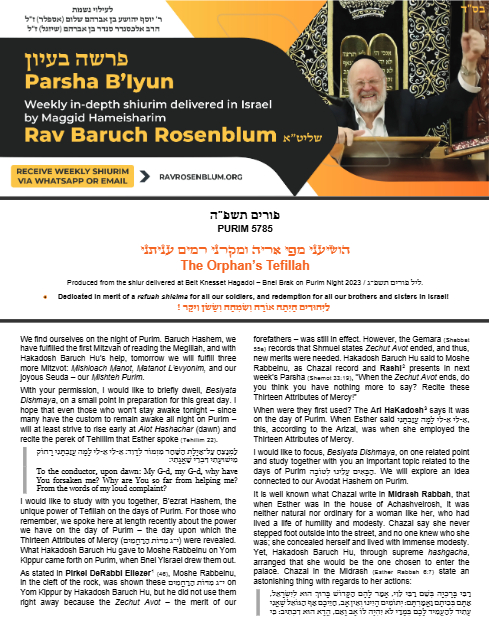
We find ourselves on the night of Purim. Baruch Hashem, we have fulfilled the first Mitzvah of reading the Megillah, and with Hakadosh Baruch Hu’s help, tomorrow we will fulfill three more Mitzvot: Mishloach Manot, Matanot L’evyonim, and our joyous Seuda – our Mishteh Purim.

With your permission, I would like to briefly dwell, Besiyata Dishmaya, on a small point in preparation for this great day. I hope that even those who won’t stay awake tonight – since many have the custom to remain awake all night on Purim – will at least strive to rise early at Alot Hashachar (dawn) and recite the perek of Tehillim that Esther spoke (Tehillim 22).

To the conductor, upon dawn: My G-d, my G-d, why have You forsaken me? Why are You so far from helping me? From the words of my loud complaint?

I would like to study with you together, B’ezrat Hashem, the unique power of Tefillah on the days of Purim. For those who remember, we spoke here at length recently about the power we have on the day of Purim – the day upon which the Thirteen Attributes of Mercy (י״ג מִדּוֹת הַרַ חֲמִים) were revealed. What Hakadosh Baruch Hu gave to Moshe Rabbeinu on Yom Kippur came forth on Purim, when Bnei Yisrael drew them out. As stated in Pirkei DeRabbi Eliezer (46), Moshe Rabbeinu, in the cleft of the rock, was shown these י״ג מִדּוֹת הַרַ חֲמִים on Yom Kippur by Hakadosh Baruch Hu, but he did not use them right away because the Zechut Avot – the merit of our forefathers – was still in effect. However, the Gemara (Shabbat 55a) records that Shmuel states Zechut Avot ended, and thus, new merits were needed. Hakadosh Baruch Hu said to Moshe Rabbeinu, as Chazal record and Rashi presents in next week’s Parsha (Shemot 33:19), “When the Zechut Avot ends, do you think you have nothing more to say? Recite these Thirteen Attributes of Mercy!”

When were they first used? The Ari HaKadosh says it was on the day of Purim. When Esther said אֵ -לִ י אֵ -לִ י לָמָ ה עֲזַבְ תָּ נִ י, this, according to the Arizal, was when she employed the Thirteen Attributes of Mercy.

I would like to focus, Besiyata Dishmaya, on one related point and study together with you an important topic related to the days of Purim הַ בָּאִ ים עָלֵינוּ לְטוֹבָה. We will explore an idea connected to our Avodat Hashem on Purim.

The Orphan’s Tefillah

It is well known what Chazal write in Midrash Rabbah, that when Esther was in the house of Achashveirosh, it was neither natural nor ordinary for a woman like her, who had lived a life of humility and modesty. Chazal say she never stepped foot outside into the street, and no one knew who she was; she concealed herself and lived with immense modesty. Yet, Hakadosh Baruch Hu, through supreme hashgacha, arranged that she would be the one chosen to enter the palace. Chazal in the Midrash (Esther Rabbah 6:7) state an astonishing thing with regards to her actions:

Rabbi Berechya said in the name of Rabbi Levi: Hakadosh Baruch Hu said to them, to Israel: You wept and said: “We have become orphans, fatherless.” By your lives, also the savior that I will establish for you in Media in the future will not have a mother or father. That is what is written: “For she had neither father nor mother.”

Bnei Yisrael said: “יְתוֹמִ ים הָ יִינוּ וְ אֵ ין אָ ב – We are orphans without a father.” They cried out to Hakadosh Baruch Hu, and He replied, “You are orphans without a father? I will raise up a redeemer for you who has neither father nor mother.”

When reading these words, one immediately wonders: What is this all about? Is it a positive or a negative? A plus or a minus? They declared that they were orphans without a father, and in response, they were given a redeemer who had neither father nor mother?!

As we know from what the Gemara teaches, Esther lost her father the moment her mother conceived, and the moment her mother gave birth, she too passed away, leaving Esther as a completely orphaned infant. This is where Mordechai enters the scene and we all know the tremendous merit we just read about in the Megillah: וּבְ מוֹת אָ בִ יהָ וְ אִ מָּ הּ לְ קָ חָ הּ מׇ רְ דֳּ כַי לוֹ לְ בַת – And with the death of her father and mother, Mordechai took her as a daughter. Let’s take a moment to examine how Mordechai is introduced. After mentioning his presence in Shushan, the Megillah states:

Who had been exiled from Yerushalayim with the captivity which had been carried away into exile with Yechonya king of Yehuda, whom Nevuchadnetzar the king of Bavel had carried away into exile.

Why are we told that Mordechai was exiled? Is it not obvious? Wasn’t everyone exiled?! The reason this fact is emphasized in such detail is that, while others had already settled into their new reality, Mordechai did not simply endure the exile – he actively chose to leave his place of residence to live near Esther. Why? Because of her natural environment and her surroundings, so that she would remain, so to speak, in her proper place. Mordechai was a member of the Sanhedrin and lived in Yerushalayim, yet he left the holy city and his home to care for her. He uprooted himself from Yerushalayim and moved to Persia, solely to be near this little orphaned girl.

And it was no coincidence that Hakadosh Baruch Hu chose Mordechai to be the redeemer of Am Yisrael – a man willing to leave his home for the sake of others. Chazal constantly draw parallels between Moshe Rabbeinu and Mordechai – open the Midrash, and you’ll find them. Just as Moshe Rabbeinu stood before Bnei Yisrael and defended them when they were about to be destroyed following Cheit Ha’egel, so too did Mordechai stand before the nation. Just as Moshe Rabbeinu taught Torah to Am Yisrael, so too did Mordechai.

This is a great yesod we learn on the days of Purim. Why did Hakadosh Baruch Hu choose Mordechai to be the one through whom redemption would come and through whom we would be saved? Because Mordechai left Yerushalayim, left his place of residence, to care for an orphaned girl who had no father or mother. Mordechai extended his protection over her.

If these are the words of Chazal, there is one thing I don’t understand. Hakadosh Baruch Hu says, “You said you are orphans without a father? I will raise up for you a redeemer who has neither father nor mother.” Rabbotai, allow me to ask: What does this mean? Is a parentless redeemer a good thing? A gift? What is the underlying idea here?

The Secret of Esther’s Orphanhood

To understand this, let us learn a great yesod in Avodat Hashem, so that we approach Tefillah tomorrow morning correctly, and B’ezrat Hashem, at the conclusion of Shacharit, Hakadosh Baruch Hu will י ו ֹ שׁ ִ י ט אֶ ת לוֹ הַ מּ ֶ לֶ ך שׁ ַ רְ בִ יט הַ זָּהָ ב – He will extend to each one His golden scepter; and each person will touch the golden scepter of Hakadosh Baruch Hu and receive all the good that He bestows upon him. We’ll learn a great yesod in Avodat Hashem; pay close attention to the wonderful idea I want to share with you.

Rabbotai, there is a prayer called תְּ פִ ילָה – we daven. But there is also a special prayer called תְּ פִ לַּת יָתוֹם – the prayer of an orphan. What’s this special prayer of an orphan? One does not need to be an orphan to daven such a Tefillah. When Chazal say that Hakadosh Baruch Hu said, “You said you were orphans, etc.,” we must understand its deeper meaning.

When Esther was chosen as the redeemer, she was, according to the Midrash (Lech Lecha), already seventy-five (or seventy-four) years old, derived from the numerical value of הֲ דַ סּ ָ ה. The Midrash states that Hakadosh Baruch Hu said to Avraham Avinu: “You left your father’s house at seventy-five; by your life, I will raise up for Bnei Yisrael a redeemer who will be seventy-five years old.” Who is this redeemer, and what is her name? It is Esther.

Now, usually – I’m not saying always, but usually – by the age of seventy-five, one is an orphan. Not always – may Hakadosh Baruch Hu grant everyone long days and years. I once heard about an eighty-year-old man who came to the rabbinate to register for marriage. They asked him, “Now, at eighty, you’re getting married?” He replied, “I wouldn’t have done it, but my parents are pressuring me, Baruch Hashem.” May it be that everyone has parents who can lovingly pressure their children even at the age of one hundred and ten!

But in any case, what is the meaning of יְ תוֹ מִ ים in the phrase יְתוֹמִ ים הָ יִינוּ וְ אֵ ין אָ ב? The Midrash states that Esther stood in the house of Achashveirosh, moving from window to window, from door to door, and then cried out to Hakadosh Baruch Hu, “Ribbono Shel Olam, do not forget that I am an orphan!”

Rabbotai, how long can you play that card? How long can you carry the merit of being an orphan? She was an orphan from the moment she was born – she had neither father nor mother at childbirth. Seventy-five years later, what is she trying to remind Hakadosh Baruch Hu? What is the secret hidden in this concept of Esther’s orphanhood?

The Ten Expressions of Prayer

My friends, there are ten expressions of prayer. If you want to learn about these different expressions, open Midrash Tanchuma in Parshat Va’etchanan, where Chazal enumerate the ten expressions of prayer found there:

הֲרֵ י בְּהַרְ בֵּה שׁ ֵמוֹת נִקְ רֵ את הַתְּפִלָה, תְּפִלָה, תְּחִנָּה, צְעָקָה, זְעָקָה, שׁ ַוְעָה, רְ נָנָה, פְּגִיעָה, נְפִילָה, עֲמִידָה. וְלָמָּה לֹא נִתְפַּלֵל מֹשׁ ֶה בְּאַחַת מֵהֶן אֶל אֵלָה, שׁ ֶנֶּאֱמַר: וָאֶתְ חַנָּן.

The complete list is analyzed and explained by Rav Shimshon David Pincus z”l in a sefer called She’arim B’Tefillah (Gates of Prayer). His entire focus is on explaining these ten expressions of prayer and the differences between them. The sefer is called She’arim B’Tefillah because each type of prayer has its own special gate, and I would now like to delve into the gate called יָתוֹם – orphan.

The Gate Called "Orphan"

What is the gate called "orphan"? First, let’s reiterate that one does not need to be an orphan to enter this gate. A person can have a father and mother, a grandfather and grandmother, even a great-grandfather and great-great-grandfather, and still, their prayer can be a תְּ פִ לַּת יָתוֹם – the prayer of an orphan. How do we recognize this type of Tefillah? We’ll learn that from Esther, B’ezrat Hashem.

Let’s together study the Tehillim (22) that Esther recited when entering the inner court of Achashveirosh. We will recite it, Besiyata Dishmaya, tomorrow morning at dawn, and perhaps we can recite it all together here at the conclusion of this shiur. In this Perek, Esther says the following:

Save my life from the sword, my precious life from the clutches of a dog. Deliver me from a lion’s mouth; from the horns of wild oxen rescue me.

The Gemara (Megillah 15b) asks: What was Esther saying here? She was saying, “Ribbono Shel Olam, I ask forgiveness if I called Achashveirosh a dog. If I called him a dog – I apologize. From now on, I will call him a lion.” She had prayed for her soul to be delivered from the hand of a dog, and now, as they say in Hebrew, she says, “I’m sorry.”

Rabbotai, I want to ask you: Which name suits Achashveirosh more – dog or lion? Clearly, the answer is dog. If anything, she should be asking forgiveness from the dogs for comparing Achashveirosh to them! After all, at least a dog does a few good things! So why did she first compare him to a dog? And after apologizing, why switch to a lion? Why not lower the comparison even further and call him kelev ben kelev – a dog, son of a dog? What does this all mean?

The Four Who Must Give Thanks

Let’s now learn this wonderful yesod, Besiyata Dishmaya, one also learned from another Perek of Tehillim (107) which speaks about four people who are obligated to give thanks. Who are these four people? One who crosses the sea, one who traverses the desert, one who is released from prison, and one who is healed from illness. Let’s read the Pesukim inside:

They wandered in the desert and wasteland, hungry and thirsty. So, what did they do? וַיִּצְעֲקוּ אֶל ה' – they cried out to Hakadosh Baruch Hu in their distress, and He arranged a place of dwelling for them and showed them the way because they didn’t have Waze. Everything was fine, and Baruch Hashem, they cleared the journey and offered their thanks. Let’s now learn the next category:

Those who dwell in darkness and the shadow of death, prisoners of affliction and iron – who are they? These are people in prison. Being in prison means dwelling in darkness, whether in a physical prison or another form of confinement. What do they do? וַיִּזְעֲקוּ אֶל ה' – They cry out to Hakadosh Baruch Hu in their distress, pleading for Him to take them out. Did you notice the difference between prison and the desert? In the desert, it says וַיִּצְעֲקוּ, while in prison, it says וַיִּזְעֲקוּ. Why does the language change? Let’s move on to the third category, a person at the hospital in serious condition:

All food was loathsome to them, and they reached the gates of death. A person who says, “I have no appetite” – what does that mean? It’s a sign that he is seriously ill, right? There’s no choice – they need to insert a feeding tube so that food can enter another way. What do people in such a condition do? וַיִּזְעֲקוּ אֶל־ה' – they cry out to Hakadosh Baruch Hu and He sends His word, heals them, and delivers them from their pit. Once again, we’re back to וַיִּזְעֲקוּ, just like in the case of prison, and unlike the case of the desert, where it says וַיִּצְעֲקוּ. Now to the final category:

Those who go out to sea in ships and work in great waters, sailing in the middle of the day and witnessing the wondrous works of Hakadosh Baruch Hu in the depths. All is calm until He speaks and raises a storm, lifting the waves and causing the sea to dance – and Rabbotai, when the sea dances, it certainly knows how to dance! As they rise and descend in their ships, what do they do? וַיִּצְעֲקוּ אֶל ה' – just like in the desert.

The sefer Minchat Ani, by the author of Aruch LaNer, asks a wonderful question. He says: I don’t understand – why does וַיִּצְעֲקוּ appear here, while וַיִּזְעֲקוּ appears there? What is the difference between the desert and the sea, where it says צְעָקָה, and the prison and hospital, where we find זְעָקָה? In presenting his answer, we will also uncover another wonderful idea.

The Deeper Meaning of Tefillat Yatom

Rabbotai, regarding Esther, it is written that she was beautiful of form and appearance – יְפַת תֹּאַר וְטוֹבַת מַרְ אֶה. And therefore, she didn’t request anything. Every other woman who entered the pageant spent six months with oils and six months with fragrances, only then becoming ready for the king. What we are told about Esther – יְפַת תּ ֹאַ ר וְ טוֹבַת מַ רְ אֶ ה – is also written about Rachel Imeinu and Yosef. The Rokeach says that the acronym formed from these four words is יָתוֹם – orphan. He’s not just pointing this out because the letters happen to align; there is clearly a deeper meaning behind it.

But what does beauty have to do with being an orphan? Where is the connection, and what can we learn from it regarding the Tefillah called יָתוֹם? The Minchat Ari provides a wonderful yesod, which will open for us a deeper understanding of what Purim is all about.

A Tefillat Yatom is when a person completely relinquishes hope in anything else – placing no trust or reliance on anyone or anything. His sole and absolute trust rests in the Borei Olam. He cries out, “No one can help me, no one can provide for me, no one can assist me – only You, שׁ ְ מ ו ֹ ל ָ ע ַ ד י ִ תְ ב ּ ָ רַ ך, can help me!” Such a heartfelt prayer, in which a person places all his hope in Hakadosh Baruch Hu, is called a Tefillat Yatom.

Why? Because it says so explicitly in the Torah:

You shall not ill-treat any widow or orphan. If you do mistreat them, I will heed their outcry as soon as they cry out to Me.

The Ramban asks why this rule is set in place and explains that it is because an orphan has no one to turn to. When a person faces troubles, what do they ordinarily do? If they didn’t get paid at work, who do they turn to? They turn to their father.

“Abba, I’m coming up to your place for coffee.”
“What kind of coffee do you want me to make you?”
“Black coffee.”
“Why black?”
“Because my situation is black. Make me black coffee with no chance of anything white inside – all black.”

Why is he going to his father for coffee? Because the bank will start bouncing his checks tomorrow. If he doesn’t transfer money today, they’ll freeze his account, the checks will bounce, and he’ll face serious financial restrictions.

“Why didn’t they pay you at work?”
“Well, the account was like this, the account was like that... Abba, the fact is – there’s no payment and tomorrow payments are due for the daycare, the IsraCard, the Visa, and more. If I don’t deposit ten thousand shekels now, everything starts bouncing tomorrow. Please, do me a favor!”

Why does he turn to his father? Because, Baruch Hashem, he has a father and can! And if his father can’t help, he turns to his brother. And if his brother can’t help, he turns to his uncle. An orphan, on the other hand, has no father – so what’s the first thing he does in such a situation? The Ramban says that the first thing he does is turn to his Father in Heaven. The first one he turns to is Hakadosh Baruch Hu.

כִּי אָבִי וְאִמִּי עֲזָבוּנִי וַה' יַאַסְפֵנִי – “This is my Father, because my father and mother have forsaken me, and Hashem will gather me in. I have no one else but You.” And about a person who casts off all hope of help from anyone and places it solely in Hakadosh Baruch Hu, Chazal say:

יְהִי־חַסְדְּךָ ה' עָלֵינוּ כַּאֲשֶׁר יִחַלְנוּ לָךָ – May we enjoy, Hashem, Your faithful kindness, as we have put our hope in You.

As much as you put your hope in Hakadosh Baruch Hu, so Hakadosh Baruch Hu responds to you.

Rabbotai, the Aruch LaNer says: Regarding a person sitting in prison, it doesn’t say וַיִּצְעֲקוּ. What does it say? וַיִּזְעֲקוּ. Why a זְ עָ קָ ה? The man is sitting in prison and says:

"Listen, I got a three-year sentence. My lawyer just submitted a request to the president for a pardon. He’s also a friend of a friend of a friend of someone deep in the judicial reform process who can pull some strings. My lawyer also has round glasses, so he’s part of that group – he’ll talk to him; he’ll surely work it out, Baruch Hashem."

So, his prayer is, so to speak, so-so. It’s not all-in. The ball’s in play – a bit with the court, a bit with the accountant, a bit with the president, and a bit with Hakadosh Baruch Hu. He’s got all grounds covered. And it’s the same regarding a sick person. He’s lying in the hospital, and the doctor approaches:

“How can I help you?”
“You can’t help me, but Baruch Hashem, my brother lives in Arizona, and another in Memphis, and I’ll ask them if there’s someone in the United States who can help. Maybe there’s an expert doctor there. I’ll also ask the medical activists here which hospital is the best. Maybe, B’ezrat Hashem, they’ll bring me a good doctor, and whatever it is you can’t do, they can! And besides, this is a terrible hospital – I’ll move to the center of the country, where there are bigger experts around.”

What does he trust in? He trusts in a doctor and in a hospital. He says, “B’ezrat Hashem,” but where is his B’ezrat Hashem placed? “B’ezrat Hashem, I’ll find the right doctor.” It’s in him finding the redeemer, and then in the doctor bringing him his salvation. That outcry is וַיִּזְעֲקוּ. His cry is a זְ עָ קָ ה.

When you’re stuck in the desert, however, it’s different. Who do you turn to? Only Hakadosh Baruch Hu. That is why, says the Aruch LaNer, it says וַיִּצְעֲקוּ – “Hakadosh Baruch Hu, only You can save me!” That is called a צְ עָ קָ ה. It is the same when you’re at sea and the ship catches joy and starts dancing, and the captain gets on the PA system and says to everyone:

"Good evening, passengers. Our ship is about to break apart. Whoever wants to write a note for their family, put it in a bottle, and seal it, should do so now. Write the address on it, in English – maybe the bottle will reach somewhere and find its way to them. Tell them where the money is – behind which picture it’s hidden or which tile in the living room to move, so they don’t sell the house along with all the money inside. Give ..."
We find ourselves on the night of Purim. Baruch Hashem, we have fulfilled the first Mitzvah of reading the Megillah, and with Hakadosh Baruch Hu’s help, tomorrow we will fulfill three more Mitzvot: Mishloach Manot, Matanot L’evyonim, and our joyous Seuda – our Mishteh Purim.

With your permission, I would like to briefly dwell, Besiyata Dishmaya, on a small point in preparation for this great day. I hope that even those who won’t stay awake tonight – since many have the custom to remain awake all night on Purim – will at least strive to rise early at Alot Hashachar (dawn) and recite the perek of Tehillim that Esther spoke (Tehillim 22).

To the conductor, upon dawn: My G-d, my G-d, why have You forsaken me? Why are You so far from helping me? From the words of my loud complaint?

I would like to study with you together, B’ezrat Hashem, the unique power of Tefillah on the days of Purim. For those who remember, we spoke here at length recently about the power we have on the day of Purim – the day upon which the Thirteen Attributes of Mercy (י״ג מִדּוֹת הַרַ חֲמִים) were revealed. What Hakadosh Baruch Hu gave to Moshe Rabbeinu on Yom Kippur came forth on Purim, when Bnei Yisrael drew them out. As stated in Pirkei DeRabbi Eliezer (46), Moshe Rabbeinu, in the cleft of the rock, was shown these י״ג מִדּוֹת הַרַ חֲמִים on Yom Kippur by Hakadosh Baruch Hu, but he did not use them right away because the Zechut Avot – the merit of our forefathers – was still in effect. However, the Gemara (Shabbat 55a) records that Shmuel states Zechut Avot ended, and thus, new merits were needed. Hakadosh Baruch Hu said to Moshe Rabbeinu, as Chazal record and Rashi presents in next week’s Parsha (Shemot 33:19), “When the Zechut Avot ends, do you think you have nothing more to say? Recite these Thirteen Attributes of Mercy!”

When were they first used? The Ari HaKadosh says it was on the day of Purim. When Esther said אֵ -לִ י אֵ -לִ י לָמָ ה עֲזַבְ תָּ נִ י, this, according to the Arizal, was when she employed the Thirteen Attributes of Mercy.

I would like to focus, Besiyata Dishmaya, on one related point and study together with you an important topic related to the days of Purim הַ בָּאִ ים עָלֵינוּ לְטוֹבָה. We will explore an idea connected to our Avodat Hashem on Purim.

The Orphan’s Tefillah

It is well known what Chazal write in Midrash Rabbah, that when Esther was in the house of Achashveirosh, it was neither natural nor ordinary for a woman like her, who had lived a life of humility and modesty. Chazal say she never stepped foot outside into the street, and no one knew who she was; she concealed herself and lived with immense modesty. Yet, Hakadosh Baruch Hu, through supreme hashgacha, arranged that she would be the one chosen to enter the palace. Chazal in the Midrash (Esther Rabbah 6:7) state an astonishing thing with regards to her actions:

Rabbi Berechya said in the name of Rabbi Levi: Hakadosh Baruch Hu said to them, to Israel: You wept and said: “We have become orphans, fatherless.” By your lives, also the savior that I will establish for you in Media in the future will not have a mother or father. That is what is written: “For she had neither father nor mother.”

Bnei Yisrael said: “יְתוֹמִ ים הָ יִינוּ וְ אֵ ין אָ ב – We are orphans without a father.” They cried out to Hakadosh Baruch Hu, and He replied, “You are orphans without a father? I will raise up a redeemer for you who has neither father nor mother.”

When reading these words, one immediately wonders: What is this all about? Is it a positive or a negative? A plus or a minus? They declared that they were orphans without a father, and in response, they were given a redeemer who had neither father nor mother?!

As we know from what the Gemara teaches, Esther lost her father the moment her mother conceived, and the moment her mother gave birth, she too passed away, leaving Esther as a completely orphaned infant. This is where Mordechai enters the scene and we all know the tremendous merit we just read about in the Megillah: וּבְ מוֹת אָ בִ יהָ וְ אִ מָּ הּ לְ קָ חָ הּ מׇ רְ דֳּ כַי לוֹ לְ בַת – And with the death of her father and mother, Mordechai took her as a daughter. Let’s take a moment to examine how Mordechai is introduced. After mentioning his presence in Shushan, the Megillah states:

Who had been exiled from Yerushalayim with the captivity which had been carried away into exile with Yechonya king of Yehuda, whom Nevuchadnetzar the king of Bavel had carried away into exile.

Why are we told that Mordechai was exiled? Is it not obvious? Wasn’t everyone exiled?! The reason this fact is emphasized in such detail is that, while others had already settled into their new reality, Mordechai did not simply endure the exile – he actively chose to leave his place of residence to live near Esther. Why? Because of her natural environment and her surroundings, so that she would remain, so to speak, in her proper place. Mordechai was a member of the Sanhedrin and lived in Yerushalayim, yet he left the holy city and his home to care for her. He uprooted himself from Yerushalayim and moved to Persia, solely to be near this little orphaned girl.

And it was no coincidence that Hakadosh Baruch Hu chose Mordechai to be the redeemer of Am Yisrael – a man willing to leave his home for the sake of others. Chazal constantly draw parallels between Moshe Rabbeinu and Mordechai – open the Midrash, and you’ll find them. Just as Moshe Rabbeinu stood before Bnei Yisrael and defended them when they were about to be destroyed following Cheit Ha’egel, so too did Mordechai stand before the nation. Just as Moshe Rabbeinu taught Torah to Am Yisrael, so too did Mordechai.

This is a great yesod we learn on the days of Purim. Why did Hakadosh Baruch Hu choose Mordechai to be the one through whom redemption would come and through whom we would be saved? Because Mordechai left Yerushalayim, left his place of residence, to care for an orphaned girl who had no father or mother. Mordechai extended his protection over her.

If these are the words of Chazal, there is one thing I don’t understand. Hakadosh Baruch Hu says, “You said you are orphans without a father? I will raise up for you a redeemer who has neither father nor mother.” Rabbotai, allow me to ask: What does this mean? Is a parentless redeemer a good thing? A gift? What is the underlying idea here?

The Secret of Esther’s Orphanhood

To understand this, let us learn a great yesod in Avodat Hashem, so that we approach Tefillah tomorrow morning correctly, and B’ezrat Hashem, at the conclusion of Shacharit, Hakadosh Baruch Hu will י ו ֹ שׁ ִ י ט אֶ ת לוֹ הַ מּ ֶ לֶ ך שׁ ַ רְ בִ יט הַ זָּהָ ב – He will extend to each one His golden scepter; and each person will touch the golden scepter of Hakadosh Baruch Hu and receive all the good that He bestows upon him. We’ll learn a great yesod in Avodat Hashem; pay close attention to the wonderful idea I want to share with you.

Rabbotai, there is a prayer called תְּ פִ ילָה – we daven. But there is also a special prayer called תְּ פִ לַּת יָתוֹם – the prayer of an orphan. What’s this special prayer of an orphan? One does not need to be an orphan to daven such a Tefillah. When Chazal say that Hakadosh Baruch Hu said, “You said you were orphans, etc.,” we must understand its deeper meaning.

When Esther was chosen as the redeemer, she was, according to the Midrash (Lech Lecha), already seventy-five (or seventy-four) years old, derived from the numerical value of הֲ דַ סּ ָ ה. The Midrash states that Hakadosh Baruch Hu said to Avraham Avinu: “You left your father’s house at seventy-five; by your life, I will raise up for Bnei Yisrael a redeemer who will be seventy-five years old.” Who is this redeemer, and what is her name? It is Esther.

Now, usually – I’m not saying always, but usually – by the age of seventy-five, one is an orphan. Not always – may Hakadosh Baruch Hu grant everyone long days and years. I once heard about an eighty-year-old man who came to the rabbinate to register for marriage. They asked him, “Now, at eighty, you’re getting married?” He replied, “I wouldn’t have done it, but my parents are pressuring me, Baruch Hashem.” May it be that everyone has parents who can lovingly pressure their children even at the age of one hundred and ten!

But in any case, what is the meaning of יְ תוֹ מִ ים in the phrase יְתוֹמִ ים הָ יִינוּ וְ אֵ ין אָ ב? The Midrash states that Esther stood in the house of Achashveirosh, moving from window to window, from door to door, and then cried out to Hakadosh Baruch Hu, “Ribbono Shel Olam, do not forget that I am an orphan!”

Rabbotai, how long can you play that card? How long can you carry the merit of being an orphan? She was an orphan from the moment she was born – she had neither father nor mother at childbirth. Seventy-five years later, what is she trying to remind Hakadosh Baruch Hu? What is the secret hidden in this concept of Esther’s orphanhood?

The Ten Expressions of Prayer

My friends, there are ten expressions of prayer. If you want to learn about these different expressions, open Midrash Tanchuma in Parshat Va’etchanan, where Chazal enumerate the ten expressions of prayer found there:

הֲרֵ י בְּהַרְ בֵּה שׁ ֵמוֹת נִקְ רֵ את הַתְּפִלָה, תְּפִלָה, תְּחִנָּה, צְעָקָה, זְעָקָה, שׁ ַוְעָה, רְ נָנָה, פְּגִיעָה, נְפִילָה, עֲמִידָה. וְלָמָּה לֹא נִתְפַּלֵל מֹשׁ ֶה בְּאַחַת מֵהֶן אֶל אֵלָה, שׁ ֶנֶּאֱמַר: וָאֶתְ חַנָּן.

The complete list is analyzed and explained by Rav Shimshon David Pincus z”l in a sefer called She’arim B’Tefillah (Gates of Prayer). His entire focus is on explaining these ten expressions of prayer and the differences between them. The sefer is called She’arim B’Tefillah because each type of prayer has its own special gate, and I would now like to delve into the gate called יָתוֹם – orphan.

The Gate Called "Orphan"

What is the gate called "orphan"? First, let’s reiterate that one does not need to be an orphan to enter this gate. A person can have a father and mother, a grandfather and grandmother, even a great-grandfather and great-great-grandfather, and still, their prayer can be a תְּ פִ לַּת יָתוֹם – the prayer of an orphan. How do we recognize this type of Tefillah? We’ll learn that from Esther, B’ezrat Hashem.

Let’s together study the Tehillim (22) that Esther recited when entering the inner court of Achashveirosh. We will recite it, Besiyata Dishmaya, tomorrow morning at dawn, and perhaps we can recite it all together here at the conclusion of this shiur. In this Perek, Esther says the following:

Save my life from the sword, my precious life from the clutches of a dog. Deliver me from a lion’s mouth; from the horns of wild oxen rescue me.

The Gemara (Megillah 15b) asks: What was Esther saying here? She was saying, “Ribbono Shel Olam, I ask forgiveness if I called Achashveirosh a dog. If I called him a dog – I apologize. From now on, I will call him a lion.” She had prayed for her soul to be delivered from the hand of a dog, and now, as they say in Hebrew, she says, “I’m sorry.”

Rabbotai, I want to ask you: Which name suits Achashveirosh more – dog or lion? Clearly, the answer is dog. If anything, she should be asking forgiveness from the dogs for comparing Achashveirosh to them! After all, at least a dog does a few good things! So why did she first compare him to a dog? And after apologizing, why switch to a lion? Why not lower the comparison even further and call him kelev ben kelev – a dog, son of a dog? What does this all mean?

The Four Who Must Give Thanks

Let’s now learn this wonderful yesod, Besiyata Dishmaya, one also learned from another Perek of Tehillim (107) which speaks about four people who are obligated to give thanks. Who are these four people? One who crosses the sea, one who traverses the desert, one who is released from prison, and one who is healed from illness. Let’s read the Pesukim inside:

They wandered in the desert and wasteland, hungry and thirsty. So, what did they do? וַיִּצְעֲקוּ אֶל ה' – they cried out to Hakadosh Baruch Hu in their distress, and He arranged a place of dwelling for them and showed them the way because they didn’t have Waze. Everything was fine, and Baruch Hashem, they cleared the journey and offered their thanks. Let’s now learn the next category:

Those who dwell in darkness and the shadow of death, prisoners of affliction and iron – who are they? These are people in prison. Being in prison means dwelling in darkness, whether in a physical prison or another form of confinement. What do they do? וַיִּזְעֲקוּ אֶל ה' – They cry out to Hakadosh Baruch Hu in their distress, pleading for Him to take them out. Did you notice the difference between prison and the desert? In the desert, it says וַיִּצְעֲקוּ, while in prison, it says וַיִּזְעֲקוּ. Why does the language change? Let’s move on to the third category, a person at the hospital in serious condition:

All food was loathsome to them, and they reached the gates of death. A person who says, “I have no appetite” – what does that mean? It’s a sign that he is seriously ill, right? There’s no choice – they need to insert a feeding tube so that food can enter another way. What do people in such a condition do? וַיִּזְעֲקוּ אֶל־ה' – they cry out to Hakadosh Baruch Hu and He sends His word, heals them, and delivers them from their pit. Once again, we’re back to וַיִּזְעֲקוּ, just like in the case of prison, and unlike the case of the desert, where it says וַיִּצְעֲקוּ. Now to the final category:

Those who go out to sea in ships and work in great waters, sailing in the middle of the day and witnessing the wondrous works of Hakadosh Baruch Hu in the depths. All is calm until He speaks and raises a storm, lifting the waves and causing the sea to dance – and Rabbotai, when the sea dances, it certainly knows how to dance! As they rise and descend in their ships, what do they do? וַיִּצְעֲקוּ אֶל ה' – just like in the desert.

The sefer Minchat Ani, by the author of Aruch LaNer, asks a wonderful question. He says: I don’t understand – why does וַיִּצְעֲקוּ appear here, while וַיִּזְעֲקוּ appears there? What is the difference between the desert and the sea, where it says צְעָקָה, and the prison and hospital, where we find זְעָקָה? In presenting his answer, we will also uncover another wonderful idea.

The Deeper Meaning of Tefillat Yatom

Rabbotai, regarding Esther, it is written that she was beautiful of form and appearance – יְפַת תֹּאַר וְטוֹבַת מַרְ אֶה. And therefore, she didn’t request anything. Every other woman who entered the pageant spent six months with oils and six months with fragrances, only then becoming ready for the king. What we are told about Esther – יְפַת תּ ֹאַ ר וְ טוֹבַת מַ רְ אֶ ה – is also written about Rachel Imeinu and Yosef. The Rokeach says that the acronym formed from these four words is יָתוֹם – orphan. He’s not just pointing this out because the letters happen to align; there is clearly a deeper meaning behind it.

But what does beauty have to do with being an orphan? Where is the connection, and what can we learn from it regarding the Tefillah called יָתוֹם? The Minchat Ari provides a wonderful yesod, which will open for us a deeper understanding of what Purim is all about.

A Tefillat Yatom is when a person completely relinquishes hope in anything else – placing no trust or reliance on anyone or anything. His sole and absolute trust rests in the Borei Olam. He cries out, “No one can help me, no one can provide for me, no one can assist me – only You, שׁ ְ מ ו ֹ ל ָ ע ַ ד י ִ תְ ב ּ ָ רַ ך, can help me!” Such a heartfelt prayer, in which a person places all his hope in Hakadosh Baruch Hu, is called a Tefillat Yatom.

Why? Because it says so explicitly in the Torah:

You shall not ill-treat any widow or orphan. If you do mistreat them, I will heed their outcry as soon as they cry out to Me.

The Ramban asks why this rule is set in place and explains that it is because an orphan has no one to turn to. When a person faces troubles, what do they ordinarily do? If they didn’t get paid at work, who do they turn to? They turn to their father.

“Abba, I’m coming up to your place for coffee.”
“What kind of coffee do you want me to make you?”
“Black coffee.”
“Why black?”
“Because my situation is black. Make me black coffee with no chance of anything white inside – all black.”

Why is he going to his father for coffee? Because the bank will start bouncing his checks tomorrow. If he doesn’t transfer money today, they’ll freeze his account, the checks will bounce, and he’ll face serious financial restrictions.

“Why didn’t they pay you at work?”
“Well, the account was like this, the account was like that... Abba, the fact is – there’s no payment and tomorrow payments are due for the daycare, the IsraCard, the Visa, and more. If I don’t deposit ten thousand shekels now, everything starts bouncing tomorrow. Please, do me a favor!”

Why does he turn to his father? Because, Baruch Hashem, he has a father and can! And if his father can’t help, he turns to his brother. And if his brother can’t help, he turns to his uncle. An orphan, on the other hand, has no father – so what’s the first thing he does in such a situation? The Ramban says that the first thing he does is turn to his Father in Heaven. The first one he turns to is Hakadosh Baruch Hu.

כִּי אָבִי וְאִמִּי עֲזָבוּנִי וַה' יַאַסְפֵנִי – “This is my Father, because my father and mother have forsaken me, and Hashem will gather me in. I have no one else but You.” And about a person who casts off all hope of help from anyone and places it solely in Hakadosh Baruch Hu, Chazal say:

יְהִי־חַסְדְּךָ ה' עָלֵינוּ כַּאֲשֶׁר יִחַלְנוּ לָךָ – May we enjoy, Hashem, Your faithful kindness, as we have put our hope in You.

As much as you put your hope in Hakadosh Baruch Hu, so Hakadosh Baruch Hu responds to you.

Rabbotai, the Aruch LaNer says: Regarding a person sitting in prison, it doesn’t say וַיִּצְעֲקוּ. What does it say? וַיִּזְעֲקוּ. Why a זְ עָ קָ ה? The man is sitting in prison and says:

"Listen, I got a three-year sentence. My lawyer just submitted a request to the president for a pardon. He’s also a friend of a friend of a friend of someone deep in the judicial reform process who can pull some strings. My lawyer also has round glasses, so he’s part of that group – he’ll talk to him; he’ll surely work it out, Baruch Hashem."

So, his prayer is, so to speak, so-so. It’s not all-in. The ball’s in play – a bit with the court, a bit with the accountant, a bit with the president, and a bit with Hakadosh Baruch Hu. He’s got all grounds covered. And it’s the same regarding a sick person. He’s lying in the hospital, and the doctor approaches:

“How can I help you?”
“You can’t help me, but Baruch Hashem, my brother lives in Arizona, and another in Memphis, and I’ll ask them if there’s someone in the United States who can help. Maybe there’s an expert doctor there. I’ll also ask the medical activists here which hospital is the best. Maybe, B’ezrat Hashem, they’ll bring me a good doctor, and whatever it is you can’t do, they can! And besides, this is a terrible hospital – I’ll move to the center of the country, where there are bigger experts around.”

What does he trust in? He trusts in a doctor and in a hospital. He says, “B’ezrat Hashem,” but where is his B’ezrat Hashem placed? “B’ezrat Hashem, I’ll find the right doctor.” It’s in him finding the redeemer, and then in the doctor bringing him his salvation. That outcry is וַיִּזְעֲקוּ. His cry is a זְ עָ קָ ה.

When you’re stuck in the desert, however, it’s different. Who do you turn to? Only Hakadosh Baruch Hu. That is why, says the Aruch LaNer, it says וַיִּצְעֲקוּ – “Hakadosh Baruch Hu, only You can save me!” That is called a צְ עָ קָ ה. It is the same when you’re at sea and the ship catches joy and starts dancing, and the captain gets on the PA system and says to everyone:

"Good evening, passengers. Our ship is about to break apart. Whoever wants to write a note for their family, put it in a bottle, and seal it, should do so now. Write the address on it, in English – maybe the bottle will reach somewhere and find its way to them. Tell them where the money is – behind which picture it’s hidden or which tile in the living room to move, so they don’t sell the house along with all the money inside. Give ..."

PDF Preview