Faith and Reason: The Dual Path to Divine Service
Faith and reason
These two ideas mentioned in the Medrash, of the Divine lowering itself to this world and this world raising itself to the Divine, are respectively expressed in the concepts of faith and reason.
Faith does not come through man’s own efforts. It instead comes from tradition that is passed down. Thus, even when a person has complete faith in G-d, in a sense, this faith was superimposed upon him and is not something that he himself relates to. Although the individual fulfills the will of G-d, he remains distant from Him, and G-d’s will does not transform his personal existence.
The act of faith is similar to G-d coming down to the mountain. It serves as the means for the person to elevate himself afterwards through his own efforts, not as an end in itself.
It is specifically when a person works on his own to understand G-dliness and when this comes from the individual himself, that he becomes a person who is one with the Divine. He and G-d are then united.
However, the initial faith is very much necessary. Although a person needs reason to serve G-d, he must also have faith, since reason in and of itself can be corrupted and lead the person along a false path.
The “enticement” of self-love is so great, that when a person rationalizes on his own, he is susceptible to error. As a prerequisite to reason, a person must first have faith and accept the yoke of Heaven. Only then can he use his own faculties of reason, without worrying that it will lead him along a false path.
Yisro and Mishpatim
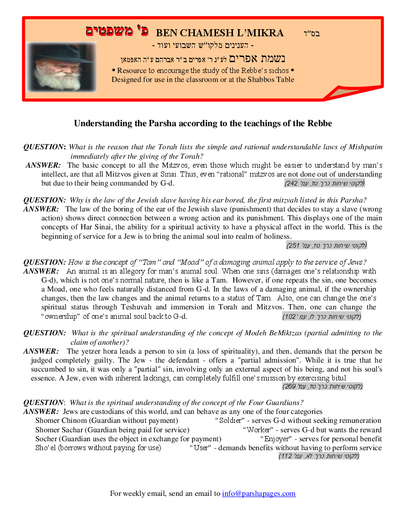
Accordingly, we can now understand why the giving of the Torah is immediately followed by Parshas Mishpatim, which contains the mitzvos of rational nature.
First comes Parshas Yisro, the parsha of the giving of the Torah, which implanted in the Jewish people a sense of faith and nullification to the Almighty.
After the giving of the Torah though, the imperative was that the Jewish people themselves become one with G-dliness. Their mandate was to become one with the Almighty, without losing their sense of personal identity.
It was for this reason that the giving of the Torah was immediately followed by the rational laws. In these laws, G-d’s logic is grasped in human comprehension, to the point where the individual identifies with them. It is specifically then that the G-dliness becomes one with the human experience. This idea is expressed in Tanya:
Text 11
Now, when an intellect conceives and comprehends a concept with its intellectual faculties, this intellect grasps the concept and encompasses it. This concept is [in turn] grasped, enveloped and enclothed within that intellect which conceived and comprehended it. The mind, for its part, is also clothed in the concept at the time it comprehends and grasps it with the intellect. For example, when a person understands and comprehends, fully and clearly, any halacha (law) in the Mishnah or Talmud, his intellect grasps and encompasses it and, at the same time, is clothed in it...now therefore, when a person knows and comprehends with his intellect such a verdict in accordance with the law as it is set out in the Mishnah, Talmud, or Posekim (Codes), he has thus comprehended, grasped and encompassed with his intellect the will and wisdom of the Holy One, Blessed be He, Whom no thought can grasp, nor His will and wisdom, except when they are clothed in the laws that have been set out for us... This is a wonderful union, like which there is none other, and which has no parallel anywhere in the material world, whereby complete oneness and unity, from every side and angle, could be attained.
Tanya, Ch. 5
Through understanding G-d’s will in a way that can be grasped through the rational mind, the human being himself becomes permeated and one with G-dliness, to the point that they are in complete union.
It is then that the ultimate purpose of the giving of the Torah—the unity of the Divine and the mundane—is fulfilled. It is therefore understood why Parshas Mishpatim follows the giving of the Torah, as after the Jewish people were infused with faith, they were given the mandate to develop their own relationship and understanding of G-d.
Related Articles