Revelation at Sinai and the Role of Rational and Superrational Laws
Ben Chamesh L'Mikra | February 04, 2024
Print This Article
View Original PDF

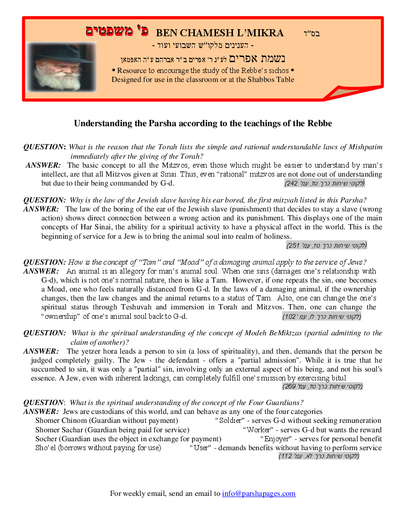
Revelation at Sinai and the Role of Rational and Superrational Laws

Ben Chamesh L'Mikra | December 10, 2025

Even were the Torah not to have been written, it would be understood that one should live by a moral framework.

2) Many of the laws that are expressed in this Torah portion were, in fact, already mandatory obligations prior to the giving of the Torah. They were included in the seven Noachide laws that were given to all mankind, and which dictate that man should live a civil and moral life. Nachmonidies expressed this idea in his commentary on the Torah.

Text 4
...And in my opinion, the laws which were assigned to the children of Noach in their seven mitzvos, are not only to settle judges in every province, rather, He commanded them regarding the laws of robbery, cheating, withholding the wages of an employee, watchmen, rape, seduction, damages, injury, lending and borrowing, business, and the like, similar to the laws which were commanded to Israel....
Ramban, Vayishlach 34:13

Even without the giving of the Torah, the Jewish people were already directed to fulfill the majority of the rational laws. The specific revolution that was introduced by Mt. Sinai however, was concerning the commandments which exceeded logic; the realm of the super-rational. Without G-d commanding us to fulfill them, we would not have understood to perform them on our own.

Revelation at Sinai

It was for this reason that during the giving of the Torah, the revelation of G-d’s presence on Mt. Sinai was in a manner that the Jewish people “saw which was usually heard.” G-dliness that transcends the world and which is usually “heard,” was perceived by the people outright. This intimates that they perceived G-dliness in a way that transcended normative human experience and rationale.

Being that the giving of the Torah was primarily expressed in the super-rational, the above question is exacerbated: It would seem appropriate that immediately following the giving of the Torah, the Jewish people should have been commanded regarding those mitzvos which are classified as chukim, edicts above logical meaning, not the rational mitzvos.

Why then, was the giving of the Torah (recounted in Parshas Yisro) immediately followed by the rational laws of Parshas Mishpatim, and not by those of the super-rational?

Chronology within the Parsha

What is more, is that it seems rather curious that the episode at the end of Parshas Mishpatim is the Jewish people’s preparations for receiving the Torah—an event which, in actuality, occurred during the time of the giving of the Torah—while the beginning section of Parshas Mishpatim deals with rational laws that were not given immediately at Sinai, but rather during the forty days that Moshe was on the mountain following the giving of the Torah.

(This perplexity is further enunciated according to opinions who hold that these laws were given during the encampment in Mara, before the Israelites even reached Sinai.)

From all of the questions enumerated above, and from the fact that the Torah did indeed write the laws in the manner that they are found, it is clear that:

  1. Because Parshas Mishpatim immediately follows Parshas Yisro, it is understood that although the giving of the Torah itself is not characterized by rational laws, it must be that specifically within the rational, the essential concept of the giving of the Torah is expressed.
  2. From the fact that after listing the rational laws, the Torah once again discusses the preparation for receiving the Torah, it is understood that after reason and logic we must once again express the idea of Sinai and accepting the Torah through faith.
  3. Nonetheless, all these ideas, even the ones that are beyond reason, are incorporated in Parshas Mishpatim. One can therefore conclude that the later discussion of the giving of the Torah is also expressive of the concept of the parsha, i.e. mishpatim-rational laws.

Even were the Torah not to have been written, it would be understood that one should live by a moral framework.

2) Many of the laws that are expressed in this Torah portion were, in fact, already mandatory obligations prior to the giving of the Torah. They were included in the seven Noachide laws that were given to all mankind, and which dictate that man should live a civil and moral life. Nachmonidies expressed this idea in his commentary on the Torah.

Text 4
...And in my opinion, the laws which were assigned to the children of Noach in their seven mitzvos, are not only to settle judges in every province, rather, He commanded them regarding the laws of robbery, cheating, withholding the wages of an employee, watchmen, rape, seduction, damages, injury, lending and borrowing, business, and the like, similar to the laws which were commanded to Israel....
Ramban, Vayishlach 34:13

Even without the giving of the Torah, the Jewish people were already directed to fulfill the majority of the rational laws. The specific revolution that was introduced by Mt. Sinai however, was concerning the commandments which exceeded logic; the realm of the super-rational. Without G-d commanding us to fulfill them, we would not have understood to perform them on our own.

Revelation at Sinai

It was for this reason that during the giving of the Torah, the revelation of G-d’s presence on Mt. Sinai was in a manner that the Jewish people “saw which was usually heard.” G-dliness that transcends the world and which is usually “heard,” was perceived by the people outright. This intimates that they perceived G-dliness in a way that transcended normative human experience and rationale.

Being that the giving of the Torah was primarily expressed in the super-rational, the above question is exacerbated: It would seem appropriate that immediately following the giving of the Torah, the Jewish people should have been commanded regarding those mitzvos which are classified as chukim, edicts above logical meaning, not the rational mitzvos.

Why then, was the giving of the Torah (recounted in Parshas Yisro) immediately followed by the rational laws of Parshas Mishpatim, and not by those of the super-rational?

Chronology within the Parsha

What is more, is that it seems rather curious that the episode at the end of Parshas Mishpatim is the Jewish people’s preparations for receiving the Torah—an event which, in actuality, occurred during the time of the giving of the Torah—while the beginning section of Parshas Mishpatim deals with rational laws that were not given immediately at Sinai, but rather during the forty days that Moshe was on the mountain following the giving of the Torah.

(This perplexity is further enunciated according to opinions who hold that these laws were given during the encampment in Mara, before the Israelites even reached Sinai.)

From all of the questions enumerated above, and from the fact that the Torah did indeed write the laws in the manner that they are found, it is clear that:

  1. Because Parshas Mishpatim immediately follows Parshas Yisro, it is understood that although the giving of the Torah itself is not characterized by rational laws, it must be that specifically within the rational, the essential concept of the giving of the Torah is expressed.
  2. From the fact that after listing the rational laws, the Torah once again discusses the preparation for receiving the Torah, it is understood that after reason and logic we must once again express the idea of Sinai and accepting the Torah through faith.
  3. Nonetheless, all these ideas, even the ones that are beyond reason, are incorporated in Parshas Mishpatim. One can therefore conclude that the later discussion of the giving of the Torah is also expressive of the concept of the parsha, i.e. mishpatim-rational laws.

PDF Preview