Self-Confidence
Hashgacha Pratis | February 08, 2024
Print This Article
View Original PDF

Self-Confidence

Hashgacha Pratis | December 10, 2025

There is so much talk nowadays about self-confidence (“bitachon atzmi”). We develop self-confidence, we are afraid to lose it, we work on acquiring more of it, and all types of coaches, practitioners, and therapists promise they can help restore our self-confidence.

What does the Torah say about this? Is it important? Is it unimportant? Bitachon, we’ve always known, is only in Hakadosh Baruch Hu! Indeed, if the definition of self-confidence is that the person is sure of his ways and does what he needs to do without fear of what others will think, then a quick look around us will reveal that people with bitachon in Hashem have self-confidence. They are strong and steadfast, and they radiate a feeling of calm and security.

The reason for this confidence is that they trust in the Divine power hidden within them. They trust in the power of their neshamah, which itself is a part of Hashem, and their bitachon helps them to overcome all hurdles.

If Hakadosh Baruch Hu created me and placed me here in His world, then He created me with all the necessary powers, including all my weaknesses. My weaknesses too are included in my strengths, because through them I will come to fulfill my role in the world.

The belief in our divine powers includes as well the belief in a Jew’s power to make things happen in the upper Worlds. This is a critical awareness for every one of us.

A Jew who believes in his own powers – acts! This is true of every Jew!

Two people learn together, daven together, and do acts of chessed together. The first one shakes up all the Worlds and brings about yeshuos for Am Yisrael, while the second accomplishes nothing. Of course he is doing mitzvos, and he will receive his reward, but he is not achieving anything right now.

This is as the Maggid of Mezeritch wrote (Toras Hamaggid, Vayishlach 32:26): There are people who are on a very high level, but they are not able to achieve anything on High, and this is due to the fact that they lack complete emunah.

The Maggid taught that if a person wants to achieve something in Shamayim, he must believe in his own divine powers. He needs to believe that “when a person connects himself to Hashem yisbarach, then all the worlds beneath him are connected to the Creator through him. For example, if a person has the ability to serve Hashem yisbarach by eating or dressing, then within him are included the inanimate world, the world of plants, the world of living beings, and the world of man, who is able to speak. All these worlds connect to Hashem yisbarach through him. And if he does not believe with complete faith that he achieves this through his speech and his connection to Hashem yisbarach, then in truth he achieves nothing at all in Shamayim.”

We must believe in our own powers. Each and every Jew, with every act both small and large, has tremendous power. And if you thought that all of this is referring to giants of previous generations – the very opposite is true, as the Beis Aharon zy”a wrote: My beloved brothers, believe me – and this concept is supported in all the sefarim – that what tzaddikim of previous times achieved in a few days or months, it is possible now to achieve in one hour!

If we just believe in this, we will bring about yeshuos!

Gut Shabbat
Pinchas Shefer
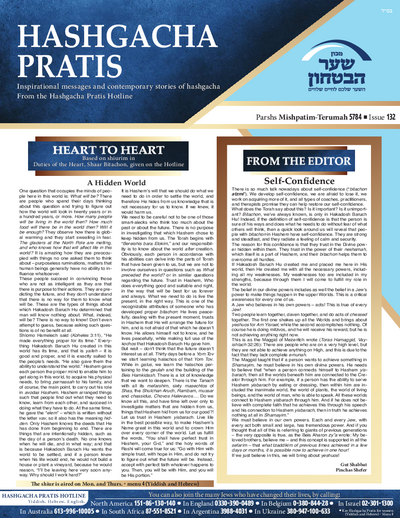
There is so much talk nowadays about self-confidence (“bitachon atzmi”). We develop self-confidence, we are afraid to lose it, we work on acquiring more of it, and all types of coaches, practitioners, and therapists promise they can help restore our self-confidence.

What does the Torah say about this? Is it important? Is it unimportant? Bitachon, we’ve always known, is only in Hakadosh Baruch Hu! Indeed, if the definition of self-confidence is that the person is sure of his ways and does what he needs to do without fear of what others will think, then a quick look around us will reveal that people with bitachon in Hashem have self-confidence. They are strong and steadfast, and they radiate a feeling of calm and security.

The reason for this confidence is that they trust in the Divine power hidden within them. They trust in the power of their neshamah, which itself is a part of Hashem, and their bitachon helps them to overcome all hurdles.

If Hakadosh Baruch Hu created me and placed me here in His world, then He created me with all the necessary powers, including all my weaknesses. My weaknesses too are included in my strengths, because through them I will come to fulfill my role in the world.

The belief in our divine powers includes as well the belief in a Jew’s power to make things happen in the upper Worlds. This is a critical awareness for every one of us.

A Jew who believes in his own powers – acts! This is true of every Jew!

Two people learn together, daven together, and do acts of chessed together. The first one shakes up all the Worlds and brings about yeshuos for Am Yisrael, while the second accomplishes nothing. Of course he is doing mitzvos, and he will receive his reward, but he is not achieving anything right now.

This is as the Maggid of Mezeritch wrote (Toras Hamaggid, Vayishlach 32:26): There are people who are on a very high level, but they are not able to achieve anything on High, and this is due to the fact that they lack complete emunah.

The Maggid taught that if a person wants to achieve something in Shamayim, he must believe in his own divine powers. He needs to believe that “when a person connects himself to Hashem yisbarach, then all the worlds beneath him are connected to the Creator through him. For example, if a person has the ability to serve Hashem yisbarach by eating or dressing, then within him are included the inanimate world, the world of plants, the world of living beings, and the world of man, who is able to speak. All these worlds connect to Hashem yisbarach through him. And if he does not believe with complete faith that he achieves this through his speech and his connection to Hashem yisbarach, then in truth he achieves nothing at all in Shamayim.”

We must believe in our own powers. Each and every Jew, with every act both small and large, has tremendous power. And if you thought that all of this is referring to giants of previous generations – the very opposite is true, as the Beis Aharon zy”a wrote: My beloved brothers, believe me – and this concept is supported in all the sefarim – that what tzaddikim of previous times achieved in a few days or months, it is possible now to achieve in one hour!

If we just believe in this, we will bring about yeshuos!

Gut Shabbat
Pinchas Shefer

PDF Preview