A Unique Time
The Weekly Farbrengen | August 11, 2023
Print This Article
View Original PDF

A Unique Time

The Weekly Farbrengen | December 31, 2025

On Rosh Chodesh Elul, Moshe Rabbeinu ascended Har Sinai for the final forty days to receive the second set of luchos. At the conclusion of those days, on Yom Kippur, HaShem forgave the Yidden completely and that day was designated as a day of forgiveness. For this reason, those forty days are auspicious for teshuvah.
(פרקי דר"א פמ"ו, וראה דברי נחמי' השלמה לסי' תקפ"א)

Though the month of Elul is an earnest time of teshuva, it is during this very time that we experience a particular closeness to HaShem.

In a classic maamar, the Alter Rebbe explains this by the mashal of a king who, on the way to his palace, walks through the fields. There, everyone can approach him and he greets them all with a smiling countenance, until he enters his palace with only his chosen courtiers.

So, too, during the month of Elul, as HaShem prepares to enter his throne room on Rosh HaShana and Yom Kippur, He passes through the mundane world. Thus, we are able to connect to Him more easily than usual. At that time in particular, He inspires us and empowers us to do teshuva and return to Him.
(לקוטי תורה דברים לב,א)

In Lubavitch, even though Shabbos Mevarchim Elul would still be a clear and sunny day, the air felt different. There was a smell of Elul in the air; you could feel the first stirrings of a teshuvah-breeze. Every person there was beginning to grow a little more deliberate, a little more thoughtful, and allowing his weekday affairs to fade from his memory.

From Shabbos Nachamu onwards, people would already begin to learn in groups after Maariv, in order to “cry out in the night.” By the time Shabbos Mevarchim Elul came around one could sense the atmosphere of Elul. Anxiously, people now awaited the time when they could say “LeDovid: HaShem ori”; eagerly, they awaited the first blast of the shofar that would announce that the gates of chodesh harachamim had been thrown open. The maamarei Chassidus of Shabbos Mevarchim Elul, opening with the familiar words Ani LeDodi, were permeated with the spirit of Elul.

Every day of Elul was quite unlike every other day of the year. Lying in bed at six o’clock in the morning, you could hear that the vasikin-minyan in the beis midrash had already finished Shacharis. You could already hear the shofar. It woke you up to the fact that the world was now filled with Elul. You dress hastily, a trifle dissatisfied with yourself for having somehow slept in so late. You recall that this was the time that Moshe Rabbeinu spent on the mountain. These are propitious days, days in which you can accomplish more than usual. You tell yourself that you really should become a mensch: you cannot let these hours be lost on sleep.

By the time you arrive at the beis midrash you find quite a crowd already there. Some are saying Tehillim, some are learning Chassidus, some are reading Tikkunei Zohar, while others, whether standing or sitting, are davening.
(לקו"ד ח"א ע' 230)

At one farbrengen the Rebbe emphasized that the Frierdiker Rebbe told this narrative long after he had left Lubavitch, in order to inspire others to follow this lifestyle. Even today, every Yid is capable of feeling the “Elul air.”
(התוועדויות תשמ"’ה ח"ה ע' 2668)
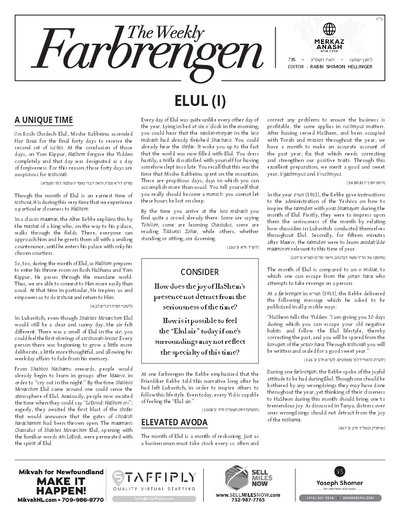
On Rosh Chodesh Elul, Moshe Rabbeinu ascended Har Sinai for the final forty days to receive the second set of luchos. At the conclusion of those days, on Yom Kippur, HaShem forgave the Yidden completely and that day was designated as a day of forgiveness. For this reason, those forty days are auspicious for teshuvah.
(פרקי דר"א פמ"ו, וראה דברי נחמי' השלמה לסי' תקפ"א)

Though the month of Elul is an earnest time of teshuva, it is during this very time that we experience a particular closeness to HaShem.

In a classic maamar, the Alter Rebbe explains this by the mashal of a king who, on the way to his palace, walks through the fields. There, everyone can approach him and he greets them all with a smiling countenance, until he enters his palace with only his chosen courtiers.

So, too, during the month of Elul, as HaShem prepares to enter his throne room on Rosh HaShana and Yom Kippur, He passes through the mundane world. Thus, we are able to connect to Him more easily than usual. At that time in particular, He inspires us and empowers us to do teshuva and return to Him.
(לקוטי תורה דברים לב,א)

In Lubavitch, even though Shabbos Mevarchim Elul would still be a clear and sunny day, the air felt different. There was a smell of Elul in the air; you could feel the first stirrings of a teshuvah-breeze. Every person there was beginning to grow a little more deliberate, a little more thoughtful, and allowing his weekday affairs to fade from his memory.

From Shabbos Nachamu onwards, people would already begin to learn in groups after Maariv, in order to “cry out in the night.” By the time Shabbos Mevarchim Elul came around one could sense the atmosphere of Elul. Anxiously, people now awaited the time when they could say “LeDovid: HaShem ori”; eagerly, they awaited the first blast of the shofar that would announce that the gates of chodesh harachamim had been thrown open. The maamarei Chassidus of Shabbos Mevarchim Elul, opening with the familiar words Ani LeDodi, were permeated with the spirit of Elul.

Every day of Elul was quite unlike every other day of the year. Lying in bed at six o’clock in the morning, you could hear that the vasikin-minyan in the beis midrash had already finished Shacharis. You could already hear the shofar. It woke you up to the fact that the world was now filled with Elul. You dress hastily, a trifle dissatisfied with yourself for having somehow slept in so late. You recall that this was the time that Moshe Rabbeinu spent on the mountain. These are propitious days, days in which you can accomplish more than usual. You tell yourself that you really should become a mensch: you cannot let these hours be lost on sleep.

By the time you arrive at the beis midrash you find quite a crowd already there. Some are saying Tehillim, some are learning Chassidus, some are reading Tikkunei Zohar, while others, whether standing or sitting, are davening.
(לקו"ד ח"א ע' 230)

At one farbrengen the Rebbe emphasized that the Frierdiker Rebbe told this narrative long after he had left Lubavitch, in order to inspire others to follow this lifestyle. Even today, every Yid is capable of feeling the “Elul air.”
(התוועדויות תשמ"’ה ח"ה ע' 2668)

PDF Preview