A Potpourri of Some Interesting Tzitzis Related Shailos
Limuday Moshe | June 27, 2024
Print This Article
View Original PDF

A Potpourri of Some Interesting Tzitzis Related Shailos

Limuday Moshe | June 27, 2025

In this week’s parsha we have the mitzvah of: ועשו להם ציצית על כנפי בגדיהם – “You shall make for yourself tzitzis on the corner of your garment” (15:38). Therefore, we will take this week’s opportunity to discuss some interesting halachos related to the mitzvah of tzitzis.

Tightening Tzitzis in the Beis Hakisay [Toilet]

Is one allowed to tighten his tzitzis in the beis hakisay, or is tying the tzitzis perhaps considered a mitzvah and therefore one should refrain from doing so?

The Shu”t Shevet HaLevi (10:15, ois 2) addresses this very question. He writes: Strictly speaking there is no prohibition, as, אין דיבור ולא מחשבה לאיזה דבר שבקדושה – “as there is no speaking or thought related to matters of holiness involved”. However, he concludes: כדי ליזהר וכן אני נוהג – “It’s worthwhile being careful about it, and this is how I am accustomed”.

R’ Yitzchok Zilbertstein in his Chasukay Chemed (Shabbos 111b) discusses this shailah. He writes: One is supposed to have intention when tying his tzitzis that he is doing it “l’shem mitzvas tzitzis”, for the sake of the mitzvah of tzitzis (see Shulchan Aruch, Orach Chaim 14:2), and perhaps it is forbidden to have thoughts of lishmah in the beis hakisay.

Then he brings a Biur Halachah (588) which writes:שאסור להרהר בבית הכסא שמכוין לשמה לשם מצוה ולכן אסור לתקוע שם בשופר – “It’s forbidden to think in the beis hakisay that one is having intention lishma to fulfil a mitzvah. Therefore, it’s forbidden to blow shofar in a beis hakisay”.

However, he concludes, kavonah [intention] when tying tzitzis is just a hechsher mitzvah [an act which helps one carry out the mitzvah] and not the mitzvah itself, therefore, it is allowed. He concludes, that R’ Chaim Kanievsky also held like this.

However, R’ Moshe Fried in his sefer Vayishma Moshe (pg. 15) writes that he was by R’ Elyashiv zt”l when he was asked this question, and he said that it’s forbidden. R’ Elyashiv held, the mere thought that one is tightening his tzitzis to fulfil the mitzvah of tzitzis is like learning Torah, which is forbidden in a dirty place.

Cleaning Glasses (Spectacles) With a Tallis

If one is in the middle of davening and his glasses need cleaning, is he allowed to use his tallis, or is it perhaps forbidden as it is a bizoyan [disgrace] to the tallis?

R’ Elyashiv in Kovetz Teshuvos (Vol. 1, siman 3) was asked this very question. R’ Elyashiv writes: אין אני רואה בזה שום איסור, כי מדרך בני אדם שאינם מקפידים להשתמש לצורך שפשוף המשקפיים גם בבגד הכי חשוב להם, ואין זה בגדר תשמיש גנאי ומותר לעשות כן – “I can’t see anything wrong with doing this. People are not particular with what they clean their glasses with, and sometimes people even use their most expensive garments. Consequently, using a tallis to do the job is not a disgrace to the tallis, and doing so is permitted”.

However, R’ Wosner in Shu”t Shevet HaLevi (11:229, s.k. 2) was asked: “Is it permissible to clean glasses with tzitzis or a tallis gadol?” and he answered: נראה דיש בזה בזיון מצוה – “It seems that doing so is a big disgrace to the mitzvah of tzitzis”.

R’ Shlomah Zalman in Halichos Shlomah (Tefillah, Perek 3, Devar Halachah 19) is cited as holding that cleaning glasses on a tallis gadol is not a good thing to do, and it could be that it is even forbidden. As the poskim say, that at a time one is wearing a tallis, it’s forbidden to use the tallis even for a non-disrgraceful purpose.

In Orchos Halachah (41, footnotes of Halichos Shlomah) it’s brought down that using a tallis kotan is allowed according to the Mishnah Berurah. However, the Kaf HaChaim brings that some are machmir for a tallis kotan as well. Nowadays, we only wear a tallis kotan for the mitzvah, therefore, certainly there is room to be stringent.

The Steipler (cited in Orchos Rabbeinu, Vol. 3, pg. 107) was makpid [particular] and didn’t use his tallis.

The Aderes (Nefesh Dovid ois 67) testifies that he himself would clean his glasses with a tallis. However, he adds an important caveat: “Only when I was busy learning or davening, however, for non-mitzvah purposes I would refrain”

In Orchos Rabbeinu it’s brought down that the Steipler would sometimes wipe his eyes on the edge of his tallis, whilst he was in the middle of davening. This fits well with the Aderes, that when it is for the need of davening there is more room to be lenient.

Practically

It seems like a dispute amongst the poskim if it is allowed or not, some poskim allow and some don’t. Practically, using a tallis to clean glasses is not so ideal, and it may cause the glasses to get scratched. Therefore, I advise that one buys himself a cloth to use for cleaning his glasses, and he should make sure to keep it with him when davening. A simple cheap one should do the trick, however, if one wants to get a special one meyuchod for davening I see no harm.

Is It Ba’al Tosif to Wear More Than One Pair of Tzitzis?

For most people, wearing one pair of tzitzis is enough for them. However, if one would want to wear more than one pair would it be allowed, or would it be a problem of ba’al tosif [adding on to mitzvos]?

The Levush (Orach Chaim 34) writes: One is allowed to wear many garments with tzitzis and there is no problem of ba’al tosif, as each individual garment which has four corners is obligated in tzitzis.

The Shu”t Yad Eliyohu (41) also writes: When it comes to the mitzvah of tzitzis one can wear a number of garments with tzitzis and there is no problem of ba’al tosif.

However, the Ralbag cited in Yofeh Lev (Orach Chaim 8) writes: One shouldn’t wear two garments with tzitzis on at the same time as it says, אשר תכסה בה - “You shall cover yourself with it”, and we darshen, אשר תכסה ולא בה ובחברתה – you shall cover yourself without it, it and not another one aswell. Similarly, we darshan, וראיתם אותו – “you shall see it”, וראיתם אותו ולא אותו וחברתו – you shall it, it and not a second one aswell.

Moreover, it may bring one to think that there is more than one G-d in charge of what goes on, and there is more than one Torah and mitzvos, therefore, one should only wear one pair of tzitzis.

Moreover, just like wearing two pairs of tefillin on one’s head is ba’al tosif, similarly, wearing more than one pair of tzitzis is ba’al tosif.

However, the Malbim (Artzois HaChaim, Hameir La’aretz, s.k. 10) cites the above, asks a number of questions on it, and concludes that we don’t need to worry about such an opinion.

The Beis Yosef (Orach Chaim 8, d.h. umah shekosav) writes: “If one wears a tallis kotan all day, and when he davens he wears a tallis gadol, he must make a berachah. The reason being, there is an obligation to place tzitzis upon all the four garments that one wears, and each one is its own individual mitzvah.”

Similarly, the Shulchan Aruch (8:12) writes: “If one has many garments of four corners, they are all obligated in tziztis”.

The truth is, most of us wear more than one pair of tzitzis on a regular day. Most people wear a tallis kotan, and when it comes to davening they put on a taliis gadol, and we don’t find that people remove their tallis kotan before putting on a taliis gadol. From the fact that everyone does this, it must be that doing so is allowed.

If the minhag ha’olam is not enough proof, we can bring proof from R’ Chaim Pinchos Scheinberg tz”l who was famous for wearing numerous pairs of tzitzis at one time.

[As an interesting a side, I once read, that R’ Scheinberg’s many tzitzis caused him lots of back pain. His Rebbetzin was very worried about this and wanted him to stop, so she called R’ Moshe Feinstein to try and persuade her husband to stop. However, R’ Moshe told her to leave him, as “he was different”.]

The Tallis and Shabbos Sheva Berachos Dilemma

It’s very common for one who is invited to a Shabbos sheva berachos, to go straight from shul to the hall. Normally upon arriving at the hall one takes off his tallis, and then at the end of the meal puts his tallis back on and heads home. There may easily be a three our gap between the taking off and putting back on of the tallis. Does this interruption obligated a new berachah, or may one still rely on the original berachah made when putting on the tallis for the first time.

The same question may arise if one goes straight from shul to eat out by a friend?

The Shevet HaLevi (10:2) was asked about the first case. The sho’el [asker] writes: Many people go straight from shul to the sheva berachos hall, take off their talleisim and eat the meal. Once they finish eating, they put on their talleisim and return him, without making another berachah. The sho’el wanted to know: האם יש טעם למנהג זה שלא לברך – “Is there anything behind the common custom not to make another berachah?”

The Shevet HaLevi responds: לא מצאתי טעם נכון למנהג זה, דדברי מגן אברהם סימן ח ' ס "ק י"ח ברורים דאם מפסיק הפסק גדול מהפשיטה ללבישה שניה גם לרמ"א צריך לברך, ואף דמגן אברהם ס"ק י"ד סבירא ליה דאם בשעת ברכה חשב גם ללבישה שניה גם להשו"ע שם סי "ד דא"צ לברך כיון דהמשיך הברכה גם על הלבישה השניה, מכ "מ כל זה אם לא הפסיק בזמן ובמעשה זמן רב, אבל כה"ג דהיה הפסק גמור א"כ פשיטא דהפסיד שייכות הברכה על הלבישה השניה דכבר נתבטלה ברכה ראשונה – “I haven’t found any good reason for this custom. The words of Magen Avraham (8:18) are clear, that if there is a big interruption between the taking off of the tallis and the putting it on a second time, even the Rema holds that one must make another berachah. Although the Magen Avraham (s.k. 14) holds, if one had intention for a subsequent wearing it helps, it only helps if there isn’t a large interruption. In our case however, there is a big interruption, therefore, certainly the original berachah doesn’t go on the second time one wears the tallis”.

The Shevet HaLevi then quotes the Mishnah Berurah (Biur Halachah siman 14) who is unsure if having special intention helps when the is a large gap, and he concludes: שיכונו בבקר בשעת ברכת הטלית לפטור רק עד זמן הסעודה, ואח"כ כשלובשים עוד פעם יברכו, או שאחד עכ "פ יברך בקול רם ויפטר האחרים – “One should have in mind when making a berachah for the first time in the morning, that it should only last until the meal, and then when putting it on a second time he should make a second berachah. Or one person there should recite the berachah aloud and have in mind to exempt everyone else present”.

When R' Naftoli Nusbaum shlita was asked this question, he said it’s obvious that one should recite a new berachah, as there is both a large interruption, and a new place.
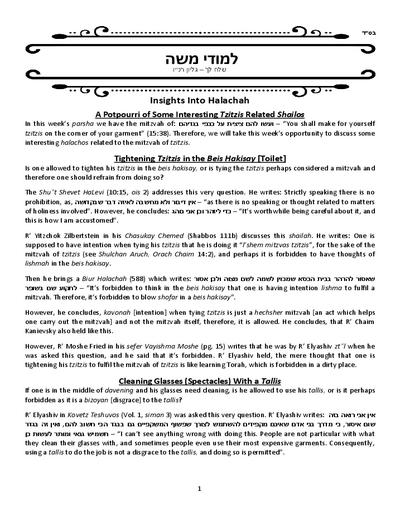

In this week’s parsha we have the mitzvah of: ועשו להם ציצית על כנפי בגדיהם – “You shall make for yourself tzitzis on the corner of your garment” (15:38). Therefore, we will take this week’s opportunity to discuss some interesting halachos related to the mitzvah of tzitzis.

Tightening Tzitzis in the Beis Hakisay [Toilet]

Is one allowed to tighten his tzitzis in the beis hakisay, or is tying the tzitzis perhaps considered a mitzvah and therefore one should refrain from doing so?

The Shu”t Shevet HaLevi (10:15, ois 2) addresses this very question. He writes: Strictly speaking there is no prohibition, as, אין דיבור ולא מחשבה לאיזה דבר שבקדושה – “as there is no speaking or thought related to matters of holiness involved”. However, he concludes: כדי ליזהר וכן אני נוהג – “It’s worthwhile being careful about it, and this is how I am accustomed”.

R’ Yitzchok Zilbertstein in his Chasukay Chemed (Shabbos 111b) discusses this shailah. He writes: One is supposed to have intention when tying his tzitzis that he is doing it “l’shem mitzvas tzitzis”, for the sake of the mitzvah of tzitzis (see Shulchan Aruch, Orach Chaim 14:2), and perhaps it is forbidden to have thoughts of lishmah in the beis hakisay.

Then he brings a Biur Halachah (588) which writes:שאסור להרהר בבית הכסא שמכוין לשמה לשם מצוה ולכן אסור לתקוע שם בשופר – “It’s forbidden to think in the beis hakisay that one is having intention lishma to fulfil a mitzvah. Therefore, it’s forbidden to blow shofar in a beis hakisay”.

However, he concludes, kavonah [intention] when tying tzitzis is just a hechsher mitzvah [an act which helps one carry out the mitzvah] and not the mitzvah itself, therefore, it is allowed. He concludes, that R’ Chaim Kanievsky also held like this.

However, R’ Moshe Fried in his sefer Vayishma Moshe (pg. 15) writes that he was by R’ Elyashiv zt”l when he was asked this question, and he said that it’s forbidden. R’ Elyashiv held, the mere thought that one is tightening his tzitzis to fulfil the mitzvah of tzitzis is like learning Torah, which is forbidden in a dirty place.

Cleaning Glasses (Spectacles) With a Tallis

If one is in the middle of davening and his glasses need cleaning, is he allowed to use his tallis, or is it perhaps forbidden as it is a bizoyan [disgrace] to the tallis?

R’ Elyashiv in Kovetz Teshuvos (Vol. 1, siman 3) was asked this very question. R’ Elyashiv writes: אין אני רואה בזה שום איסור, כי מדרך בני אדם שאינם מקפידים להשתמש לצורך שפשוף המשקפיים גם בבגד הכי חשוב להם, ואין זה בגדר תשמיש גנאי ומותר לעשות כן – “I can’t see anything wrong with doing this. People are not particular with what they clean their glasses with, and sometimes people even use their most expensive garments. Consequently, using a tallis to do the job is not a disgrace to the tallis, and doing so is permitted”.

However, R’ Wosner in Shu”t Shevet HaLevi (11:229, s.k. 2) was asked: “Is it permissible to clean glasses with tzitzis or a tallis gadol?” and he answered: נראה דיש בזה בזיון מצוה – “It seems that doing so is a big disgrace to the mitzvah of tzitzis”.

R’ Shlomah Zalman in Halichos Shlomah (Tefillah, Perek 3, Devar Halachah 19) is cited as holding that cleaning glasses on a tallis gadol is not a good thing to do, and it could be that it is even forbidden. As the poskim say, that at a time one is wearing a tallis, it’s forbidden to use the tallis even for a non-disrgraceful purpose.

In Orchos Halachah (41, footnotes of Halichos Shlomah) it’s brought down that using a tallis kotan is allowed according to the Mishnah Berurah. However, the Kaf HaChaim brings that some are machmir for a tallis kotan as well. Nowadays, we only wear a tallis kotan for the mitzvah, therefore, certainly there is room to be stringent.

The Steipler (cited in Orchos Rabbeinu, Vol. 3, pg. 107) was makpid [particular] and didn’t use his tallis.

The Aderes (Nefesh Dovid ois 67) testifies that he himself would clean his glasses with a tallis. However, he adds an important caveat: “Only when I was busy learning or davening, however, for non-mitzvah purposes I would refrain”

In Orchos Rabbeinu it’s brought down that the Steipler would sometimes wipe his eyes on the edge of his tallis, whilst he was in the middle of davening. This fits well with the Aderes, that when it is for the need of davening there is more room to be lenient.

Practically

It seems like a dispute amongst the poskim if it is allowed or not, some poskim allow and some don’t. Practically, using a tallis to clean glasses is not so ideal, and it may cause the glasses to get scratched. Therefore, I advise that one buys himself a cloth to use for cleaning his glasses, and he should make sure to keep it with him when davening. A simple cheap one should do the trick, however, if one wants to get a special one meyuchod for davening I see no harm.

Is It Ba’al Tosif to Wear More Than One Pair of Tzitzis?

For most people, wearing one pair of tzitzis is enough for them. However, if one would want to wear more than one pair would it be allowed, or would it be a problem of ba’al tosif [adding on to mitzvos]?

The Levush (Orach Chaim 34) writes: One is allowed to wear many garments with tzitzis and there is no problem of ba’al tosif, as each individual garment which has four corners is obligated in tzitzis.

The Shu”t Yad Eliyohu (41) also writes: When it comes to the mitzvah of tzitzis one can wear a number of garments with tzitzis and there is no problem of ba’al tosif.

However, the Ralbag cited in Yofeh Lev (Orach Chaim 8) writes: One shouldn’t wear two garments with tzitzis on at the same time as it says, אשר תכסה בה - “You shall cover yourself with it”, and we darshen, אשר תכסה ולא בה ובחברתה – you shall cover yourself without it, it and not another one aswell. Similarly, we darshan, וראיתם אותו – “you shall see it”, וראיתם אותו ולא אותו וחברתו – you shall it, it and not a second one aswell.

Moreover, it may bring one to think that there is more than one G-d in charge of what goes on, and there is more than one Torah and mitzvos, therefore, one should only wear one pair of tzitzis.

Moreover, just like wearing two pairs of tefillin on one’s head is ba’al tosif, similarly, wearing more than one pair of tzitzis is ba’al tosif.

However, the Malbim (Artzois HaChaim, Hameir La’aretz, s.k. 10) cites the above, asks a number of questions on it, and concludes that we don’t need to worry about such an opinion.

The Beis Yosef (Orach Chaim 8, d.h. umah shekosav) writes: “If one wears a tallis kotan all day, and when he davens he wears a tallis gadol, he must make a berachah. The reason being, there is an obligation to place tzitzis upon all the four garments that one wears, and each one is its own individual mitzvah.”

Similarly, the Shulchan Aruch (8:12) writes: “If one has many garments of four corners, they are all obligated in tziztis”.

The truth is, most of us wear more than one pair of tzitzis on a regular day. Most people wear a tallis kotan, and when it comes to davening they put on a taliis gadol, and we don’t find that people remove their tallis kotan before putting on a taliis gadol. From the fact that everyone does this, it must be that doing so is allowed.

If the minhag ha’olam is not enough proof, we can bring proof from R’ Chaim Pinchos Scheinberg tz”l who was famous for wearing numerous pairs of tzitzis at one time.

[As an interesting a side, I once read, that R’ Scheinberg’s many tzitzis caused him lots of back pain. His Rebbetzin was very worried about this and wanted him to stop, so she called R’ Moshe Feinstein to try and persuade her husband to stop. However, R’ Moshe told her to leave him, as “he was different”.]

The Tallis and Shabbos Sheva Berachos Dilemma

It’s very common for one who is invited to a Shabbos sheva berachos, to go straight from shul to the hall. Normally upon arriving at the hall one takes off his tallis, and then at the end of the meal puts his tallis back on and heads home. There may easily be a three our gap between the taking off and putting back on of the tallis. Does this interruption obligated a new berachah, or may one still rely on the original berachah made when putting on the tallis for the first time.

The same question may arise if one goes straight from shul to eat out by a friend?

The Shevet HaLevi (10:2) was asked about the first case. The sho’el [asker] writes: Many people go straight from shul to the sheva berachos hall, take off their talleisim and eat the meal. Once they finish eating, they put on their talleisim and return him, without making another berachah. The sho’el wanted to know: האם יש טעם למנהג זה שלא לברך – “Is there anything behind the common custom not to make another berachah?”

The Shevet HaLevi responds: לא מצאתי טעם נכון למנהג זה, דדברי מגן אברהם סימן ח ' ס "ק י"ח ברורים דאם מפסיק הפסק גדול מהפשיטה ללבישה שניה גם לרמ"א צריך לברך, ואף דמגן אברהם ס"ק י"ד סבירא ליה דאם בשעת ברכה חשב גם ללבישה שניה גם להשו"ע שם סי "ד דא"צ לברך כיון דהמשיך הברכה גם על הלבישה השניה, מכ "מ כל זה אם לא הפסיק בזמן ובמעשה זמן רב, אבל כה"ג דהיה הפסק גמור א"כ פשיטא דהפסיד שייכות הברכה על הלבישה השניה דכבר נתבטלה ברכה ראשונה – “I haven’t found any good reason for this custom. The words of Magen Avraham (8:18) are clear, that if there is a big interruption between the taking off of the tallis and the putting it on a second time, even the Rema holds that one must make another berachah. Although the Magen Avraham (s.k. 14) holds, if one had intention for a subsequent wearing it helps, it only helps if there isn’t a large interruption. In our case however, there is a big interruption, therefore, certainly the original berachah doesn’t go on the second time one wears the tallis”.

The Shevet HaLevi then quotes the Mishnah Berurah (Biur Halachah siman 14) who is unsure if having special intention helps when the is a large gap, and he concludes: שיכונו בבקר בשעת ברכת הטלית לפטור רק עד זמן הסעודה, ואח"כ כשלובשים עוד פעם יברכו, או שאחד עכ "פ יברך בקול רם ויפטר האחרים – “One should have in mind when making a berachah for the first time in the morning, that it should only last until the meal, and then when putting it on a second time he should make a second berachah. Or one person there should recite the berachah aloud and have in mind to exempt everyone else present”.

When R' Naftoli Nusbaum shlita was asked this question, he said it’s obvious that one should recite a new berachah, as there is both a large interruption, and a new place.

PDF Preview