Waging War Against The Yetzer With Hashems Help
Me'oros Hatzaddikim | August 17, 2023
Print This Article
View Original PDF

Waging War Against The Yetzer With Hashems Help

Me'oros Hatzaddikim | December 31, 2025

“When you go out to war against your enemies and you see horses and chariots, a more numerous nation than you, do not fear them because Hashem, your G-d is with you, He Who took you out of the land of Egypt” (Devorim 20:1).

The Ohr HaChaim HaKodosh sees here a hint at the constant war against our own yetzer hora, the war we wage daily against our own evil inclinations and desire to do evil. The Ohr HaChaim interprets our pasuk as giving us chizuk against this difficult constant battle and rereads our pasuk as follows:

When you go out to war – this refers to the well-known war to end all wars, for there is no greater battle than the war we wage against the evil one, the yetzer hora. The Ohr HaChaim gives two reasons why this war is so difficult: First, as opposed to and unlike our yetzer, we are not well versed in the arts of war, whereas the evil one is well trained in the arts of combat. Second, our whole physical makeup is ill suited for such a war. In fact, we are created in such a way that our defeat is quite likely, since most base passions and desires are tempting to us. When the yetzer tries to tempt us with glory and self-aggrandizement, pride and arrogance, we are easily persuaded. When it tempts us to steal, eat and perform all manners of sin, we do in fact want to listen to him. This prevents us from fulfilling the Torah and its mitzvos. Furthermore, once we do stumble, make mistakes and fail, the more we sin and transgress, the more this fans the flames and causes us to desire to sin more and more, giving more power to the side of evil. Our own failings and sins therefore cause us to give greater strength to the enemy and to add troops to the opposing side.

This is how the Ohr HaChaim reads our pasuk: First, our pasuk says that when we go to war against our enemy, the yetzer hora, we will see in our mind’s eye horses and chariots. The Ohr HaChaim explains that the horse represents the bestial, evil yetzer, war-horse ready for battle, unlike us. The chariot is a vehicle for these desires and passions for sin. The word for chariot, rechev, also means a compound of two things that when put together create a new object or mixture. The chariot is a compound of its rider and the vehicle upon which he rides. In this case, the forces of evil ride upon us; we are their vehicle when we sin, because we chase after our desires, and our physical makeup causes us to lust after evil, sinful things. We also see a numerous people – mimcha – which can be understood as “because of you”. When we give in to our desires, we create more and more powers of evil; they are the enemies on the battlefield who now stand and oppose us.

When confronted by such a formidable force of foes, such a great army of darkness, we might quake and tremble and wish to flee. So Hashem says to us in the pasuk, “Do not fear them because Hashem your G-d is with you.” It is true that alone you lack the strength to overcome these enemies and by yourself you cannot hope to naturally win this war. But Hashem is with you; He has the strength to save you and help you overcome the yetzer and win this war. When a person turns to Hashem to purify himself, Hashem lends a hand, to aid him in attaching himself to Hashem and subjugating his yetzer.

Our pasuk therefore concludes that Hashem is the One Who took us out of the land of Egypt, because the entire purpose of Golus Mitzrayim and the Exodus was to uplift the fallen sparks of holiness, to refine the sanctity from among the husks and shells of impurity. Hashem gives you this as a sign why you must wage war to achieve victory. Be strong and Hashem will be at your side, as is said in Tehillim 37 that the wicked look to the righteous, attempting to harm them but Hashem does not forsake the Tzaddik and leave him in the hands of the wicked. Chazal also teach us in Kiddushin 30b that Hashem knows that the yetzer grows stronger every day and that daily we must do battle with it, yet Hashem helps us, saving us from its clutches. This chizuk should strengthen us to help us win.
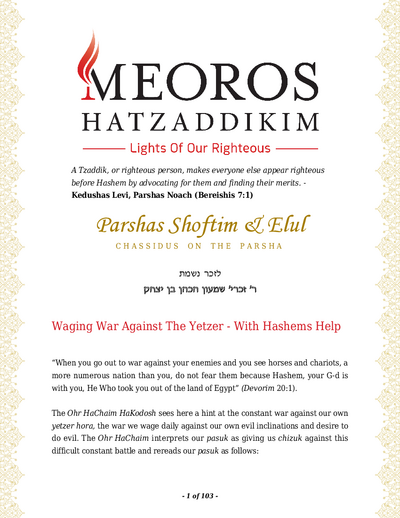
“When you go out to war against your enemies and you see horses and chariots, a more numerous nation than you, do not fear them because Hashem, your G-d is with you, He Who took you out of the land of Egypt” (Devorim 20:1).

The Ohr HaChaim HaKodosh sees here a hint at the constant war against our own yetzer hora, the war we wage daily against our own evil inclinations and desire to do evil. The Ohr HaChaim interprets our pasuk as giving us chizuk against this difficult constant battle and rereads our pasuk as follows:

When you go out to war – this refers to the well-known war to end all wars, for there is no greater battle than the war we wage against the evil one, the yetzer hora. The Ohr HaChaim gives two reasons why this war is so difficult: First, as opposed to and unlike our yetzer, we are not well versed in the arts of war, whereas the evil one is well trained in the arts of combat. Second, our whole physical makeup is ill suited for such a war. In fact, we are created in such a way that our defeat is quite likely, since most base passions and desires are tempting to us. When the yetzer tries to tempt us with glory and self-aggrandizement, pride and arrogance, we are easily persuaded. When it tempts us to steal, eat and perform all manners of sin, we do in fact want to listen to him. This prevents us from fulfilling the Torah and its mitzvos. Furthermore, once we do stumble, make mistakes and fail, the more we sin and transgress, the more this fans the flames and causes us to desire to sin more and more, giving more power to the side of evil. Our own failings and sins therefore cause us to give greater strength to the enemy and to add troops to the opposing side.

This is how the Ohr HaChaim reads our pasuk: First, our pasuk says that when we go to war against our enemy, the yetzer hora, we will see in our mind’s eye horses and chariots. The Ohr HaChaim explains that the horse represents the bestial, evil yetzer, war-horse ready for battle, unlike us. The chariot is a vehicle for these desires and passions for sin. The word for chariot, rechev, also means a compound of two things that when put together create a new object or mixture. The chariot is a compound of its rider and the vehicle upon which he rides. In this case, the forces of evil ride upon us; we are their vehicle when we sin, because we chase after our desires, and our physical makeup causes us to lust after evil, sinful things. We also see a numerous people – mimcha – which can be understood as “because of you”. When we give in to our desires, we create more and more powers of evil; they are the enemies on the battlefield who now stand and oppose us.

When confronted by such a formidable force of foes, such a great army of darkness, we might quake and tremble and wish to flee. So Hashem says to us in the pasuk, “Do not fear them because Hashem your G-d is with you.” It is true that alone you lack the strength to overcome these enemies and by yourself you cannot hope to naturally win this war. But Hashem is with you; He has the strength to save you and help you overcome the yetzer and win this war. When a person turns to Hashem to purify himself, Hashem lends a hand, to aid him in attaching himself to Hashem and subjugating his yetzer.

Our pasuk therefore concludes that Hashem is the One Who took us out of the land of Egypt, because the entire purpose of Golus Mitzrayim and the Exodus was to uplift the fallen sparks of holiness, to refine the sanctity from among the husks and shells of impurity. Hashem gives you this as a sign why you must wage war to achieve victory. Be strong and Hashem will be at your side, as is said in Tehillim 37 that the wicked look to the righteous, attempting to harm them but Hashem does not forsake the Tzaddik and leave him in the hands of the wicked. Chazal also teach us in Kiddushin 30b that Hashem knows that the yetzer grows stronger every day and that daily we must do battle with it, yet Hashem helps us, saving us from its clutches. This chizuk should strengthen us to help us win.

PDF Preview